


What Applied Behavior Analysis (ABA) Therapy Actually Is — and Why It Matters
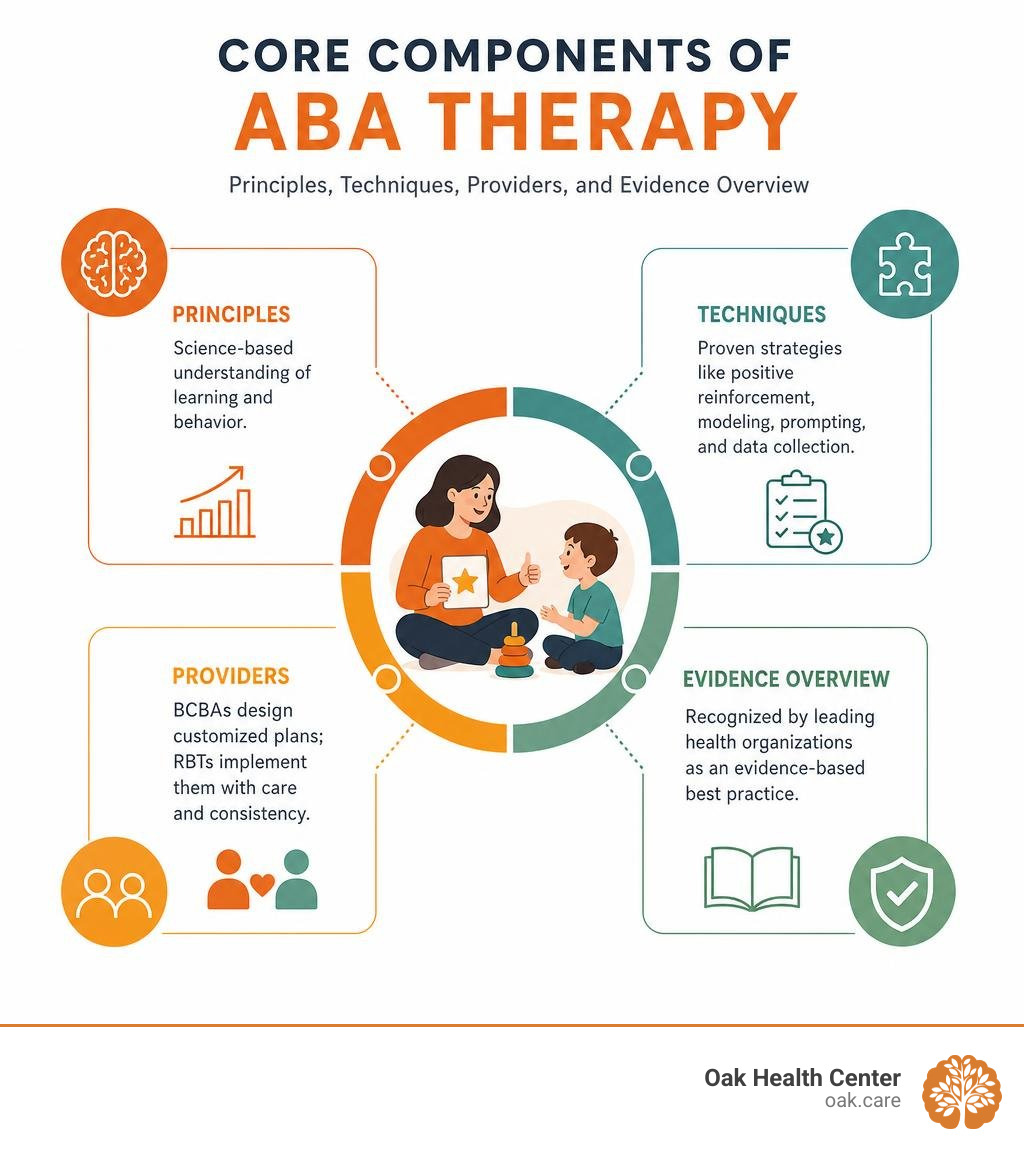
Applied behavior analysis ABA therapy is a science-based treatment that helps individuals build useful life skills and reduce behaviors that get in the way of learning and daily life.
Here’s the short version:
- What it is: A structured, data-driven therapy rooted in how people learn and respond to their environment
- Who it’s for: Primarily children with autism, but also used for ADHD, developmental delays, traumatic brain injury, and more
- How it works: Positive reinforcement encourages helpful behaviors; unhelpful behaviors are systematically reduced
- Who delivers it: Board Certified Behavior Analysts (BCBAs) design the program; Registered Behavior Technicians (RBTs) carry it out day to day
- Is it proven? Yes — the US Surgeon General and the American Psychological Association both recognize it as an evidence-based best practice
ABA is not a single technique. It’s a broad framework with dozens of methods — from structured one-on-one sessions to play-based learning in natural settings.
It’s also not just for children. ABA principles are used in geriatric care, substance abuse treatment, workplace performance, and more.
If you’re a parent trying to figure out whether ABA is right for your child, or just trying to understand what it actually involves, this guide breaks it all down in plain language — no jargon, no fluff.
I’m Andrew Brewer, Practice Manager at Oak Health Center, where I’ve worked closely with clinical teams to develop and expand behavioral health programs. While my background is in operations and organizational development rather than direct clinical practice, my work supporting the growth of Oak Health Center’s services — including our behavior therapy program — has given me a grounded, practical understanding of how applied behavior analysis ABA therapy fits into real-world mental health care. In the sections ahead, we’ll walk through everything you need to know, from core principles to choosing the right provider.
Understanding Applied Behavior Analysis ABA Therapy and Its Core Principles
At its heart, applied behavior analysis ABA therapy is the scientific study of learning and behavior. It is not a magic trick, nor is it a rigid set of repetitive drills. Instead, it is a flexible, highly personalized approach to understanding why people do what they do, and using that understanding to make meaningful, positive changes in their lives.
To understand how modern ABA therapy works, it helps to look at its scientific roots. The discipline is built on behavioral psychology principles that have been studied and refined for over a century.

Early behaviorism began with classical conditioning—think of Ivan Pavlov pairing the sound of a bell with food until his dogs salivated at the sound alone. Later, B.F. Skinner introduced the concept of operant conditioning, which explains how our voluntary actions are shaped by their consequences. If an action leads to a pleasant outcome, we are more likely to do it again. If it leads to an unpleasant or neutral outcome, we are less likely to repeat it.
Modern ABA is grounded in radical behaviorism, a philosophy established by Skinner. In radical behaviorism, thoughts and emotions are treated as “private events” or covert behaviors. They are not ignored; rather, they are believed to follow the exact same laws of learning as outward, observable actions.
However, because we cannot directly measure a private thought, ABA practitioners focus their interventions on observable, measurable behavior. This clinical focus is often explained using a classic behavioral rule of thumb known as the “Dead Man’s Test,” coined by behavior analyst Ogden Lindsley: If a dead man can do it, it isn’t behavior. For example, “lying perfectly still” or “not talking” are things a dead man can easily do, so they aren’t active target behaviors. “Asking for a snack” or “stacking blocks,” on the other hand, require active engagement—and those are the types of skills ABA aims to build.
You can read a detailed breakdown of the history and scientific development of these behavioral models on the Applied behavior analysis on Wikipedia page.
The ABC Model of Behavior
To change a behavior, we must first understand what triggers it and what keeps it going. In ABA, we analyze this using the three-term contingency, commonly known as the ABC model:
- Antecedent (A): The trigger, event, or environment that occurs immediately before the behavior.
- Behavior (B): The specific action or response of the individual (which must pass the Dead Man’s Test!).
- Consequence (C): What happens immediately after the behavior, which either strengthens or weakens the likelihood of that behavior happening again.
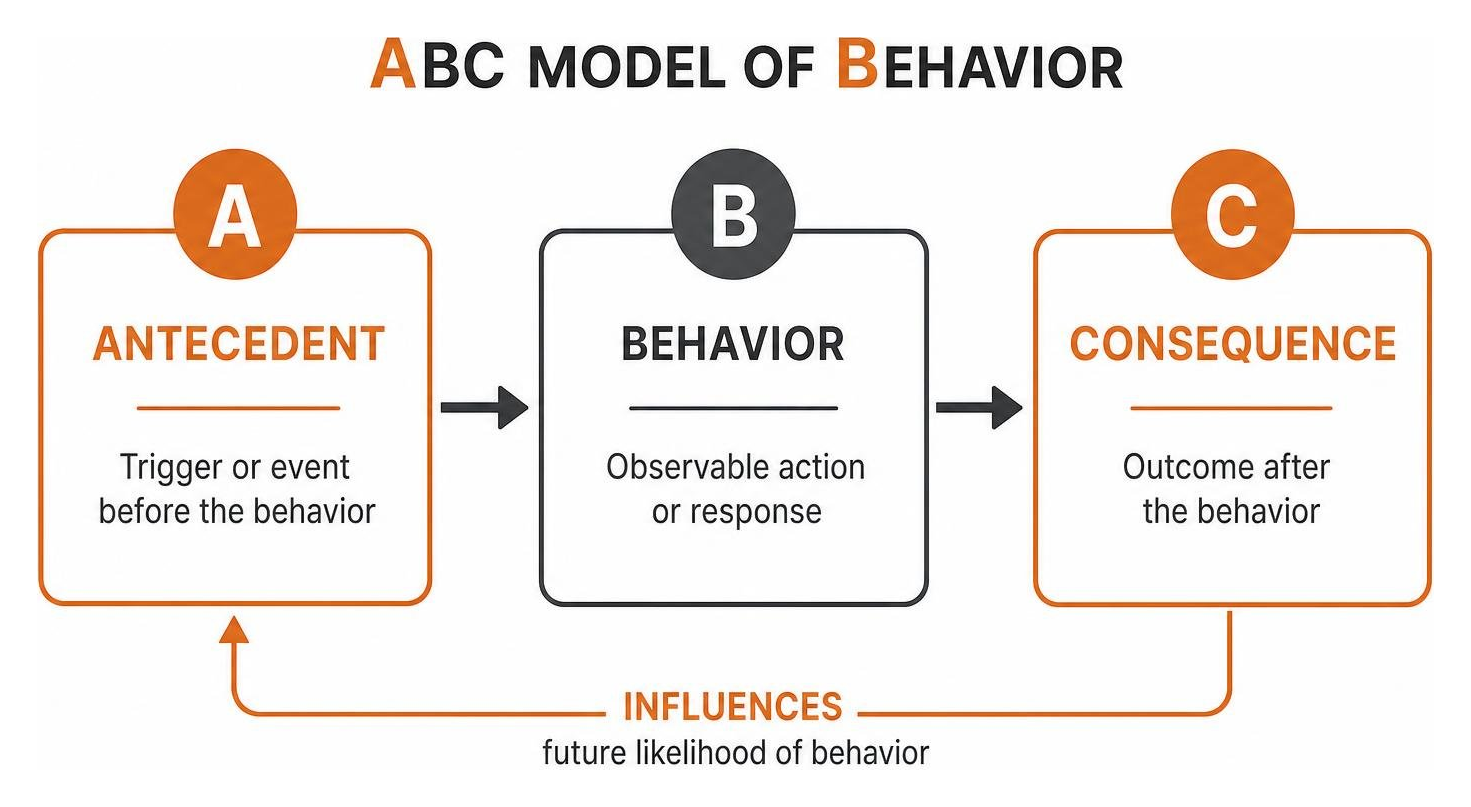
By systematically adjusting the Antecedents and the Consequences, we can naturally encourage helpful behaviors and discourage disruptive ones.
- Reinforcement is the most powerful tool in the ABA toolkit. Positive reinforcement involves following a desired behavior with a motivating reward (like praise, a high-five, or access to a favorite toy), making the child eager to repeat that behavior. Negative reinforcement involves removing an unpleasant stimulus when a positive behavior occurs (such as letting a child take a break from a difficult task once they ask politely).
- Punishment refers to any consequence that decreases the likelihood of a behavior. While historical applications of behavior modification in the mid-20th century sometimes relied on punitive measures, modern clinical standards have shifted entirely away from punishment, focusing instead on positive support.
- Extinction occurs when we stop reinforcing a behavior that was previously rewarded, which eventually causes the behavior to fade away. For example, if a child screams to get their parent’s attention, and the parent stops responding to the screaming while actively rewarding polite requests, the screaming behavior undergoes extinction.
Core Characteristics and the Seven Dimensions
In a seminal 1968 paper, researchers Baer, Wolf, and Risley defined the seven core dimensions that make an intervention true “applied behavior analysis.” For any therapy program to be considered high-quality ABA, it must meet these seven criteria:
- Applied: The program targets socially significant behaviors that directly improve the individual’s daily life, safety, and independence.
- Behavioral: The focus is on observable, physical actions that can be precisely measured.
- Analytic: The practitioner must demonstrate a clear, data-proven relationship between the intervention and the change in behavior.
- Technological: The treatment plans are written so clearly and thoroughly that any trained therapist can read them and implement them exactly the same way.
- Conceptually Systematic: All interventions are derived from established scientific principles of behavior theory.
- Effective: The program must produce practical, meaningful results that make a noticeable difference in the individual’s life.
- Generality: The learned skills must last over time and transfer successfully to different settings (like home, school, and the grocery store) and with different people.
These standards ensure that clinical programs maintain the highest levels of safety, efficacy, and professionalism. You can review the complete industry frameworks in the Applied Behavior Analysis Practice Guidelines for the Treatment of Autism Spectrum Disorder.
How ABA Works in Practice: Techniques, Programs, and Qualifications
If you walk into an ABA session today, you won’t see a therapist forcing a child to sit still at a desk for hours on end. Instead, you’ll see dynamic, engaging interactions designed to make learning feel like play.

Practitioners use several specialized teaching techniques to help individuals master complex life skills:
- Task Analysis: This involves breaking down a complex, multi-step skill into tiny, manageable steps. For example, brushing teeth isn’t just one action; it involves picking up the toothbrush, wet-rinsing the bristles, applying toothpaste, brushing the top teeth, brushing the bottom teeth, rinsing, and spitting.
- Chaining: Once a task is broken down, we teach it sequentially. In forward chaining, the child learns step one first, and the therapist completes the rest. Once step one is mastered, they move to step two. In backward chaining, the therapist completes all the initial steps, and the child performs the very last step, enjoying the immediate satisfaction of completing the task.
- Prompting and Fading: To help a child learn, therapists use prompts (like physical guidance, verbal cues, or visual gestures). Crucially, therapists systematically “fade” these prompts as quickly as possible to prevent prompt dependency, ensuring the child learns to perform the skill completely on their own.
- Errorless Learning: This is an instructional strategy that ensures the child always responds correctly during the initial learning stages. By immediately prompting the correct answer before the child has a chance to make a mistake, we reduce frustration and build confidence.
Common Methodologies: DTT, PRT, and ESDM
ABA is not a one-size-fits-all model. Depending on your child’s age, personality, and developmental goals, a clinical team will select and blend different methodologies:
- Discrete Trial Training (DTT): First developed in the 1960s, DTT is a highly structured, therapist-led teaching method. It breaks skills down into small “trials.” Each trial has a clear instruction, a response from the child, and an immediate consequence (reinforcement or correction). DTT is excellent for teaching foundational cognitive skills, like shapes, colors, or letter sounds.
- Pivotal Response Treatment (PRT): PRT is a naturalistic, play-based approach that is entirely child-led. Instead of focusing on individual behaviors, PRT targets “pivotal” areas of a child’s development—such as motivation, self-management, and social initiations. When we improve these pivotal areas, it triggers widespread positive growth across many other skills.
- Early Start Denver Model (ESDM): This is a specialized Naturalistic Developmental Behavioral Intervention (NDBI) designed specifically for toddlers and very young children (under age 5). It blends behavioral principles with developmental science, embedding therapeutic goals directly into everyday play routines and social interactions.
| Feature | Discrete Trial Training (DTT) | Pivotal Response Treatment (PRT) |
|---|---|---|
| Structure | Highly structured, therapist-led | Naturalistic, child-led |
| Setting | Contrived clinical/desk setting | Natural play environments |
| Reinforcement | Often external (e.g., tokens, praise) | Natural, directly related to behavior |
| Focus | Specific, isolated skills | Pivotal areas (motivation, self-management) |
To learn more about how these naturalistic and play-based behavioral approaches compare to other developmental therapies, explore the resources available at ABA and other therapies | Autism Speaks.
What a Typical Program Involves: Assessment to Data Collection
A high-quality ABA program is highly structured and entirely customized. It typically progresses through several key stages:
- Functional Behavior Assessment (FBA): Before treatment begins, a clinician conducts a thorough FBA. This involves directly observing the child, interviewing parents, and analyzing environmental variables to determine the exact “function” of any challenging behaviors (e.g., is the child acting out to escape a difficult task, gain attention, or obtain a physical item?).
- Setting Individualized Goals: Based on the assessment, the clinical team designs a personalized treatment plan with clear, small-unit goals targeting communication, self-care, social skills, and academic readiness.
- Establishing Baseline Data: Before starting any teaching protocol, the therapist measures the child’s current ability level to establish a “baseline.” This ensures we can prove exactly how much progress is being made over time.
- Ongoing Assessment and Data Collection: During every single therapy session, the therapist collects objective data on the child’s responses. This data is graphed and reviewed regularly by the supervising clinician to determine if the teaching plan needs to be adjusted.
At Oak Health Center, we believe that behavioral care must adapt to your family’s unique lifestyle. You can learn more about how our structured, compassionate team guides families through this journey by visiting our Behavior Therapy Program page.
Professional Roles: BCBAs, RBTs, and Clinical Standards
To ensure safety and clinical quality, ABA services are delivered using a collaborative, multi-tiered professional model:
- Board Certified Behavior Analyst (BCBA): A BCBA is a graduate-level independent practitioner who holds a master’s or doctoral degree in psychology or behavior analysis, has completed extensive supervised fieldwork, and has passed a national certification exam. BCBAs are responsible for conducting assessments, designing individualized treatment plans, analyzing data, and providing ongoing case supervision.
- Registered Behavior Technician (RBT): An RBT is a trained paraprofessional who works directly with the individual on a daily basis to implement the treatment plan. RBTs must be at least 18 years old, hold a high school diploma, complete a rigorous 40-hour training program, pass a competency assessment, and work under the close, ongoing supervision of a BCBA.
All certified behavior analysts must strictly adhere to the Behavior Analyst Certification Board (BACB) Ethics Code. This code protects consumers by enforcing strict professional boundaries, ensuring client confidentiality, and prohibiting conflicts of interest (such as dual relationships).
If you are looking for highly qualified, compassionate behavioral experts in Southern California, we invite you to meet our team, including clinical leaders like Ashley Smith MS BCBA, who specialize in delivering ethical, family-centered care.
Efficacy, Misconceptions, and Applications Beyond Autism
One of the reasons applied behavior analysis ABA therapy is so widely recommended by medical professionals is its unparalleled track record of scientific validation.
The clinical foundation of intensive behavioral intervention began with the landmark 1987 UCLA Young Autism Project, led by Dr. O. Ivar Lovaas. This study demonstrated that 47% of children who participated in intensive, early intervention ABA therapy achieved normal intellectual and educational functioning, compared to only 2% of children in the control group. Over the subsequent decades, hundreds of peer-reviewed studies have consistently replicated these findings, proving that early intervention can produce life-changing developmental gains.
Scientific Evidence Supporting Applied Behavior Analysis ABA Therapy
Today, the scientific consensus is clear. More than 20 comprehensive studies have established that intensive, long-term ABA therapy—typically providing 25 to 40 hours per week of direct instruction for 1 to 3 years—significantly improves cognitive, language, social, and adaptive outcomes for children with autism.
Furthermore, a massive scoping review of 770 study records found that between 63% and 88% of published research reported positive improvements across multiple critical areas, including:
- Cognitive functioning and academic readiness
- Receptive and expressive language abilities
- Social and communication skills
- Reduction of dangerous or self-injurious behaviors
- Daily living and adaptive behavior skills
A rigorous 2023 multi-level meta-analysis published in BMC Psychiatry evaluated 11 high-quality studies representing 632 participants. The researchers found that comprehensive ABA-based interventions yielded medium to large positive effects on both intellectual functioning and adaptive behavior. You can read the full, peer-reviewed scientific analysis on the Comprehensive ABA-based interventions in the treatment of children with autism spectrum disorder – a meta-analysis – PMC database.
Addressing Criticisms and the Evolution of Modern Practice
Despite its clinical success, traditional ABA has faced valid criticisms, particularly from the neurodiversity movement. Autistic self-advocates have pointed out that early behavioral interventions in the 1960s and 70s focused heavily on forcing “normalization” (such as suppressing safe, non-harmful self-stimulatory behaviors like hand-flapping) and sometimes relied on coercive compliance or physical aversives.
Modern, ethical ABA practitioners have listened to these concerns and evolved the practice significantly:
- From Normalization to Acceptance: Modern ABA does not try to “cure” autism or eliminate harmless neurodivergent traits. Safe “stimming” is respected as a natural coping mechanism. Intervention is strictly reserved for behaviors that cause physical harm, limit independence, or directly block learning.
- Elimination of Aversives: Modern clinical guidelines completely prohibit the use of physical punishment or negative reinforcement. Therapy is built entirely on positive reinforcement, play, and building joyful, cooperative relationships.
- Client-Centered, Collaborative Care: Today’s practitioners involve the individual and their family directly in goal-setting, ensuring that therapy respects the client’s dignity, autonomy, and personal preferences.
To read more about how the autistic community and modern clinical associations are working together to shape the future of behavioral care, visit Applied Behavior Analysis (ABA) | Autism Speaks.
Applications Beyond Autism Spectrum Disorder
While ABA is best known as an autism treatment, its core scientific principles—how humans learn and interact with their environments—make it highly effective for a wide range of conditions and populations:
- ADHD and Executive Dysfunction: ABA helps children with ADHD learn to break down schoolwork, improve focus, manage impulsivity, and build organizational routines.
- Traumatic Brain Injury (TBI): Behavioral therapy supports cognitive rehabilitation, helping individuals relearn essential daily living skills and manage emotional regulation during recovery.
- Geriatric Care and Dementia: ABA techniques are used to help older adults with cognitive decline maintain their daily independence, manage anxiety, and reduce behavioral challenges associated with memory loss.
- Organizational Behavior Management (OBM): ABA is highly valued in the corporate world, where businesses use behavioral science to improve employee performance, safety compliance, and workplace satisfaction.
- Substance Abuse Treatment: Clinicians use behavioral reinforcement schedules to support recovery programs, helping individuals build healthy coping mechanisms and prevent relapse.
How to Choose the Right Applied Behavior Analysis ABA Therapy Provider
Choosing an ABA provider is a deeply personal decision. To ensure you find a high-quality, neurodiversity-affirming clinical team that aligns with your family’s values, we recommend asking potential providers the following questions:
- How do you determine which behaviors to target for change? (Are they focused on safety and independence, or just compliance?)
- What is your policy on self-stimulatory behaviors (stimming)? (Red flag: any provider who attempts to stop safe, non-harmful stimming).
- How do you handle challenging behaviors during a session? (They should focus on functional communication training and positive reinforcement, never punishment).
- How much direct supervision does a BCBA provide to the RBTs working with my child? (Industry standards recommend at least 10% to 15% of direct therapy hours be supervised).
- How do you involve parents and caregivers in the treatment process? (Look for providers who offer active, regular parent training).
- Can we tour your facility or observe a session to see if the environment feels warm, welcoming, and fun?
Insurance Coverage, Treatment Duration, and Accessing Services
Navigating the logistics of behavioral care can feel overwhelming, but helpful resources are available to simplify the process.
In California, most private health insurance plans are legally mandated to cover behavioral health treatments, including ABA, when prescribed as medically necessary by a licensed physician or psychologist. Additionally, California’s Medi-Cal program covers medically necessary ABA services for eligible beneficiaries up to the age of 21.
The duration and intensity of therapy vary widely based on your child’s unique needs:
- Comprehensive Early Intervention: Typically requires 20 to 40 hours per week of structured therapy for 1 to 3 years to maximize developmental gains before school age.
- Focused Behavioral Intervention: Typically requires 10 to 20 hours per week, focusing on a few specific behavioral or social goals.
To learn more about accessing behavioral health services and verifying your insurance benefits, please visit our comprehensive Services page.
Frequently Asked Questions About ABA
Here are some of the most common questions families ask when exploring behavioral support options.
What is the difference between ABA and speech therapy?
While both therapies aim to improve a child’s quality of life, they approach communication from different clinical angles:
- Speech-Language Pathology (SLP) focuses on the mechanics of speech, language structure, articulation, and cognitive-communication disorders.
- ABA Therapy focuses on the function of communication—teaching a child why and how to use language to get their needs met in social settings.
Fortunately, these two disciplines do not conflict; they are highly complementary. For example, the Picture Exchange Communication System (PECS) is an ABA-grounded communication tool that is widely used by speech therapists to help non-verbal children learn to communicate using pictures.
You can read more about how speech-language pathologists and behavior specialists collaborate to support communication development in the Applied Behavior Analysis and Communication Services guideline.
Can a parent act as their child’s Registered Behavior Technician (RBT)?
No. Under the BACB Ethics Code, a parent cannot serve in the official, certified role of an RBT for their own child. This boundary is in place because acting as both a primary caregiver and a clinical therapist creates a clear conflict of interest and a “multiple relationship.”
To protect the clinical integrity of the therapy and maintain healthy family dynamics, direct therapy should always be delivered by an objective, third-party professional, while parents receive dedicated training to reinforce those same skills naturally at home.
How long does a typical ABA therapy program last?
Because ABA is highly individualized, there is no set timeline. Some children with focused behavioral goals (such as learning a specific self-care routine or reducing a single disruptive behavior) may only need therapy for 3 to 6 months.
However, children receiving comprehensive developmental support typically participate in programs lasting 1 to 3 years. The ultimate goal of any quality ABA program is to help the individual build the independence they need to transition out of therapy as soon as they are ready.
Conclusion
Understanding applied behavior analysis ABA therapy is the first step toward unlocking life-changing support for your child or loved one. When delivered ethically, compassionately, and with a focus on positive reinforcement, ABA empowers individuals to build meaningful skills, gain independence, and thrive in their daily lives.
At Oak Health Center, we are dedicated to providing comprehensive, compassionate mental healthcare tailored to your family’s unique journey. With five convenient Southern California locations—in Beverly Hills, Fullerton, Laguna Hills, Rancho Cucamonga, and South Pasadena—plus statewide virtual services, we make accessing high-quality support simple and stress-free.
If you are ready to explore how personalized behavioral support can help your family, we invite you to learn more about our Behavior Therapy Program and connect with our team today.