

Why So Many People Dread Going to Bed — And What You Can Do About It
Sleep anxiety how to overcome is one of the most searched mental health topics right now — and for good reason. Here is a quick summary of what actually works:
How to overcome sleep anxiety — quick answers:
- Get out of bed if you are awake for more than 20 minutes. Go to a quiet room and do something calm until you feel sleepy.
- Schedule your worries. Set aside 10-15 minutes earlier in the day to write down stressors so they do not ambush you at night.
- Try the 4-7-8 breathing technique. Inhale for 4 seconds, hold for 7, exhale for 8. This slows your nervous system down.
- Keep a consistent wake time every day — yes, including weekends.
- Pursue CBT-I (Cognitive Behavioral Therapy for Insomnia). It is the gold-standard, evidence-based treatment for anxiety-driven sleep problems.
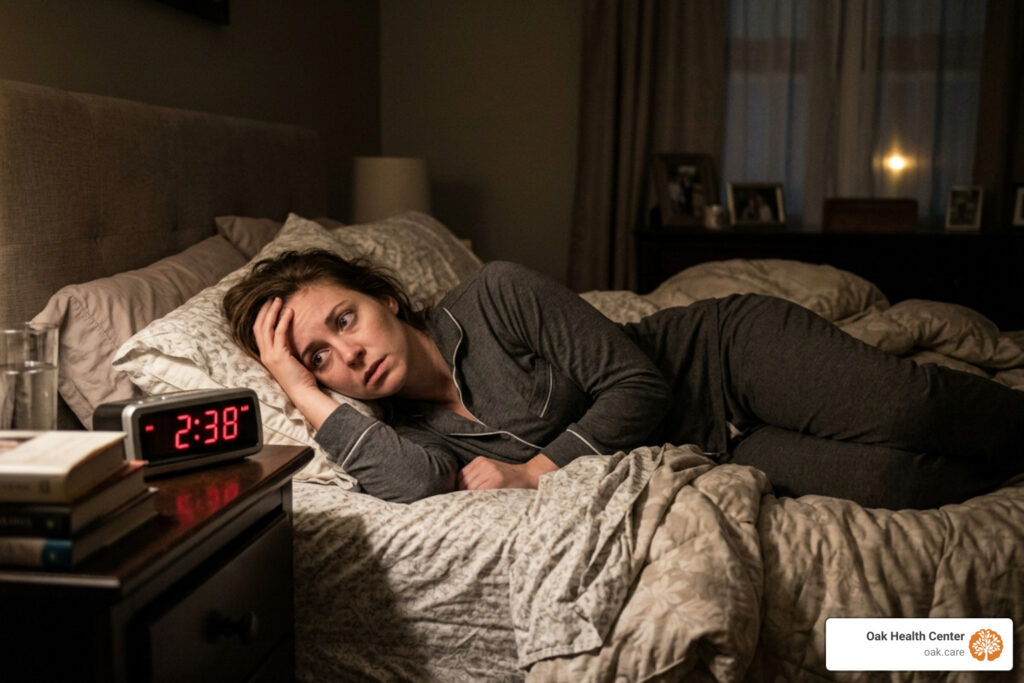
If you have ever lain awake at 3 a.m. with a racing heart and spinning thoughts, you already know the feeling. The world goes quiet — and suddenly your brain gets very loud.
You are not broken. You are not alone.
Anxiety is the most common mental health disorder in the United States, affecting roughly 40 million people. And for most of them, sleep is one of the first things to suffer. A national survey found that 44% of adults reported stress causing at least one sleepless night in the previous month. Research tracking nearly 5,000 students found that poor sleepers were 44 times more likely to experience severe anxiety than those who slept well.
That number is striking. And it points to something important: anxiety and poor sleep do not just coexist — they fuel each other in a cycle that can feel impossible to break without the right tools.
This guide will walk you through exactly how that cycle works, and more importantly, how to stop it.
I’m Andrew Brewer, Practice Manager at Oak Health Center, where I have helped develop and expand our Sleep Program alongside Dr. Alison Kole, Oak Health Center’s Sleep Program medical director. My operational work sits at the intersection of healthcare systems and patient outcomes, and supporting people who are searching for real answers on sleep anxiety how to overcome is central to what we do at Oak Health Center every day.
The Vicious Cycle: Why Anxiety and Insomnia Feed Each Other
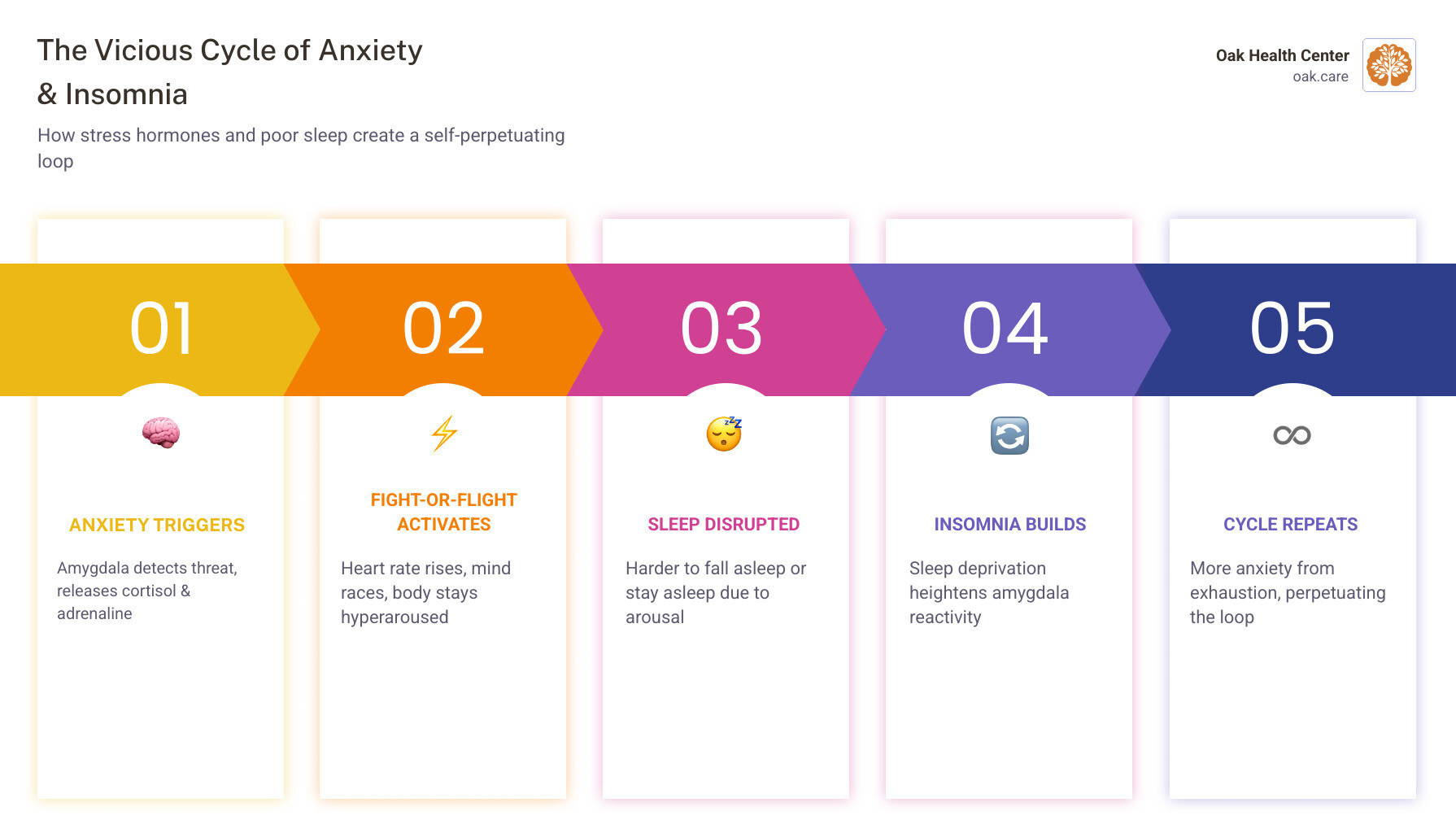
To understand sleep anxiety how to overcome, we first have to understand the biological “engine” that keeps us awake. When we are anxious, our body enters a state of hyperarousal. This isn’t just “in your head”—it is a full-body physiological event.
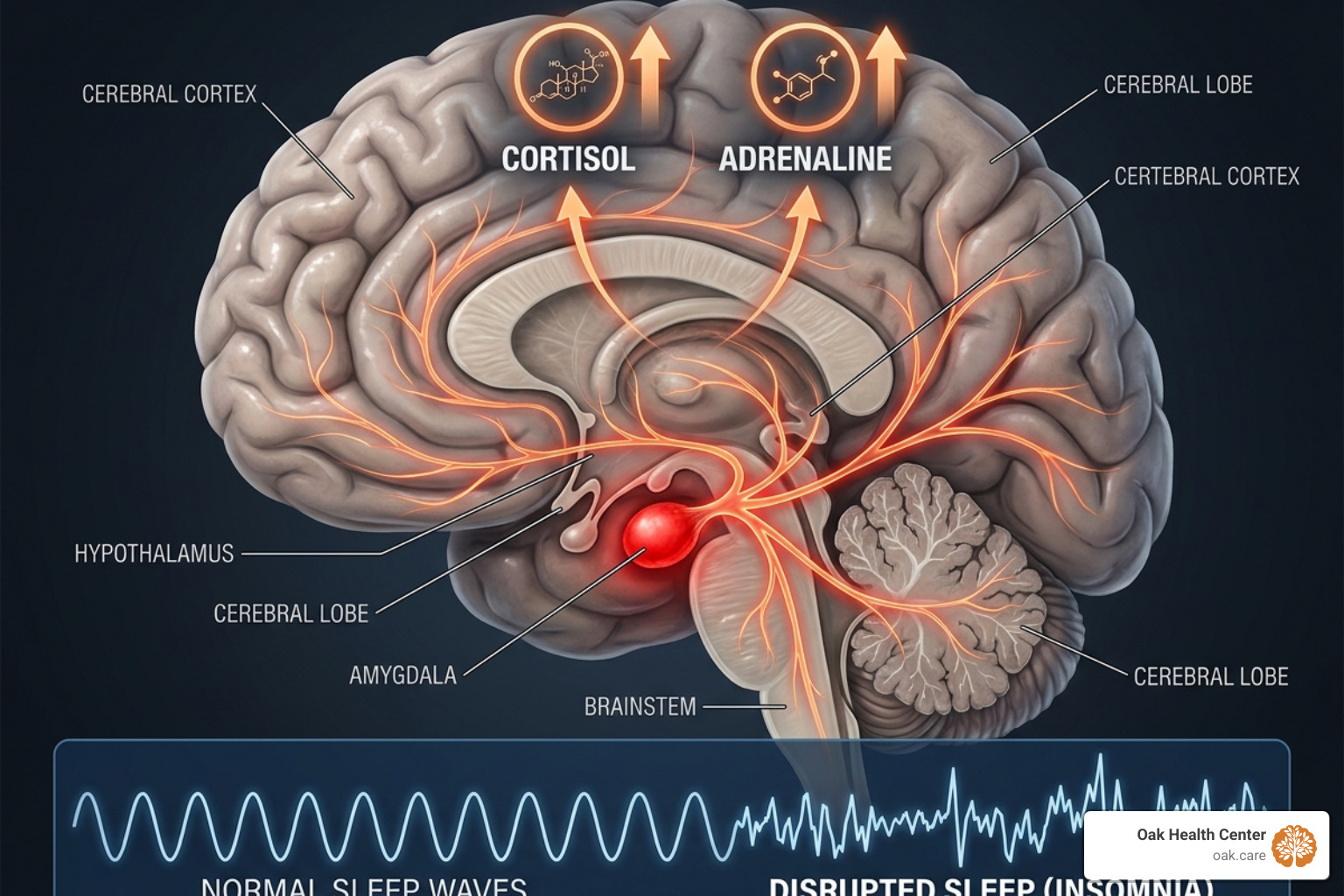
The brain’s alarm system, the amygdala, perceives a threat (even if that threat is just a tomorrow-morning deadline). In response, it triggers a cascade of stress hormones, primarily cortisol and adrenaline. This is the classic “fight-or-flight” response. While this was great for our ancestors dodging predators, it is disastrous for someone trying to drift off to sleep. Anxiety and Sleep: Understanding the Connection for Better Rest explains that these hormones keep your heart rate elevated and your mind alert, making it biologically difficult for the body to “downshift” into rest.
This creates a self-perpetuating loop. You feel anxious, so you can’t sleep. Because you can’t sleep, you start to worry about the consequences of being tired the next day. This “meta-anxiety” (worrying about the worry) creates more cortisol, which further delays sleep.
For many, this manifests as middle-of-the-night waking. You might fall asleep fine, but wake up at 3:00 a.m. with your mind immediately “snapping” to a specific concern. Without the distractions of daytime—emails, conversations, or background noise—these thoughts feel much heavier and more urgent. Understanding The Anxiety Sleep Connection highlights how this sleep loss then increases amygdala reactivity the following day, making you even more prone to anxiety. It is a closed loop that requires intentional intervention to break.
Sleep Anxiety: How to Overcome the Dread of Bedtime
The most effective way to break this cycle is through behavioral changes that retrain your brain to see the bed as a place of safety, not a battlefield. This starts with a concept called stimulus control.
The 20-Minute Rule
One of the biggest mistakes we make is staying in bed while frustrated. If you are awake for more than roughly 20 minutes, your brain begins to associate the physical environment of your bed with the feeling of being “wired and tired.”
To stop this, you must get out of bed. Go to a different room with dim lighting. Do something “calm and boring”—read a physical book (no screens!), fold laundry, or listen to soft music. Only return to bed when you feel the physical sensation of sleepiness (heavy eyelids, yawning). As noted in the 4 ways to end the cycle of sleep anxiety – NPR report, this helps break the “conditioned arousal” that makes you feel wide awake the moment your head hits the pillow.
Creating a Sleep Sanctuary
Your environment plays a massive role in your circadian rhythm—your body’s internal clock. To optimize your space:
- Light: Keep the room as dark as possible.
- Temperature: Aim for a cool environment, ideally between 60–67 degrees Fahrenheit.
- Morning Sunlight: Getting natural sunlight within 30 minutes of waking up helps “set” your clock for the following night.

Sleep Anxiety How to Overcome Through Cognitive Reframing
Much of sleep anxiety is rooted in our thoughts. We often treat sleep like a task that must be “achieved,” but sleep is actually a natural process that occurs when we let go of effort.
Paradoxical Intention This is a psychological technique where you actually give yourself permission to stay awake. By stopping the “struggle” to fall asleep, you remove the performance pressure. Often, the moment you stop trying to sleep is the moment your nervous system finally relaxes enough to allow it to happen.
The Worry Window If nighttime rumination is your primary hurdle, try “scheduling” your worry. Set aside 10-15 minutes at 5:00 p.m. to write down everything on your mind. Create a “to-do” list for the next day. When those thoughts resurface at midnight, you can tell yourself, “I’ve already processed this; it’s in the notebook.” This is a key part of Managing Anxiety Without Medication When Psychotherapy Is Enough.
A Note on Orthosomnia In May 2026, we see more people than ever suffering from “orthosomnia”—anxiety caused by trying to get “perfect” sleep data from wearable trackers. If your Oura ring or Apple Watch data is making you more stressed, it’s time to take it off. Trust how you feel more than what the app tells you.
Sleep Anxiety How to Overcome Using Physical Relaxation
When the mind is racing, we can use the body to “pull” the mind back into a state of calm.
4-7-8 Breathing This is a rhythmic breathing pattern that acts as a natural tranquilizer for the nervous system:
- Inhale through your nose for 4 seconds.
- Hold your breath for 7 seconds.
- Exhale forcefully through your mouth for 8 seconds. Repeat this four times. The long exhale is what signals your vagus nerve to switch from the sympathetic (fight-or-flight) to the parasympathetic (rest-and-digest) system.
Progressive Muscle Relaxation (PMR) Starting at your toes, tense each muscle group as hard as you can for five seconds, then release suddenly. Move up to your calves, thighs, stomach, and all the way to your jaw. This helps you identify where you are holding hidden tension and manually “reset” those muscles.
The Cognitive Shuffle If your mind won’t stop looping, try the “Cognitive Shuffle.” Think of a neutral word (like “BEDTIME”). For the first letter, B, visualize as many random, unrelated objects as you can starting with B (Bear, Bicycle, Blueberries). Once you run out, move to E (Eagle, Egg, Elephant). This occupies the brain’s “analytical” centers with low-stakes imagery, preventing it from drifting back to stressful thoughts.
Evidence-Based Techniques and Lifestyle Changes
While self-help tools are vital, chronic sleep anxiety often requires a more structured approach.
CBT-I: The Gold Standard
Cognitive Behavioral Therapy for Insomnia (CBT-I) is widely considered the first-line treatment for chronic sleep issues—more effective in the long term than any pill. It isn’t just “talk therapy”; it is a rigorous program that targets the thoughts and behaviors maintaining your insomnia.
At Oak Health Center, we emphasize the importance of specialized care. For instance, Dr Alison Kole Earns Australian Psychological Society Cbt I Badge What It Means For Better Sleep Care highlights the level of expertise required to guide patients through techniques like sleep restriction (limiting time in bed to increase “sleep drive”).
| Feature | CBT-I | Sleep Medication |
|---|---|---|
| Primary Goal | Fixes underlying behaviors/thoughts | Sedates the central nervous system |
| Long-term Success | High (skills stay with you) | Low (symptoms often return after stopping) |
| Side Effects | Temporary daytime sleepiness | Grogginess, dependency, dizziness |
| Duration | Typically 4–8 sessions | Often used indefinitely |
Lifestyle Adjustments
What you do during the day dictates what happens at night.
- Caffeine Cutoff: Caffeine has a half-life of about 5–7 hours. If you have a cup of coffee at 4:00 p.m., half of it is still in your system at 10:00 p.m. Aim for a noon or 1:00 p.m. cutoff.
- Alcohol Avoidance: While alcohol might help you fall asleep faster, it destroys sleep quality. It prevents you from entering deep REM sleep and often causes a “rebound” waking in the middle of the night as it wears off.
- Magnesium Glycinate: Many people find success with magnesium glycinate, which supports muscle relaxation and neurotransmitter regulation. Always consult your provider at Oak Health Center before starting new supplements.
- Blue Light Hygiene: Power down electronics at least 30–60 minutes before bed. The blue light from screens suppresses melatonin, the hormone that tells your body it is time to sleep.
For a deeper dive into these triggers, the Sleep Anxiety: What It Is, Causes, Symptoms & Treatment guide is an excellent resource.
When to Seek Professional Help
Occasional “Sunday scaries” are normal. However, if your sleep anxiety has become a nightly dread, it may be time for professional intervention.
Somniphobia and Nocturnal Panic Some individuals develop somniphobia—an intense, phobic fear of falling asleep. This often stems from a fear of losing control, fear of nightmares, or fear of dying in one’s sleep. Others may experience nocturnal panic attacks, where they wake up suddenly in a state of terror with a racing heart and shortness of breath.
Medical Red Flags It is also important to rule out physical causes. Conditions like hyperthyroidism can mimic anxiety by keeping your metabolic rate and heart rate too high. Sleep apnea can also cause “micro-wakings” that feel like anxiety because your brain is panicking due to a lack of oxygen.
Our Services/Sleep Program at Oak Health Center is designed to help distinguish between these psychological and physiological factors to create a personalized plan for you.
Frequently Asked Questions about Sleep Anxiety
What is the “20-minute rule” for sleep anxiety?
The 20-minute rule is a stimulus control technique. If you aren’t asleep after about 20 minutes, you should leave your bed. This prevents your brain from forming a “learned association” between your bed and the frustration of wakefulness. By only being in bed when you are actually sleeping (or having sex), you strengthen the mental link between the bedroom and rest.
Can anxiety cause nightmares or vivid dreams?
Yes. Anxiety keeps your brain in a state of high arousal, which can disrupt the architecture of your sleep. Anxious individuals often spend more time in “light” sleep and have more frequent REM (Rapid Eye Movement) cycles, which is when dreaming occurs. High stress levels can color these dreams, leading to vivid, stressful, or repetitive nightmares.
Is CBT-I effective for anxiety-related insomnia?
Absolutely. In fact, CBT-I is the recommended first-line treatment for chronic insomnia, even when it is driven by an anxiety disorder. Studies show that by treating the sleep component specifically, overall anxiety levels often decrease as well, because the person feels more capable of handling daily stressors when they are well-rested.
Conclusion
Overcoming sleep anxiety is not about “trying harder” to sleep—it is about creating the right conditions for sleep to happen naturally. By combining behavioral techniques like the 20-minute rule with relaxation exercises and professional support like CBT-I, you can reclaim your nights.
At Oak Health Center, we provide comprehensive, compassionate mental healthcare across Southern California, including Beverly Hills, Fullerton, Laguna Hills, Rancho Cucamonga, and South Pasadena. We offer simplified access to support through both in-person and virtual services, ensuring you don’t have to navigate this journey alone.
Sleep should be a sanctuary, not a source of stress. If you are ready to break the cycle, we are here to help. Take the first step toward restorative rest and reach out to our team today.