


What Your GAD-7 Anxiety Score Actually Tells You
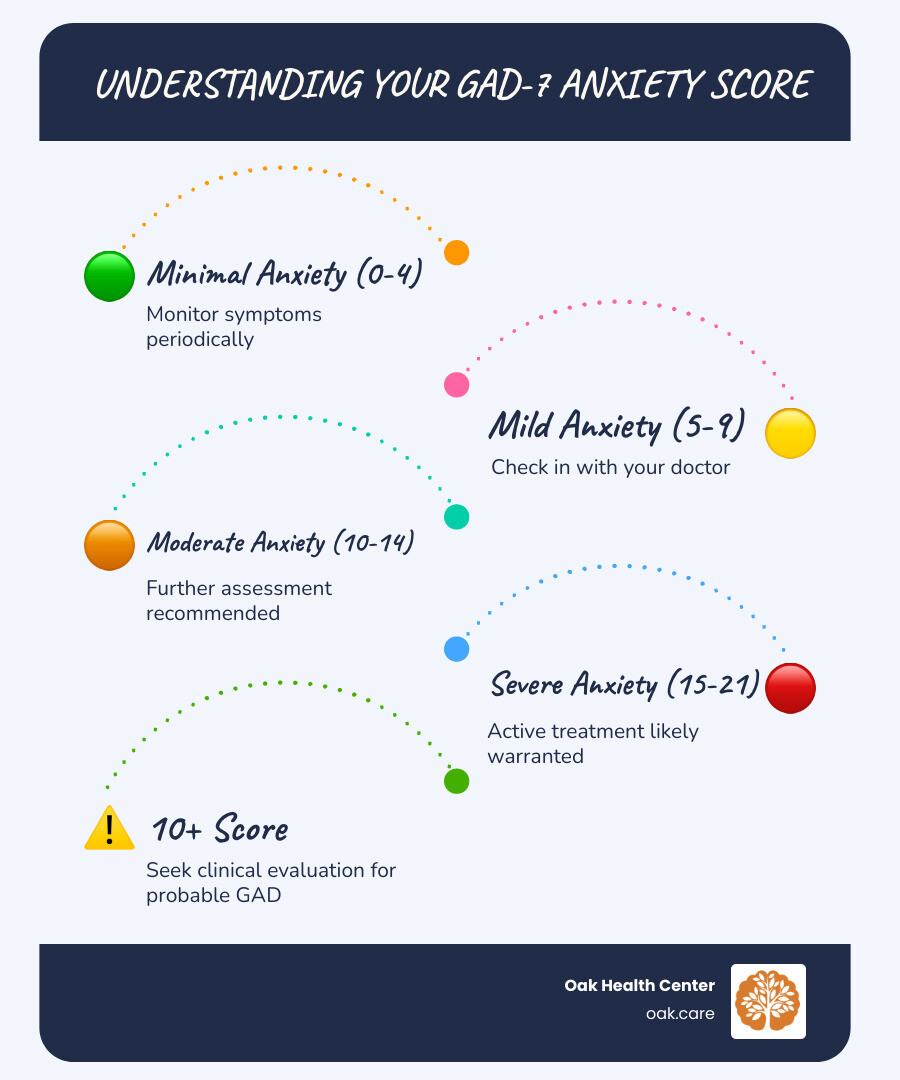
The GAD-7 anxiety scale is a 7-question screening tool that measures how often you’ve experienced anxiety symptoms over the past two weeks. Here’s a quick breakdown of what your score means:
| GAD-7 Score | Severity Level | What It Suggests |
|---|---|---|
| 0 – 4 | Minimal anxiety | Monitor symptoms |
| 5 – 9 | Mild anxiety | Check in with your doctor |
| 10 – 14 | Moderate anxiety | Further assessment recommended |
| 15 – 21 | Severe anxiety | Active treatment likely warranted |
Scores of 10 or higher suggest probable generalized anxiety disorder and are a signal to seek a clinical evaluation — not a diagnosis on their own.
Anxiety is one of the most common mental health challenges people face, yet it often goes unrecognized and untreated. The GAD-7 gives both patients and providers a fast, reliable starting point for understanding symptom severity — but knowing how to read your score matters just as much as taking the test.
I’m Andrew Brewer, Practice Manager at Oak Health Center, where I’ve helped grow our clinical programs and supported the integration of evidence-based screening tools — including GAD-7 anxiety assessments — into our patient care workflows. In the sections below, I’ll walk you through exactly how the GAD-7 works, what your score means, and what to do next.
What the GAD-7 Anxiety Scale Measures and Why It Matters
The GAD-7 is a brief self-report questionnaire designed to measure core anxiety symptoms. It was originally created to screen for generalized anxiety disorder in primary care, but over time it has also become a useful way to estimate symptom severity and track change over time.
In plain English: it helps us answer two practical questions:
- How intense are this person’s anxiety symptoms right now?
- Do these symptoms deserve a closer clinical look?
That makes it useful in busy real-world care settings, including primary care, therapy, psychiatry, and virtual mental health visits. It is short enough to complete in a couple of minutes, which is nice because anxiety is already exhausting enough without homework.
How the GAD-7 anxiety tool was developed and validated
The GAD-7 was developed by Drs. Robert L. Spitzer, Janet B. W. Williams, Kurt Kroenke, and colleagues. They started with a 13-item set based on DSM-IV generalized anxiety disorder symptoms, then selected the 7 items that performed best statistically and clinically.
In the original validation study of 2,739 primary care patients, the final 7-item scale showed strong psychometric performance:
- Internal consistency was excellent, with Cronbach’s alpha of 0.92
- Test-retest reliability was good, with an intraclass correlation of 0.83
- The 7-item version performed very well in identifying probable GAD, with an area under the ROC curve of 0.906
Those are fancy research terms for something simple: the measure was consistent, dependable, and good at separating likely cases from non-cases.
If you want to review the original paper, here is the scientific research on GAD-7 development and validation.
Where the GAD-7 fits in real-world care
The GAD-7 is best used as a screening and monitoring tool, not as a stand-alone diagnosis. A high score tells us that anxiety symptoms are likely clinically important. It does not, by itself, tell us why those symptoms are happening.
That distinction matters. Anxiety-like symptoms can overlap with:
- Panic disorder
- Social anxiety disorder
- PTSD
- Depression
- Sleep problems
- Substance effects
- Medical issues such as thyroid disease or heart rhythm concerns
That is why scores of 10 or higher generally call for further assessment, often including:
- A diagnostic interview
- A mental status exam
- Review of substance use and medications
- Medical evaluation when appropriate, such as thyroid testing or other workup
We also look at functioning, not just symptoms. If anxiety is affecting work, sleep, relationships, parenting, school, or daily responsibilities, that raises the clinical importance of the score. If you’re exploring treatment options, our psychotherapy services page explains how structured therapy can help.
How to Take the GAD-7 Anxiety Questionnaire

The GAD-7 asks about symptoms over the last 2 weeks. For each item, you choose one of four frequency options:
- Not at all = 0
- Several days = 1
- More than half the days = 2
- Nearly every day = 3
Because it is self-reported, the best approach is honesty over perfection. You do not need to overthink every answer. In fact, overthinking the anxiety test would be, well, on brand for anxiety.
A few practical tips:
- Take it in a quiet setting
- Answer based on the last 2 weeks, not your worst month ever
- Use the same version each time if you are tracking progress
- Share your result with a clinician if the score is elevated or symptoms are interfering with life
The 7 questions on the GAD-7
The official GAD-7 asks how often you have been bothered by these problems over the past 2 weeks:
- Feeling nervous, anxious, or on edge
- Not being able to stop or control worrying
- Worrying too much about different things
- Trouble relaxing
- Being so restless that it is hard to sit still
- Becoming easily annoyed or irritable
- Feeling afraid as if something awful might happen
These items cover both cognitive symptoms, like worry and fear, and physical or behavioral symptoms, like restlessness and trouble relaxing.
You can see the official form here: scientific research on the official GAD-7 form.
The difficulty question clinicians also consider
There is also a separate functional question that often gets less attention than it deserves. It asks how difficult these problems have made it to:
- Do your work
- Take care of things at home
- Get along with other people
This difficulty item is not included in the 0 to 21 total score, but clinically it matters a lot. Two people can have the same symptom score and very different levels of real-world impairment. If anxiety is actively disrupting life, we take that seriously even if the number is not sky-high.
How to Score gad 7 anxiety and Interpret the Result
Scoring is simple:
- Assign each answer a number from 0 to 3
- Add all 7 item scores
- Get a total from 0 to 21
That total gives a quick estimate of symptom severity.
gad 7 anxiety score ranges explained
The standard severity bands are:
- 0 to 4: Minimal anxiety
- 5 to 9: Mild anxiety
- 10 to 14: Moderate anxiety
- 15 to 21: Severe anxiety
Here is how we usually interpret them in practice:
| Score | Severity | Typical next step |
|---|---|---|
| 0-4 | Minimal | Monitor symptoms if needed |
| 5-9 | Mild | Watch for persistence or worsening |
| 10-14 | Moderate | Further assessment is recommended |
| 15-21 | Severe | Active treatment is often warranted |
A few important notes:
- A mild score does not mean your experience is trivial
- A severe score does not automatically confirm a specific diagnosis
- Trends over time often matter as much as one isolated score
What score suggests probable generalized anxiety disorder
The most widely cited cut point for probable GAD is 10 or greater.
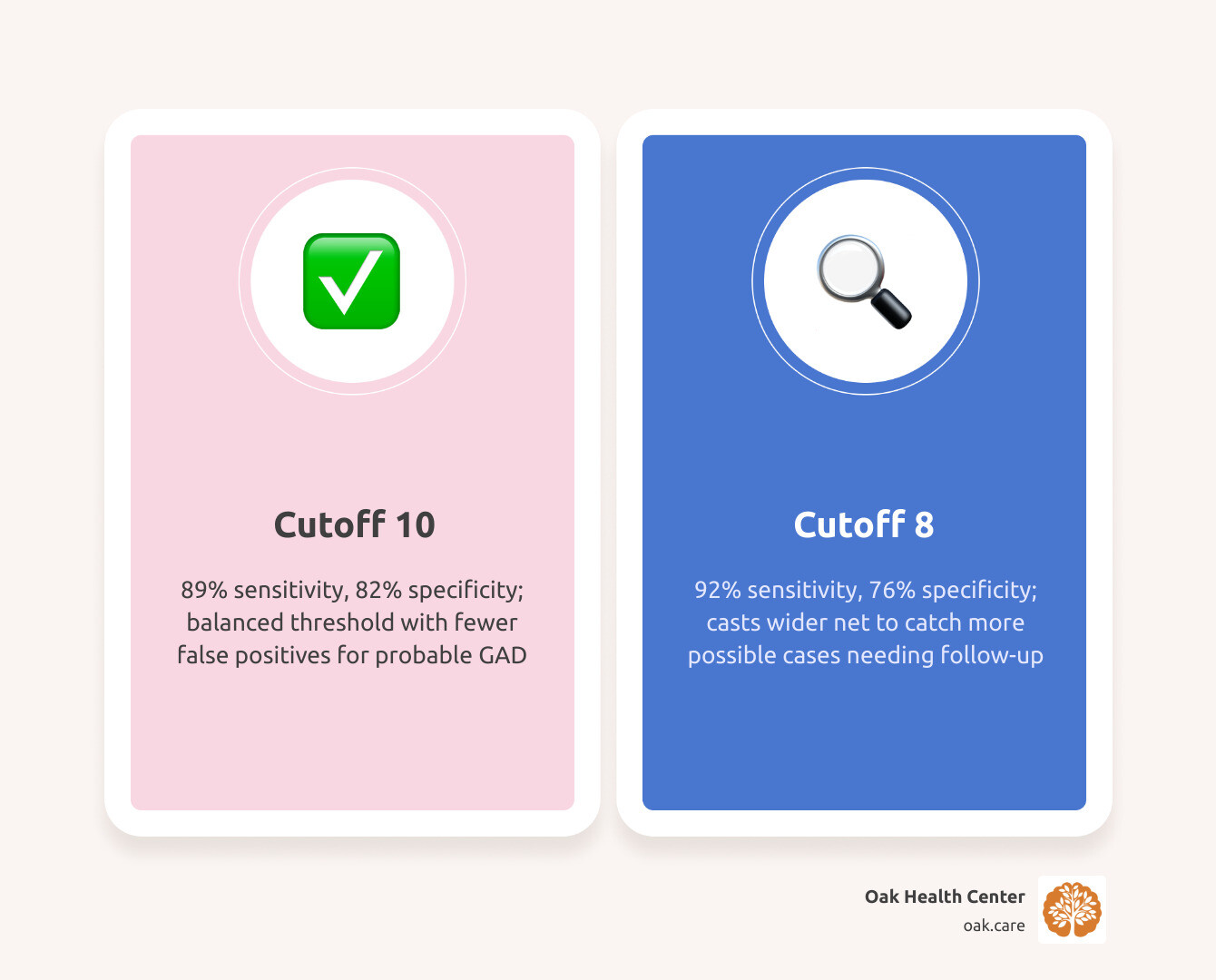
In the original primary care validation study, a cutoff of 10 had:
- Sensitivity of 89%
- Specificity of 82%
- Positive likelihood ratio of 5.1
- Negative predictive value of 99%
That means it was quite good at picking up likely GAD cases while still ruling out many people who did not have it.
Some research also supports a lower cutoff of 8, especially when the goal is broad screening and you want to catch more possible cases. At 8, the GAD-7 had:
- Sensitivity of 92%
- Specificity of 76%
So which cutoff is better?
- Use 10 when you want a balanced threshold with fewer false positives
- Use 8 when you want to cast a wider net and are comfortable with more follow-up assessments
The original study also found something clinically useful: among patients with scores of 10 or higher, 96% had symptoms lasting at least 1 month, and 67% had symptoms lasting 6 months or more. So even though the questionnaire asks about the last 2 weeks, elevated scores often reflect more persistent anxiety.
What the Research Says About Accuracy, Reliability, and Other Anxiety Disorders
The GAD-7 is popular for a reason: it is brief, reliable, and well studied.
Research supports several core strengths:
- Strong internal consistency
- Good test-retest reliability
- Good criterion validity against structured interviews
- Good construct validity compared with other anxiety measures
- A mostly one-factor structure, meaning it works well as a general anxiety severity measure
It has also been validated outside primary care. In a general population study of 5,030 adults, the GAD-7 showed strong reliability with alpha = 0.89 and maintained stable measurement properties across gender and age groups.
Operating characteristics at different cut points
Cut scores involve tradeoffs. Here is the big picture:
- Cutoff 8: more sensitive, catches more cases, but creates more false positives
- Cutoff 10: better balance of sensitivity and specificity
- Cutoff 15: more specific, fewer false positives, but misses more true cases
Key numbers from the research include:
| Cut point | Sensitivity | Specificity | What it means |
|---|---|---|---|
| 8 | 92% | 76% | Better for broad screening |
| 10 | 89% | 82% | Best-known threshold for probable GAD |
| 15 | 48% | 95% | More specific, less sensitive |
A higher cutoff can align better with lower prevalence estimates, but it risks missing people who are clearly struggling. A lower cutoff catches more potential cases, but more people will screen positive without meeting full diagnostic criteria.
That is why screening tools always need a next step: discussion, clinical judgment, and context.
How the GAD-7 performs beyond generalized anxiety disorder
Although it was built for generalized anxiety disorder, the GAD-7 also works reasonably well as a broader anxiety screener.
At a cutoff of 10 or higher, research found the following performance:
- Panic disorder: sensitivity 74%, specificity 81%
- Social anxiety disorder: sensitivity 72%, specificity 80%
- PTSD: sensitivity 66%, specificity 81%
- Any anxiety disorder: sensitivity 68%, specificity 88%
So the GAD-7 is not a one-trick pony. It is not perfect for every anxiety disorder, but it can flag clinically meaningful anxiety across diagnoses. That is one reason many clinicians use it as a transdiagnostic symptom measure.
For more on broader psychometric evidence, see this scientific research on psychometric properties in psychiatric samples.
What general population data add to interpretation
Normative data help us understand how unusual a given score is in the general public.
In a large general population sample:
- About 5% of people scored 10 or higher
- About 1% scored 15 or higher
- Women had higher mean scores than men: 3.2 vs 2.7
- The scale showed strong reliability across demographic groups
These findings support something we see clinically all the time: high scores are not common in the general population, which helps explain why a score in the moderate or severe range deserves attention.
How Clinicians Use GAD-7 Results in Practice
A GAD-7 score is most helpful when we connect it to the person’s life, not when we treat it like a random number on a lab slip.
How GAD-7 scores relate to daily functioning
In the original validation research, higher GAD-7 scores were linked to stepwise worsening across all six domains of the SF-20 functional status measure. In other words, as anxiety scores rose, functioning declined.
Higher scores were also associated with:
- More disability days
- Greater difficulty with work and home tasks
- Worse social functioning
- Higher healthcare utilization
One memorable figure from the study: patients scoring 15 or above reported an average of 16.8 disability days over the prior 3 months, compared with 3.9 days among those scoring 0 to 4.
So yes, the score reflects symptoms, but it also tends to reflect impact.
Anxiety and depression: related but not the same
Anxiety and depression often travel together, but they are not the same thing.
Research found moderate-to-strong correlations between GAD-7 scores and depression measures, which makes sense because these conditions commonly overlap. In one general population study, the GAD-7 correlated 0.64 with the PHQ-2 depression screen. In the original validation work, factor analysis showed anxiety and depression symptoms loaded onto separate factors, supporting them as distinct dimensions rather than duplicates.
That is one reason clinicians often use the GAD-7 alongside a depression measure like the PHQ-9. We want to know whether someone is dealing with:
- Anxiety alone
- Depression alone
- Both together
If you want a practical explanation of why both tools are often used, read why doctors use both GAD-7 and PHQ-9.
Limits of the GAD-7 and when to go beyond the score
The GAD-7 is useful, but it has limits.
It does not:
- Establish a formal diagnosis by itself
- Explain the cause of anxiety symptoms
- Capture the full personal history
- Replace suicide risk assessment
- Rule out medical or substance-related causes
- Fully account for cultural differences in how distress is expressed
It also focuses mainly on generalized anxiety symptoms, so it may not fully capture the experience of someone whose main issue is panic, trauma, obsessive thoughts, or performance-based fear.
We also have to think about medical mimics. Symptoms such as restlessness, racing heart, sweating, and feeling on edge can overlap with:
- Thyroid disease
- Cardiac issues
- Medication side effects
- Caffeine or stimulant use
- Substance withdrawal
- Sleep deprivation
That is why scores should always be interpreted in context. If anxiety feels like it has been escalating, our article on why anxiety keeps getting worse and what actually helps may help you make sense of the pattern.
Frequently Asked Questions About gad 7 anxiety
Is the GAD-7 a diagnosis or just a screening tool?
It is a screening tool. It estimates anxiety symptom severity and helps identify people who may need a fuller evaluation. A diagnosis still requires clinician judgment, discussion of symptom history, assessment of impairment, and consideration of other mental and medical conditions.
Should I worry if my score is 10 or higher?
Do not panic about the anxiety score telling you that you have anxiety. But do take it seriously.
A score of 10 or higher falls in the moderate range or above and is commonly used as a threshold for probable generalized anxiety disorder. It means further assessment is recommended. That may include a clinical interview, discussion of your symptoms, and treatment planning if needed.
Can the GAD-7 be used to track improvement over time?
Yes. In fact, that is one of its most practical uses. Because it is short and standardized, clinicians often repeat it over time to monitor whether symptoms are improving, staying the same, or worsening.
To make tracking meaningful:
- Use the same version each time
- Complete it at consistent intervals
- Compare scores alongside real-world functioning, not just numbers
Conclusion
The GAD-7 anxiety scale is one of the most practical tools we have for quickly assessing anxiety severity. It is brief, well validated, easy to score, and useful for both screening and follow-up. Most importantly, it gives us a structured starting point for a better conversation about what you are experiencing.
If your score is mild, monitoring may be enough. If it is 10 or higher, further assessment is usually the right move. If it is severe or your daily life is clearly being affected, treatment should be on the table.
At Oak Health Center, we provide compassionate mental healthcare across Southern California, with in-person care in Beverly Hills, Fullerton, Laguna Hills, Rancho Cucamonga, and South Pasadena, plus statewide virtual services in California. If anxiety is interfering with your life, we are here to help you move from self-screening to real support.
Learn more about our psychotherapy services and next steps for care.