


When Therapy Isn’t Enough: What a Partial Hospitalization Program Can Do for You
A partial hospitalization program is an intensive, structured mental health treatment option that sits between traditional outpatient therapy and full inpatient hospitalization. If you’re wondering whether it might be right for you, here’s a quick breakdown:
What is a partial hospitalization program (PHP)?
- A short-term, day-based treatment program for adults with acute mental health symptoms
- Typically runs Monday through Friday, roughly 5–6 hours per day
- Average length is 2–3 weeks, depending on individual needs
- Patients attend treatment during the day and return home each evening
- Treats conditions like depression, anxiety, bipolar disorder, and PTSD
- More intensive than weekly therapy, but does not require an overnight stay
Sometimes weekly therapy sessions just aren’t enough. You’re not in crisis — but you’re not okay either. Symptoms are getting worse. Daily life feels harder to manage. And the gap between “I need more help” and “I need to be hospitalized” can feel confusing and isolating.
That’s exactly the gap a partial hospitalization program is designed to fill.
PHPs offer structured, evidence-based care several hours a day — giving you real support without putting your life completely on hold. Research shows that patients in PHP experience significant symptom reduction, improved functioning, and higher satisfaction compared to traditional inpatient care. For busy professionals managing work, family, and mounting stress, that balance matters.
I’m Andrew Brewer, Practice Manager at Oak Health Center, where I’ve helped grow and develop behavioral health programs — including intensive outpatient and partial hospitalization program services — as part of our expanding continuum of mental health care. In this guide, I’ll walk you through everything you need to know to decide if PHP is the right next step for you.
What is a Partial Hospitalization Program?
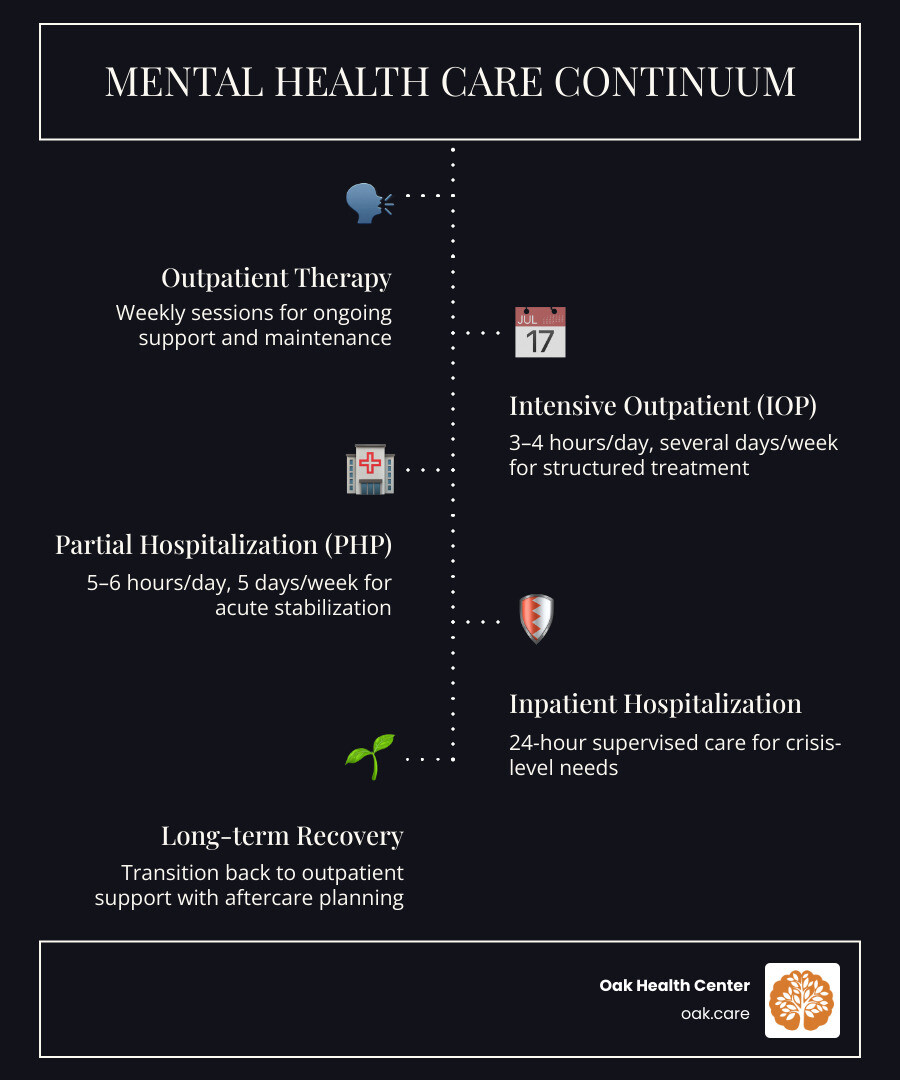
To understand a partial hospitalization program, it helps to look at it as the “Goldilocks” of mental health care. Traditional outpatient therapy (seeing a therapist once a week) might not be enough support during a major depressive episode. On the flip side, full inpatient hospitalization can feel overly restrictive if you aren’t an immediate danger to yourself. PHP is “just right” for those who need intensive, daily stabilization but are safe enough to sleep in their own beds at night.
The primary goal of a PHP is crisis stabilization and the prevention of full hospitalization. It is an active, intensive treatment designed for the diagnosis and treatment of serious mental disorders. Unlike “day treatment” programs of the past which might have been more social in nature, modern PHPs are clinically rigorous. If you want a neutral overview of this level of care, the Partial Hospitalization article offers helpful background on how PHP fits into the broader mental health system.
The History of PHP: From Moscow to Southern California
The concept of the partial hospitalization program isn’t new, though it has evolved significantly. It was first described by a Russian psychiatrist named Dzhagaow in 1937. In the United States, the Menninger Clinic began utilizing these programs in the 1950s.
A major pioneer in the field was Dr. Albert E. Moll. He believed that patients shouldn’t be unnecessarily separated from their families or their work. He argued that keeping people connected to their community actually improved long-term recovery and reduced the costs of care. By the 1970s and 80s, the community mental health movement embraced PHPs as a cost-effective, recovery-oriented alternative to the “asylums” of the past.
Today, we use PHPs to bridge the gap in care. Whether you are stepping down from a hospital stay or stepping up because your current therapy isn’t cutting it, these programs provide a safety net.
Comparing Levels of Care
When looking for services, it is important to know where PHP fits. Here is a quick comparison:
| Feature | Outpatient Therapy | Intensive Outpatient (IOP) | Partial Hospitalization (PHP) | Inpatient Hospitalization |
|---|---|---|---|---|
| Hours per Day | 1 hour | 3 hours | 5-6 hours | 24 hours |
| Days per Week | 1-2 days | 3 days | 5 days | 7 days |
| Overnight Stay | No | No | No | Yes |
| Focus | Maintenance/Growth | Increased Support | Acute Stabilization | Emergency Safety |
| Duration | Ongoing | 3-6 weeks | 2-3 weeks | 3-7 days |
At Oak Health Center, we focus on providing Partial Hospitalization Program at Oak Health Center options that prioritize this balance of intensity and independence. You can find more info about mental health services on our site to see how these levels of care might apply to your specific situation.
Structure, Schedule, and Therapeutic Modalities
If you were to walk into a partial hospitalization program in May 2026, you would find a highly structured environment. Because the program is short-term (averaging about 10 to 15 days), every hour is designed to maximize healing.
A Typical Day in PHP
Most programs operate Monday through Friday, typically starting around 9:00 a.m. and concluding near 3:00 p.m. This “workday” schedule allows you to maintain a routine while receiving the equivalent of months of therapy in just a few weeks.

A daily schedule often looks like this:
- Morning Check-in: A group session to set goals for the day and assess safety.
- Skills Group 1: Often focusing on Cognitive Behavioral Therapy (CBT) to challenge negative thought patterns.
- Mid-Morning Break/Medication Management: Meeting with a psychiatric provider to adjust medications in real-time.
- Skills Group 2: Dialectical Behavior Therapy (DBT) or Acceptance and Commitment Therapy (ACT) to build coping skills.
- Lunch: A time for social interaction and practicing interpersonal skills.
- Afternoon Process Group: A space to discuss personal challenges and receive peer feedback.
- Discharge Planning/Wrap-up: Preparing for the evening at home.
Evidence-Based Modalities
We don’t just “talk” in PHP; we use specific, proven tools to help you get better.
- CBT (Cognitive Behavioral Therapy): Helps you identify the link between your thoughts, feelings, and behaviors.
- DBT (Dialectical Behavior Therapy): Focuses on mindfulness, distress tolerance, and emotion regulation.
- ACT (Acceptance and Commitment Therapy): Uses metaphors and values-based action to help you “unhook” from painful thoughts.
- Medication Management: Because you are seen daily or several times a week, providers can monitor side effects and effectiveness much more closely than in standard outpatient care.
If you are struggling with medication or wondering if your current regimen is working, it might be how to know when it’s time to see a psychiatrist for a higher level of oversight.
Who is an Appropriate Candidate for a Partial Hospitalization Program?
Not everyone needs a PHP, and it isn’t the right fit for every situation. Admission criteria are designed to ensure that the person can actually benefit from the group-heavy, day-treatment format.
Appropriate candidates usually meet the following criteria:
- Ages 18+: Most PHPs are designed for adults (though specialized adolescent programs exist).
- Acute Symptoms: You are experiencing significant symptoms of depression, anxiety, PTSD, or bipolar disorder that interfere with your ability to work, go to school, or maintain relationships.
- Safety: You are not in immediate danger of harming yourself or others. If you are actively suicidal, inpatient care is required for 24/7 monitoring.
- Voluntary Participation: You must be willing and motivated to participate in group therapy and learn new skills.
- Supportive Environment: Since you go home at night, having stable housing and a safe environment is essential.
- Reliability: You must have reliable transportation to get to the center every day.
When deciding who to see for your initial assessment, you might wonder about the difference between a Nurse Practitioner vs Psychiatrist: Who Should You See for Mental Health Care?. Both play vital roles in a PHP team, providing the psychiatric intake and ongoing medication management needed for stabilization.
Insurance, Costs, and Financial Considerations
We know that the “business side” of mental health can be stressful. However, because a partial hospitalization program is a recognized clinical level of care, it is typically covered by most major insurance plans.
Understanding the Costs
In May 2026, most commercial and private insurance plans view PHP as a cost-effective alternative to inpatient stays. Because you aren’t paying for a hospital bed, food service, and 24-hour nursing staff, the daily rate is significantly lower than a traditional hospital admission.

Key financial terms to know:
- Medical Necessity: Your insurance will require a clinical assessment to prove that you need this level of care.
- Deductible: The amount you pay out of pocket before your insurance starts covering costs.
- Co-pay/Co-insurance: Your daily or per-session portion of the cost.
- Prior Authorization: Most programs will handle this for you, getting the “green light” from your insurance company before you start.
At Oak Health Center, we aim to make this process as transparent as possible. You can check our FAQ for more details on insurance and billing.
Long-Term Benefits of a Partial Hospitalization Program
The goal of a PHP isn’t just to get you through the week; it’s to change the trajectory of your recovery. Research shows that PHPs provide superior or equivalent recovery-based care compared to inpatient treatment, with patients often reporting higher satisfaction one year after discharge.
Why does it work so well?
- Skill Application: In a hospital, you are in a “bubble.” In a PHP, you learn a skill at 10:00 a.m. and get to practice it at home at 6:00 p.m. This real-world practice makes the skills stick.
- Peer Support: Realizing you aren’t alone is incredibly powerful. Group therapy provides supportive feedback and helps reduce the stigma of mental illness.
- Continuity of Care: A PHP acts as a bridge. We don’t just “drop” you when you’re done. We work on aftercare planning from day one, ensuring you have a therapist and psychiatrist lined up for your transition back to traditional outpatient care.
If you’re just starting out, you might want to read about what to expect in your first therapy appointment to see how that transition begins.
Frequently Asked Questions about PHP
Can I continue to work or go to school during the program?
This is one of the most common questions we hear. Because a partial hospitalization program requires about 25-30 hours of participation per week (usually 9 a.m. to 3 p.m.), most people find they cannot work or attend school simultaneously.
Think of it like recovering from a physical surgery; you need time to focus entirely on healing. Most programs can provide medical leave documentation or school absence forms. We also work with you to develop a “return-to-work” plan so that when you do go back, you have the tools to manage stress effectively.
How does a PHP differ from an Intensive Outpatient Program (IOP)?
The main difference is the “dose” of treatment.
- PHP is typically 5 days a week for 5-6 hours a day. It is for “acute” needs-meaning you need help right now to stay safe and functional.
- IOP is usually 3 days a week for about 3 hours a day. It is often used as a “step-down” after you’ve completed a PHP.
Is family involvement required during treatment?
While not always “required,” it is highly encouraged. Mental health challenges don’t happen in a vacuum-they affect the whole family. Most PHPs offer weekly family therapy sessions or caregiver education groups.
To involve your family, you will need to sign authorization forms (HIPAA) allowing us to speak with them. Involving your support system ensures that everyone is on the same page regarding your safety plan and recovery goals.
Conclusion
A partial hospitalization program is more than just a series of therapy groups; it is a life-changing intervention that respects your independence while providing the high-level support you need. Whether you are struggling with a sudden crisis or a long-standing condition that has become unmanageable, you don’t have to navigate it alone.
At Oak Health Center, we are dedicated to providing compassionate, comprehensive care that is easy to access. With five Southern California locations—including Beverly Hills, Fullerton, Laguna Hills, Rancho Cucamonga, and South Pasadena—plus statewide virtual services, we are here to support your journey back to wellness.
If you’re ready to take the next step, please contact us today. You can also start your journey at our Beverly Hills location or any of our other convenient sites. Let’s work together to help you find your “just right” level of care.