


What Is Narcissistic Abuse Recovery — and Where Do You Start?
Narcissistic abuse recovery is the process of healing your mind, body, and identity after a relationship defined by manipulation, control, and emotional harm. It is real, it is hard, and it is possible.
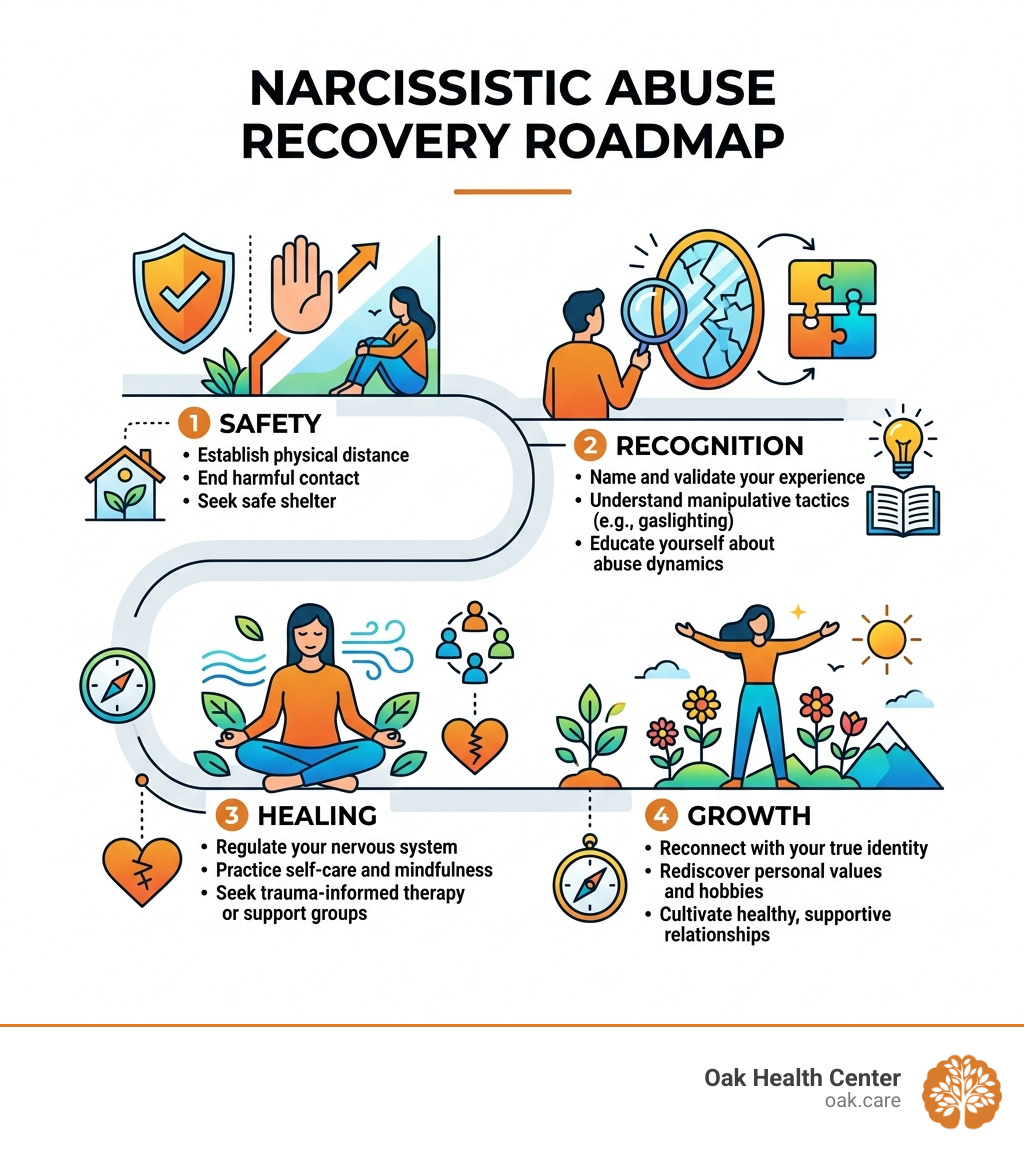
If you need a quick answer, here is what recovery looks like in four key stages:
- Safety — Remove yourself from ongoing harm and stabilize your environment
- Recognition — Name what happened, understand the tactics used against you, and validate your experience
- Healing — Rebuild self-trust, regulate your nervous system, and process trauma with professional support
- Growth — Reconnect with your identity, values, and relationships on your own terms
You probably already know something was deeply wrong. The constant self-doubt. The exhaustion. The feeling that you lost track of who you actually are. That is not a personal failure. It is a predictable response to a specific kind of psychological harm.
Narcissistic abuse is not just a difficult relationship. It is a systematic erosion of your sense of self — through gaslighting, cycles of reward and punishment, and deliberate isolation from the people who could have helped you see clearly.
The good news: your ability to trust yourself is not gone. It is buried. And it can be found again.
I’m Andrew Brewer, Practice Manager at Oak Health Center, where I work alongside clinical teams to build programs that support real recovery — including trauma-informed care for survivors of narcissistic abuse. At Oak Health Center, we’ve seen how the right support structure transforms outcomes for people navigating exactly what you’re facing. In the sections below, we’ll walk you through everything you need to understand and begin your recovery.
Understanding Narcissistic Abuse and the Cycle of Control
To begin narcissistic abuse recovery, we first have to understand what we are recovering from. Narcissistic abuse is a form of coercive control perpetrated by someone with Narcissistic Personality Disorder (NPD) or high narcissistic traits. These individuals typically possess an inflated sense of self-importance, a profound lack of empathy, and an insatiable need for admiration and control.
Unlike “normal” relationship conflict where both parties might argue but eventually seek a compromise, narcissistic abuse is one-sided. It is a psychological warfare designed to keep the victim off-balance. The abuser uses “data mining”—asking deep questions about your past traumas—only to use those vulnerabilities as weapons against you later.
It is also important to recognize “Collective Grooming.” This is when an abuser systematically prepares your social circle to disbelieve you before you even realize you’re being abused. They play the “Street Angel, House Devil” role: charming to the public, but punishing behind closed doors.
To help you distinguish between a healthy “rough patch” and a toxic dynamic, we have outlined the differences below:
Healthy vs. Narcissistic Relationship Dynamics
| Feature | Healthy Relationship | Narcissistic Abuse |
|---|---|---|
| Conflict Resolution | Respectful communication and compromise. | Blameshifting, “word salad,” and the silent treatment. |
| Boundaries | Respected and encouraged. | Viewed as a challenge or an act of war. |
| Self-Esteem | You feel supported and confident. | You feel “crazy,” “too sensitive,” or worthless. |
| Reality | Shared understanding of events. | Gaslighting; your memory is constantly questioned. |
| Support | Encourages outside friendships. | Systematic isolation and “triangulation.” |
For a deeper dive into these patterns, you can Recognize the Signs of Narcissistic Abuse and Begin Healing.
The Narcissistic Abuse Cycle and Trauma Bonds
One of the most confusing parts of narcissistic abuse recovery is the “push-pull” nature of the relationship. This isn’t just bad luck; it’s a calculated cycle that creates a physiological addiction known as a trauma bond.
The cycle typically follows four phases:
- Idealization (Love Bombing): The abuser showers you with affection, gifts, and “soulmate” rhetoric. They mirror your values to make you feel like you’ve found “the one.”
- Devaluation: The pedestal is removed. Subtle jabs turn into overt criticism. You find yourself working twice as hard to get back to the “Idealization” phase.
- Discard: When you are no longer useful or start demanding respect, the abuser leaves abruptly, often making it seem like your fault.
- Hoovering: Named after the vacuum, this is when the abuser tries to “suck” you back in with apologies or fake emergencies just as you begin to heal.
This cycle relies on “intermittent reinforcement.” Much like a slot machine, the abuser gives you just enough “love” at unpredictable intervals to keep you hooked. This creates a trauma bond—a chemical attachment driven by dopamine and oxytocin that makes leaving feel like a physical withdrawal.
Common Trauma Bond Symptoms:
- You feel “addicted” to the person despite knowing they are bad for you.
- You find yourself defending their behavior to friends and family.
- You feel a physiological compulsion to check your phone for their messages.
- You hope that if you just change one thing about yourself, they will go back to being the person they were in the beginning.
The Impact on Mind and Body: Why Recovery is Complex
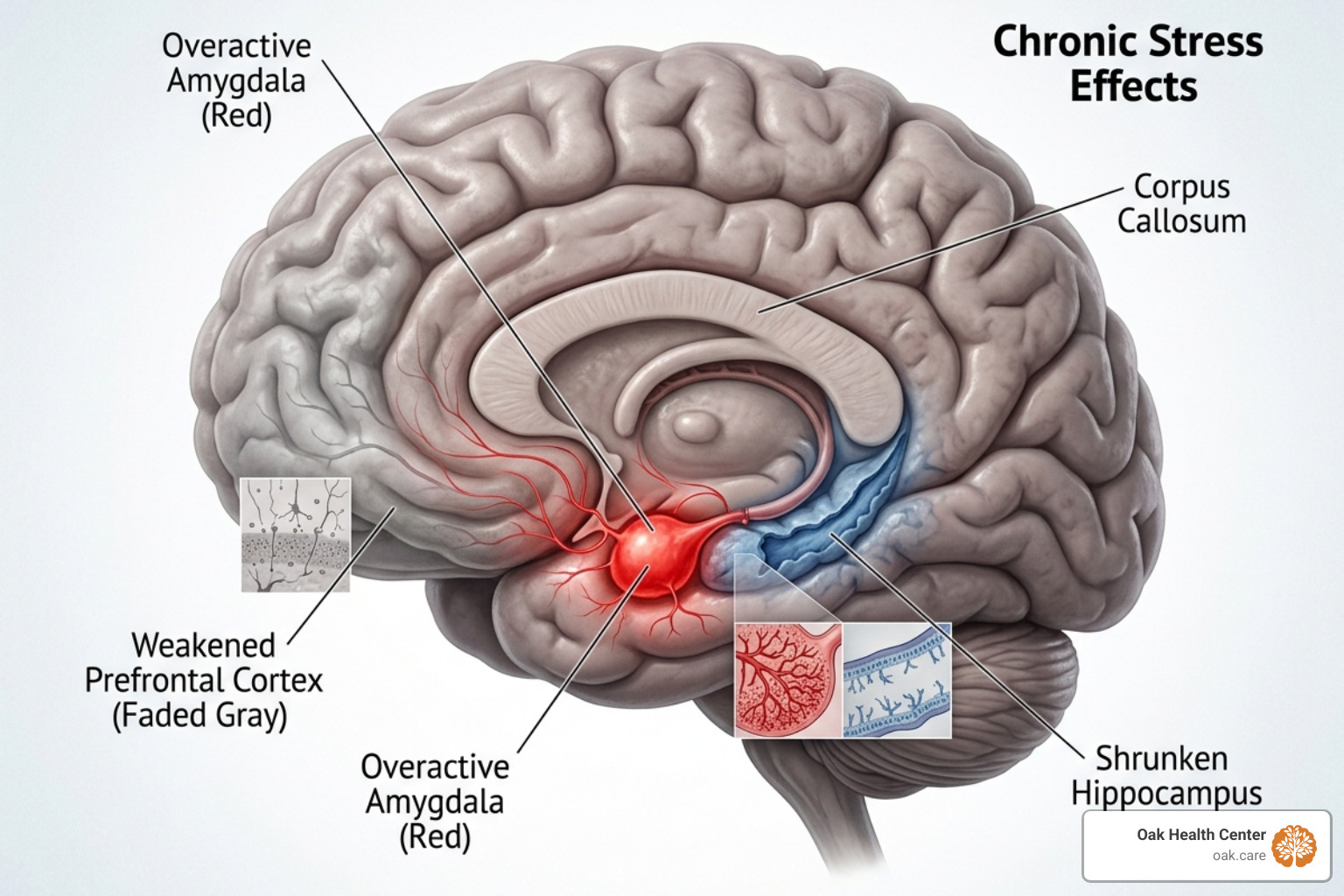
Narcissistic abuse doesn’t just hurt your feelings; it re-wires your nervous system. In May 2026, we now understand more than ever how chronic stress from emotional abuse impacts the body. Research shows that 78% of survivors experience significant trauma-related symptoms, including severe anxiety and Complex PTSD (C-PTSD).
When you live in a state of constant vigilance, your body stays in “fight-or-flight” mode. This floods your system with cortisol, which, over time, can lead to:
- Chronic fatigue and fibromyalgia
- Autoimmune disorders and migraines
- “Brain fog” and memory loss (the hippocampus, responsible for memory, can actually shrink under chronic stress)
- Difficulty making simple decisions because your “internal compass” has been broken
Overcoming Gaslighting in Narcissistic Abuse Recovery
Gaslighting is the primary weapon used to maintain control. It is the deliberate attempt to make you doubt your own perceptions, memories, and sanity. You might hear things like, “That never happened,” or “You’re remembering it wrong because you’re stressed.”
This leads to a loss of “epistemic trust”—the ability to trust yourself as a reliable source of information. Recovery involves “reality testing” and labeling these tactics in real-time. By naming the behavior (“That is blameshifting” or “That is a projection”), you begin to externalize the abuse rather than internalizing it as a personal flaw.
At Oak Health Center, we believe that understanding these mechanisms is the first step toward reclaiming your reality. You can find more info about psychotherapy services that specifically target these cognitive distortions.
The Essential Stages of Narcissistic Abuse Recovery
Recovery is not a straight line; it is a spiral. You will have days where you feel empowered and days where a single song sends you back into a tailspin. This is normal. The goal of narcissistic abuse recovery is to move through these stages at your own pace.
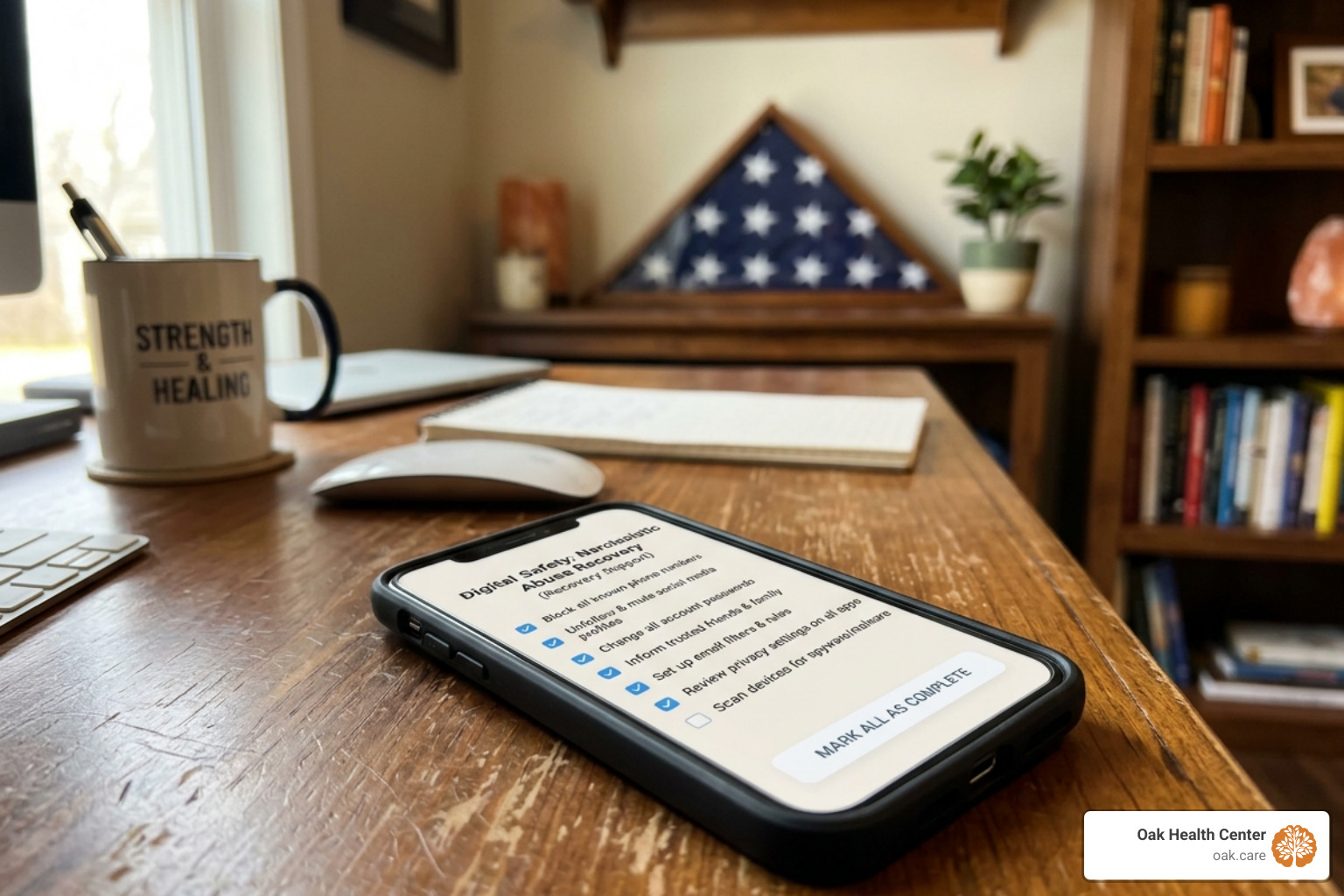
- Safety and Stabilization: This is the “emergency room” phase. Your priority is physical and digital safety, financial autonomy, and establishing “No Contact.”
- Recognition and Naming: You begin to learn the vocabulary of abuse. You realize you aren’t “crazy” and that your responses were heroic survival strategies, not character flaws.
- Integration: You process the trauma through therapy. You stop asking “Why did they do this?” and start asking “How do I ensure I never tolerate this again?”
- Post-Traumatic Growth: You rediscover your passions and values. You build a life that is so fulfilling that the abuser no longer has a place in it.
Breaking the Trauma Bond and Achieving No Contact
“No Contact” is the gold standard for breaking a trauma bond. It is not a silent treatment (which is a tool of abuse); it is a boundary for your own protection. It means no texts, no checking their Instagram, and no “checking in” through mutual friends.
If you must maintain contact due to co-parenting or legal reasons, we recommend the Grey Rock Method. This involves becoming as boring and uninteresting as a grey rock. Give short, non-committal answers (“Okay,” “I see,” “That’s fine”). Do not share your emotions or personal life. If the narcissist cannot get an emotional “rise” out of you, they will eventually look for a new “supply.”
Whether you are seeking support virtually or in person, choosing the right environment for this transition is key. Explore Teletherapy Vs In Person Which Is Right For You/ to see which fits your current safety needs.
Practical Strategies for Rebuilding Self-Trust and Identity
The abuser spent months or years telling you who you were. Now, you get to decide. Reclaiming your identity is an active construction project.
1. Positive Recovery Journaling (PRJ) Research from the University of Michigan suggests that journaling is most effective in the first 90 days of recovery. Write down one objective truth about yourself every day that has nothing to do with the abuser. For example: “I am a person who enjoys gardening,” or “I am someone who is kind to animals.”
2. Decision Drills Narcissistic abuse erodes your ability to make choices. Start small. Go to a coffee shop and pick a drink without asking anyone’s opinion. Choose a movie to watch by yourself. Practice saying “no” to small requests without offering an explanation. Remember: “No” is a complete sentence.
3. Values Clarification List five values that are important to you (e.g., honesty, creativity, freedom). Look at your life and see where those values were suppressed. Re-engaging with an old hobby, like painting or hiking, is a radical act of self-love.
Signs You Are Progressing in Narcissistic Abuse Recovery
How do you know if it’s working? Look for these “green flags” in your own healing:
- You notice red flags in new acquaintances sooner and walk away without guilt.
- You can say “no” to a family member or friend without a “guilt hangover.”
- You spend less time wondering “why” the abuser acted that way and more time wondering what you want for dinner.
- The “fog” lifts, and your memory starts to feel sharper.
- You feel hope for the future.
If you are currently in a situation where you feel unsafe, please reach out to the National Domestic Violence Hotline at 1-800-799-SAFE (7233).
Professional Therapy for Narcissistic Abuse Recovery
While self-help books and podcasts are excellent tools, the deep-seated neurological changes caused by narcissistic abuse often require professional intervention. At Oak Health Center, we utilize evidence-based modalities tailored to complex trauma.
- EMDR (Eye Movement Desensitization and Reprocessing): This helps the brain “reprocess” traumatic memories so they no longer trigger a full-body fight-or-flight response.
- Somatic Experiencing: Since trauma is stored in the body, this therapy helps release the physical “tightness” and stored energy associated with abuse.
- Cognitive Behavioral Therapy (CBT): This is used to challenge the “introject”—the internalized voice of the abuser that tells you that you aren’t good enough.
- TF-ACT (Trauma-Focused Acceptance and Commitment Therapy): Recent 2024 studies have shown that survivors can see significant restoration of identity and social ties in as few as 19 sessions of TF-ACT.
If you’re ready to take that step, we invite you to learn What To Expect In Your First Therapy Appointment at our Southern California locations.
Recommended Resources and Support Networks
You do not have to do this alone. Here are some vetted resources to help you bridge the gap between therapy sessions:
Books:
- Becoming the Narcissist’s Nightmare by Shahida Arabi
- The Body Keeps the Score by Bessel van der Kolk (for understanding somatic trauma)
- Whole Again by Jackson MacKenzie
Apps & Podcasts:
- NarcAbuse Recovery Apps: Tools for documenting evidence securely (useful for legal cases).
- Podcasts: Look for shows focusing on “The Scapegoat” and “Systemic Gaslighting” to understand the cultural roots of control.
Crisis Support:
- 988 Suicide & Crisis Lifeline: Call or text 988 anytime.
- Crisis Text Line: Text HOME to 741741.
Frequently Asked Questions about Narcissistic Abuse Recovery
How long does it typically take to recover from narcissistic abuse?
There is no universal timeline. Stabilization often occurs within six months of going “No Contact,” but full identity reconstruction can take several years. Factors include the length of the relationship, whether there was childhood trauma involved, and your access to professional support. Healing is a spiral, not a race.
Can you truly love yourself again after a narcissistic relationship?
Yes. In fact, many survivors find that they develop a stronger sense of self than they had before the abuse. This is known as post-traumatic growth. By dismantling the abuser’s lies, you are forced to build a foundation of self-worth that is much more resilient.
How can I support a loved one who is recovering from abuse?
The best thing you can do is validate their reality. Do not say, “But they were always so nice to me!” Instead, say, “I believe you, and I’m here for you.” Avoid giving unsolicited advice or pushing them to “just move on.” Recovery requires time and a safe space where their perceptions aren’t questioned.
Conclusion
Narcissistic abuse recovery is the journey of coming home to yourself. It is about moving from a state of “survival” to a state of “thriving.” While the abuser may have stolen your time or your confidence, they cannot steal your future.
At Oak Health Center, we are dedicated to providing compassionate, trauma-informed care for survivors across Southern California. Whether you are in Fullerton, Laguna Hills, Rancho Cucamonga, or South Pasadena, our team is here to help you navigate the complexities of C-PTSD and identity loss. We offer both in-person and virtual services to ensure you can access support in the way that feels safest for you.
When you are ready to stop managing the narcissist’s emotions and start honoring your own, we are here to help. Start your healing journey at our Beverly Hills location or any of our Southern California centers today.