


What Cognitive Behavioral Therapy Really Is (And Why It Works)
Cognitive behavioral therapy (CBT) is one of the most researched and effective forms of psychotherapy available today. Here’s a quick overview:
- What it is: A structured, short-term talk therapy that helps you identify and change unhelpful thinking patterns and behaviors
- How long it takes: Typically 5 to 20 sessions, usually weekly
- What it treats: Depression, anxiety, OCD, ADHD, eating disorders, substance use, chronic pain, and more
- Who it’s for: People of all ages, with or without a diagnosed mental health condition
- How it works: By changing how you think, you change how you feel and act
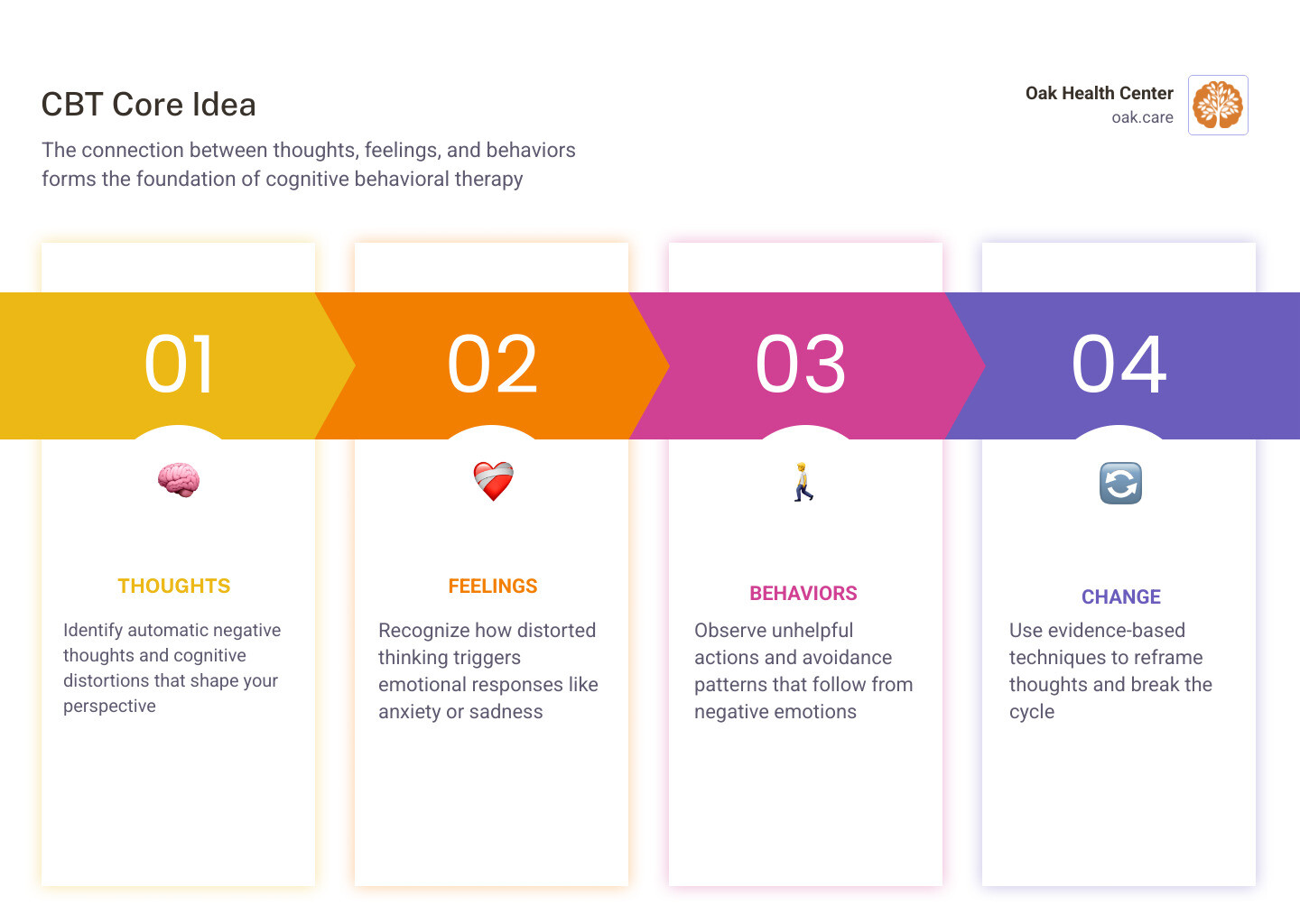
If you’ve ever caught yourself spiraling into worst-case thinking before a big meeting, or avoiding a difficult conversation until it becomes a crisis, you already know how powerfully your thoughts shape your day. CBT is built on one simple but profound idea: your thoughts, feelings, and behaviors are all connected — and changing one can change the others.
This guide breaks down exactly how CBT works, what to expect from treatment, and whether it might be the right fit for you.
I’m Andrew Brewer, Practice Manager at Oak Health Center, where I’ve helped grow our clinical programs — including psychotherapy services rooted in cognitive behavioral therapy — as part of a team committed to making evidence-based mental health care accessible across Southern California. My goal here is to give you a clear, honest look at what CBT is so you can decide if it’s the next right step for you.
What is Cognitive Behavioral Therapy?
Developed in the 1960s by psychiatrist Aaron Beck, Cognitive behavioral therapy emerged from a crucial clinical observation: Beck noticed that during depressive episodes, his patients experienced streams of negative thoughts that popped up spontaneously. He realized that depression is not just a mood issue; it is heavily driven by systematic errors in how we process information.
By combining the principles of cognitive psychology (how we think) with behaviorism (how we learn and react to our environment), Beck created a practical, goal-oriented approach. Today, CBT is widely considered the “gold standard” of evidence-based psychotherapy.
At its core, CBT operates on three fundamental principles:
- Psychological problems are based, in part, on faulty or unhelpful ways of thinking.
- Psychological problems are also based, in part, on learned patterns of unhelpful behavior.
- Individuals suffering from these problems can learn better coping mechanisms, relieving their symptoms and becoming more effective in their daily lives.
Unlike traditional psychoanalysis, which often spends months or years exploring childhood events to uncover deep-seated historical causes, CBT is firmly present-focused. While we acknowledge that your past shaped who you are, we focus our energy on the challenges you are facing right now and how to move forward.
In our practice, we treat therapy as a collaborative relationship. You and your therapist function as a team. You are the expert on your life and your experiences; your therapist is the guide who helps you build a custom toolkit of coping strategies. The ultimate goal of CBT is to teach you how to become your own therapist. By practicing these tools in your daily life, you build lasting resilience that continues long after your formal sessions end.
To help you understand where CBT fits in the broader landscape of mental health care, we can compare it to other common therapeutic approaches:
| Feature | Cognitive Behavioral Therapy (CBT) | Psychodynamic Therapy | Humanistic Therapy |
|---|---|---|---|
| Primary Focus | Current thoughts, behaviors, and actionable solutions | Unconscious patterns and past childhood experiences | Self-exploration, personal growth, and self-actualization |
| Structure | Highly structured, goal-oriented, and systematic | Loose, open-ended, and conversational | Client-led, non-directive, and highly empathetic |
| Duration | Short-term (typically 5 to 20 sessions) | Long-term (often months to several years) | Variable (depends on client goals and self-discovery) |
| Role of Homework | Essential; skills are practiced outside of sessions | Rare; focus is on in-session insight | Minimal; emphasizes in-the-moment emotional awareness |
| Scientific Evidence | Ample, robust clinical trials for various conditions | Moderate; harder to measure objective outcomes | Qualitative; focused on subjective personal experience |
For a broader look at how different therapeutic modalities compare and how to navigate your options, you can read our Step-by-Step Guide to Psychotherapy. To explore how these concepts are discussed in the wider medical community, you can also review the Harvard Health overview of CBT.
The Cognitive Model: How CBT Works
To understand why CBT is so effective, we must look at the cognitive model. This framework explains how our internal templates shape our daily experiences. When something happens in our lives, we do not react directly to the event itself. Instead, we react to our interpretation of that event.
Our minds process information through several layers, starting from our deepest core beliefs and moving up to our immediate, automatic thoughts:
- Core Beliefs (Schemas): These are the deep, rigid, and fundamental templates we hold about ourselves, other people, and the world. Formed early in life, they act like tinted lenses through which we view everything. Examples include “I am incompetent,” “People cannot be trusted,” or “The world is unsafe.”
- Intermediate Beliefs: These are the rules, assumptions, and attitudes we develop to cope with our core beliefs. For instance, if your core belief is “I am incompetent,” your intermediate rule might be: “If I work twice as hard as everyone else, no one will notice how bad I am.”
- Automatic Thoughts: These are the lightning-fast, involuntary thoughts that pop into your head in response to daily situations. They dictate your immediate emotional responses and behavioral outcomes.
- Emotional and Behavioral Responses: The way you interpret a situation instantly triggers an emotional state (e.g., anxiety, sadness, anger) and a physical response (e.g., rapid heart rate, muscle tension), which then dictates how you behave (e.g., avoiding a task, withdrawing socially).
For a deeper, clinically detailed dive into how these cognitive structures interact, you can read the comprehensive Scientific research on CBT hosted on the NCBI Bookshelf.
Identifying Automatic Thoughts in Cognitive Behavioral Therapy
Automatic thoughts are so rapid and habitual that we rarely stop to question them. We simply accept them as absolute facts.
To see this in action, consider the classic “hallway example.” Imagine you are walking down a hallway at work, and an acquaintance passes you without saying hello.
- Scenario A: Your automatic thought is, “He hates me. I must have done something to offend him.” As a result, you feel anxious, embarrassed, and rejected. Your behavioral outcome is to avoid him in the future.
- Scenario B: Your automatic thought is, “He must be in a hurry or lost in thought.” As a result, you feel completely neutral and unconcerned. Your behavioral outcome is to send him a friendly text later to check in.
Notice that the external event was exactly the same in both scenarios. The only variable was your automatic thought.
In our psychotherapy services, we teach you how to catch these thoughts in real-time. This starts with self-monitoring, often using a tool called a thought record. When you notice a sudden shift in your mood, you write down the situation, the exact thoughts you had, the emotions you felt, and the evidence supporting or refuting those thoughts. This simple act of writing slows down the mental spiral, allowing you to evaluate your thoughts objectively.
Unraveling Cognitive Distortions
When our automatic thoughts are unhelpful, it is usually because they contain cognitive distortions — systematic errors in logic that warp our perception of reality. Some of the most common distortions include:
- Catastrophizing: Automatically assuming the worst possible outcome will happen. (“If I stumble during my presentation, I will get fired and lose my house.”)
- Mind Reading: Arbitrarily assuming you know what others are thinking without any real evidence. (“They are all laughing at me behind my back.”)
- Black-and-White Thinking (All-or-Nothing): Viewing situations in extreme, binary categories. If a performance isn’t absolutely perfect, you view it as a total failure.
- Over-generalization: Taking a single negative event and seeing it as a never-ending pattern of defeat. (“I messed up this recipe; I can’t do anything right.”)
Through a process called cognitive restructuring, we help you identify these errors in logic. Instead of blindly accepting a distorted thought, you learn to cross-examine it like a lawyer. You look for objective evidence, explore alternative explanations, and replace the unhelpful thought with a more balanced, flexible, and adaptive perspective.
Core Strategies and Techniques of CBT
CBT is not just a passive conversation; it is an active, skill-building process. When you work with a therapist, you are engaging in structured training to change both your thinking patterns and your behavioral habits.
Here are the primary strategies we use during our sessions:
- SMART Goals: We don’t just talk about “feeling better.” We work together to set goals that are Specific, Measurable, Achievable, Realistic, and Time-limited. This keeps therapy focused and allows us to track your progress objectively.
- Socratic Questioning: Rather than simply telling you that your thoughts are irrational, your therapist will ask structured, open-ended questions. This guided discovery helps you uncover your own cognitive distortions and find healthier perspectives on your own.
- Role-Playing: To prepare for stressful real-world situations — like a difficult conversation with a partner or an upcoming job interview — we practice them in the safety of the therapy room. This builds confidence and sharpens your communication skills.
- Homework Assignments: What you do between sessions is just as important as what you do during them. Homework might include keeping a thought journal, practicing a relaxation technique, or intentionally putting yourself in a mildly uncomfortable social situation. This is where real, lasting brain changes occur.
Behavioral Activation and Exposure
While changing your thoughts is vital, changing your actions is equally powerful. When people feel depressed or anxious, they often fall into a cycle of behavioral avoidance. Because they feel low or afraid, they withdraw from social activities, avoid responsibilities, and stop engaging in hobbies. While this avoidance provides temporary relief, it actually reinforces their symptoms over time, making them feel more isolated and helpless.
To break this cycle, we use two key behavioral strategies:
- Behavioral Activation: This is a core tool for treating depression. We work with you to schedule small, manageable, and rewarding activities into your week — like taking a short walk, buying fresh flowers, or calling a friend. By reintroducing positive activities, we disrupt the cycle of inertia and naturally boost your mood.
- Gradual Exposure (Systematic Desensitization): This is the gold standard for treating anxiety, phobias, and OCD. Instead of avoiding the things that scare you, we help you face your fears in a controlled, step-by-step manner. We start with situations that cause mild anxiety and slowly work our way up as your confidence grows.
For instance, if you struggle with severe hand-washing compulsions or intrusive fears, we use exposure and response prevention to help you tolerate the discomfort without relying on your usual coping rituals. You can read more about how this approach helps individuals thrive in our guide on therapy for OCD.
Practical Applications of Cognitive Behavioral Therapy
CBT is incredibly versatile. Because it targets the fundamental relationship between thoughts and actions, it has been successfully adapted for a wide variety of mental and physical health conditions:
- Depression and Anxiety: CBT is highly effective at breaking the cycles of rumination, worry, and avoidance that keep people stuck. If you want to explore non-pharmacological options, you can read our article on managing anxiety without medication.
- ADHD: In both children and adults, CBT helps build essential executive functioning skills, such as time management, organization, and emotional regulation. To learn more about how this shows up in adults, check out our resource on ADHD in adults.
- Insomnia and Sleep Issues: Cognitive Behavioral Therapy for Insomnia (CBT-I) is the first-line medical recommendation for chronic sleep issues, helping you restructure unhelpful thoughts about sleep and build healthy bedtime habits. You can explore this connection further in our article on the anxiety-sleep connection.
- Chronic Pain and Fibromyalgia: While CBT does not cure physical illnesses, it is highly effective at changing how your brain processes pain signals. By reducing the stress, anxiety, and catastrophizing that often accompany chronic conditions like fibromyalgia, irritable bowel syndrome (IBS), or migraines, CBT can significantly improve your quality of life.
Frequently Asked Questions about CBT
How many sessions of CBT are typically required?
CBT is designed to be a highly structured, short-term therapy. A standard treatment course typically ranges from 5 to 20 sessions, with most people attending weekly, 50-minute sessions over a span of 12 to 16 weeks.
However, the exact duration depends entirely on your unique goals, the severity of your symptoms, and how consistently you practice your skills outside of sessions. In some cases, intensive CBT protocols can condense this schedule into daily sessions over one to three weeks.
Are there any risks or side effects associated with CBT?
Because CBT requires you to actively confront your fears, difficult memories, and unhelpful habits, it is completely normal to experience some temporary emotional discomfort. You might feel anxious, sad, or physically drained after a challenging session.
This is not a sign that therapy isn’t working; rather, it is a natural part of the healing process. A skilled therapist will work closely with you to build a strong therapeutic alliance, ensuring that you move at a pace that feels safe, supportive, and manageable.
Can CBT be done online or via teletherapy?
Yes, absolutely. Research has consistently shown that online CBT (sometimes called computerized CBT or teletherapy) is just as effective as traditional, in-person sessions for conditions like anxiety, depression, and insomnia.
Virtual therapy offers incredible flexibility, making it much easier to fit mental health care into a busy schedule without the stress of a commute. To weigh your options and see which format fits your lifestyle best, you can read our comparison of teletherapy vs. in-person therapy.
Conclusion
At the end of the day, CBT is about reclaiming control over your life. It is an empowering, practical, and highly collaborative journey that teaches you how to challenge the stories your mind tells you, face your fears, and build a life rooted in action.
If you or a loved one are ready to build healthier coping strategies and overcome life’s obstacles, we are here to support you. At Oak Health Center, we provide comprehensive, compassionate mental healthcare with simplified access across Southern California.
Whether you prefer to meet with us in person at our Oak Health Center in South Pasadena (or our other convenient locations in Beverly Hills, Fullerton, Laguna Hills, and Rancho Cucamonga) or utilize our statewide virtual services, we are ready to help you take the next step. Reach out to us today to schedule an appointment and discover how we can work together to help you thrive.