


What Is Psychotherapy — and Is It Right for You?
Psychotherapy — also called talk therapy — is a structured, evidence-based approach to treating mental health conditions and emotional challenges through regular conversation with a licensed mental health professional.
Quick answers for common questions:
- What does psychotherapy treat? Anxiety, depression, trauma, eating disorders, relationship problems, life stress, and more.
- How long does it take? Weeks for short-term issues; months to years for more complex conditions.
- How effective is it? About 75% of people who enter psychotherapy show meaningful benefit.
- Who provides it? Psychiatrists, psychologists, licensed clinical social workers, marriage and family therapists, and licensed professional counselors.
- Is it covered by insurance? Usually yes — most plans are required to cover mental health services on par with physical health care.
Feeling overwhelmed by work stress, anxiety, or low moods is more common than most people realize. More than one in five American adults experiences a mental health condition in any given year. Yet many people still don’t know where to start when it comes to getting help.
That’s exactly what this guide is for.
Whether you’re curious about what actually happens in a therapy session, trying to figure out which type of therapy fits your situation, or just want to know how to find a qualified therapist in Southern California — you’re in the right place.
I’m Andrew Brewer, Practice Manager at Oak Health Center, where I’ve helped grow our clinical programs and provider team to better serve patients seeking psychotherapy and other mental health services across Southern California. This guide draws on that hands-on experience to give you a clear, honest, step-by-step path forward.
Understanding Psychotherapy: Definition and Core Benefits

At its most fundamental level, psychotherapy is the intentional application of clinical methods and interpersonal stances derived from established psychological principles. The word itself has beautiful roots, deriving from the Ancient Greek psyche (meaning soul) and therapeia (meaning healing). It is not merely “venting” to a friendly listener; it is a collaborative, scientifically validated treatment model designed to help you modify behaviors, cognitions, emotions, and personal characteristics in ways that make your life better.
When we look at what psychotherapy actually accomplishes, the medical goals are clear: to gain relief from painful symptoms, maintain or enhance daily functioning, and improve your overall quality of life.
What the Research Says About Efficacy
It is completely normal to wonder, Does this actually work, or are we just paying to chat?
The scientific consensus is highly encouraging, though it also offers a realistic, grounded perspective:
- The 75% Benefit Rule: Decades of clinical research show that about 75 percent of people who enter psychotherapy experience symptom relief and are better able to function in their daily lives. This is reflected in fewer sick days, reduced medical problems, and increased work and relationship satisfaction.
- The Neurological Reality: Brain imaging studies have shown that successful talk therapy produces measurable, positive changes in the brain. For conditions like depression, panic disorder, and PTSD, the neurological improvements seen after a course of therapy closely mirror those produced by psychiatric medications.
- A Grounded View on Effect Sizes: To keep things entirely transparent, a landmark 2022 umbrella review of 102 meta-analyses found that the statistical effect sizes for both psychotherapies and medications are generally small to moderate across the board. This reminds us that mental health is complex; there is no magic wand, but therapy remains one of the most reliable tools we have.
- Variability in Response: It is estimated that up to 33% of patients do not experience reliable, positive changes during a standard course of therapy. This is why finding the right type of therapy and the right clinical fit is so vital.
For many people, particularly those navigating mild-to-moderate anxiety, talk therapy can be an entirely self-sufficient path to recovery. If you are curious about navigating life without pharmacotherapy, you can read more about Managing Anxiety Without Medication: When Psychotherapy Is Enough.
To explore the broader clinical definitions and historical context of this field, you can also review the Psychotherapy Overview and the medical consensus outlined by the American Psychiatric Association on What is Psychotherapy?.
Major Types of Evidence-Based Treatment
As of 2026, there are over a thousand named psychotherapies in existence. However, the vast majority of modern clinical work relies on a few highly researched, evidence-based frameworks. Rather than adhering rigidly to just one, many skilled clinicians today blend elements of these different modalities to create a tailored treatment plan.
To help you visualize the differences, here is a quick comparison of the three most common therapeutic frameworks:
| Therapy Type | Core Focus | Common Techniques | Best For | Typical Duration |
|---|---|---|---|---|
| Cognitive Behavioral Therapy (CBT) | Unhelpful thought patterns and learned behaviors | Cognitive restructuring, exposure, behavioral experiments | Anxiety, OCD, phobias, depression, insomnia | Short-term (12–20 weeks) |
| Psychodynamic Therapy | Unconscious conflicts, defense mechanisms, past relationships | Free association, exploring transference, identifying recurring themes | Complex trauma, deep-seated relationship issues, personality patterns | Medium to long-term (Months to years) |
| Interpersonal & Supportive Therapy | Current relationships, life transitions, immediate symptom relief | Role-playing, active listening, communication analysis | Grief, divorce, life adjustments, depression | Short-term (12–16 sessions) |
For a deeper dive into these clinical categories, you can explore the official resources on Psychotherapies and Elements. Let’s take a closer look at how each of these works in practice.
Cognitive Behavioral Therapy (CBT)
CBT is highly structured, goal-oriented, and focused primarily on the present. It operates on a simple premise: your thoughts, feelings, and behaviors are interconnected. When you get stuck in unhelpful thought patterns (such as “catastrophizing” or “all-or-nothing thinking”), your emotions and behaviors suffer.
In a CBT session, you won’t just talk; you will actively learn coping strategies, track your emotions, and perform behavioral experiments. For example, if you struggle with obsessive-compulsive patterns, a therapist might use Exposure and Response Prevention (ERP)—a specialized form of CBT. You can learn more about how these structured behavioral interventions work in our guide on How Therapy Helps with OCD.
Psychoanalytic and Psychodynamic Psychotherapy
While CBT looks at your current thoughts, psychodynamic therapy looks at the roots. It is based on the idea that our present behavior is deeply influenced by our past experiences, childhood relationships, and unconscious mind.
According to the clinical principles outlined in Psychoanalytic Therapy Principles, this approach focuses on several key concepts:
- Transference: Unconsciously projecting feelings and expectations from past relationships onto your therapist.
- Countertransference: The therapist’s emotional reaction to the patient, which is used as a clinical tool to understand the patient’s relational patterns.
- Defense Mechanisms: Identifying the ways you unconsciously protect yourself from painful emotions (such as denial, projection, or intellectualization).
By exploring these dynamics in a safe, non-judgmental space, you can resolve deep-seated conflicts rather than just managing surface-level symptoms.
Supportive and Interpersonal Psychotherapy
Sometimes, you don’t need to analyze your childhood or rewrite your cognitive habits; you need help navigating a painful life crisis right now.
- Interpersonal Psychotherapy (IPT) is a brief, highly focused treatment that helps you address interpersonal issues, such as unresolved grief, major life transitions (like a career change or retirement), or chronic relationship conflicts.
- Supportive Therapy focuses on reinforcing your existing coping skills, providing encouragement, and helping you find immediate stability.
These approaches are incredibly valuable for families navigating major structural shifts. For example, you can explore How Family Therapy Helps After Divorce to see how supportive dialogue restores balance. Similarly, specialized supportive care is essential for processing trauma, as discussed in Psychotherapy Services for Abuse.
What to Expect During Your Sessions

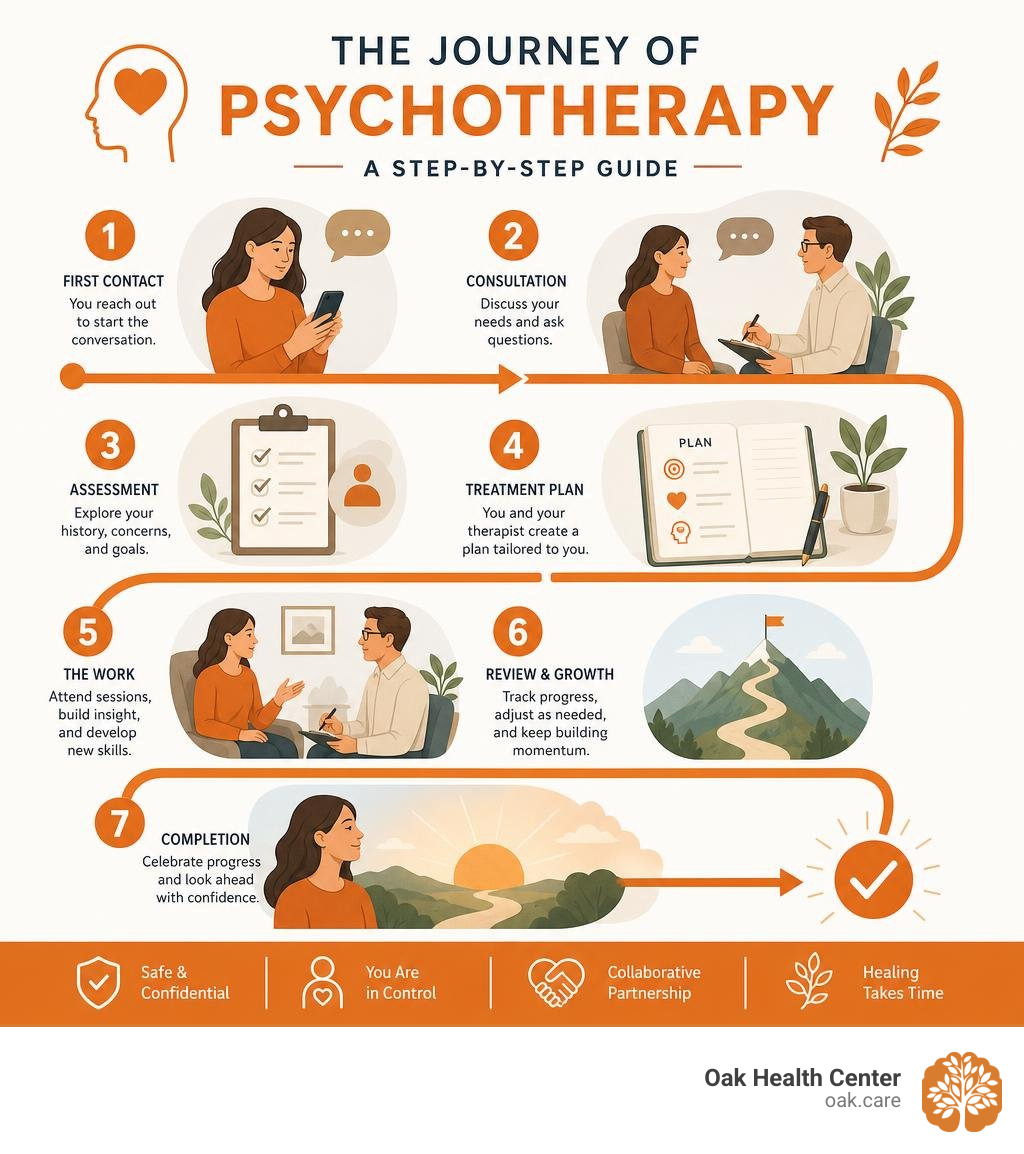
Starting therapy can feel intimidating if you don’t know what to expect. Let’s demystify the process from day one through the end of your treatment.
The First Appointment (The Intake)
Your initial session is largely about information gathering, assessment, and building comfort. Your therapist will ask about your medical history, current symptoms, and what prompted you to seek help. It is also your opportunity to interview the therapist to ensure they are a good fit for you. To help you prepare, we have written a detailed walkthrough on What to Expect in Your First Therapy Appointment.
The Therapeutic Alliance and Session Structure
The single most important factor in the success of your therapy is the therapeutic alliance — the collaborative trust, rapport, and mutual respect between you and your clinician.
- The Session: A standard session lasts 45 to 50 minutes (often called the “therapeutic hour”).
- The Frequency: Most people start with weekly sessions to build momentum, though this may transition to bi-weekly as symptoms improve.
- The Work: Therapy is an active partnership. You will be encouraged to be candid and honest, and you will often have “homework” between sessions — such as journaling, tracking your moods, or practicing a new communication skill in your daily life.
Honest Realities: Worsening Symptoms and Dropout Rates
We believe in absolute clinical honesty. Because therapy often requires you to confront painful memories, difficult emotions, and uncomfortable truths, it is not always a linear path of feeling better every week.
- Temporary Symptom Worsening: Research indicates that between 3% and 15% of patients may experience a temporary worsening of symptoms during the early or middle stages of therapy. This is a normal part of processing emotional pain, similar to how muscles sore after a physical therapy session.
- The Dropout Challenge: Nationally, dropout rates (early termination before clinical goals are met) range from 30% to 60%. Often, this happens because patients feel uncomfortable, believe it isn’t working fast enough, or experience a mismatch with their therapist. If you ever feel this way, the best step is to talk openly with your therapist about it before deciding to stop.
To learn more about the mechanics of the therapeutic relationship, check out the clinical guide on Understanding Psychotherapy and How It Works.
Frequently Asked Questions
How does psychotherapy compare to medication?
There is no one-size-fits-all answer. For mild-to-moderate anxiety, depression, and life stress, studies show that psychotherapy can be just as effective as medication, with the added benefit of teaching you long-term, sustainable coping skills.
However, for severe mental health conditions — such as major depressive disorder, bipolar disorder, or schizophrenia — a combination of pharmacotherapy (medication management) and talk therapy is generally the gold standard. Medication stabilizes brain chemistry and reduces severe symptoms, while therapy addresses the behavioral patterns and emotional coping mechanisms. For a deeper look at clinical pathways, read the Psychotherapy Guide from the Mayo Clinic.
Who is licensed to provide psychotherapy?
In California, several types of professionals are trained and licensed to deliver talk therapy, each with rigorous postgraduate education and supervised clinical training:
- Psychiatrists (MD/DO): Medical doctors who specialize in mental health. They are uniquely qualified to prescribe medications and perform medical evaluations, and some also provide talk therapy.
- Psychologists (PhD/PsyD): Doctoral-level professionals trained extensively in psychological testing, diagnostics, and evidence-based therapies.
- Licensed Clinical Social Workers (LCSW): Master’s-level clinicians who focus on the intersection of mental health and social systems, providing excellent clinical therapy and resource coordination.
- Licensed Marriage and Family Therapists (LMFT): Master’s-level professionals specializing in relationship dynamics, family systems, and individual therapy.
- Licensed Professional Clinical Counselors (LPCC): Master’s-level therapists focused on cognitive, behavioral, and rehabilitative counseling.
How do I find a qualified therapist in California?
Finding the right clinician is a step-by-step process:
- Verify Licensing: Ensure any provider you consider is fully licensed to practice in California.
- Check Insurance and Costs: Contact your insurance provider to understand your copays, deductibles, and whether they cover in-network or out-of-network mental health services.
- Use Reputable Directories: You can search for licensed professionals in your specific area using trusted clinical directories, such as:
- The statewide directory of Therapists in California.
- Localized search tools to Find Therapists in South Pasadena or Find Therapists in Fullerton.
Conclusion
Taking the first step toward mental health support can feel daunting, but you do not have to navigate it alone.
At Oak Health Center, we are dedicated to simplifying your access to compassionate, comprehensive mental healthcare. We offer convenient, in-person appointments across our five Southern California locations:
- Beverly Hills, CA
- Fullerton, CA
- Laguna Hills, CA
- Rancho Cucamonga, CA
- South Pasadena, CA
For those who prefer the comfort and convenience of home, we also provide secure, statewide virtual services throughout California. Whether you are looking for individual, family, or specialized psychiatric support, our team of licensed professionals is here to partner with you on your journey to healing.
Ready to take the next step? Explore our Oak Health Center Psychotherapy Services and schedule your initial consultation today.