

When Sleep Feels Like the Enemy: A Natural Way Out
If you’re trying to overcome sleep anxiety naturally, here are the most effective evidence-based strategies to start tonight:
- Practice 4-7-8 breathing — inhale 4 seconds, hold 7, exhale 8 — to activate your parasympathetic nervous system
- Schedule a daily “worry window” — 10-15 minutes in the afternoon to write down concerns before they hit you at bedtime
- Keep a consistent wake time — even on weekends, to anchor your circadian rhythm
- Follow the 20-minute rule — if you’re not asleep in 20 minutes, get up and do something calm in dim light
- Optimize your sleep environment — cool (65-68°F), dark, and screen-free at least 30 minutes before bed
- Consider magnesium glycinate or L-theanine — two of the better-studied natural supplements for anxiety-driven sleep disruption
- Seek CBT-I — Cognitive Behavioral Therapy for Insomnia is the gold-standard non-medication treatment
Most people assume sleep problems are about not being tired enough. But if anxiety is keeping you awake, that’s a completely different problem.
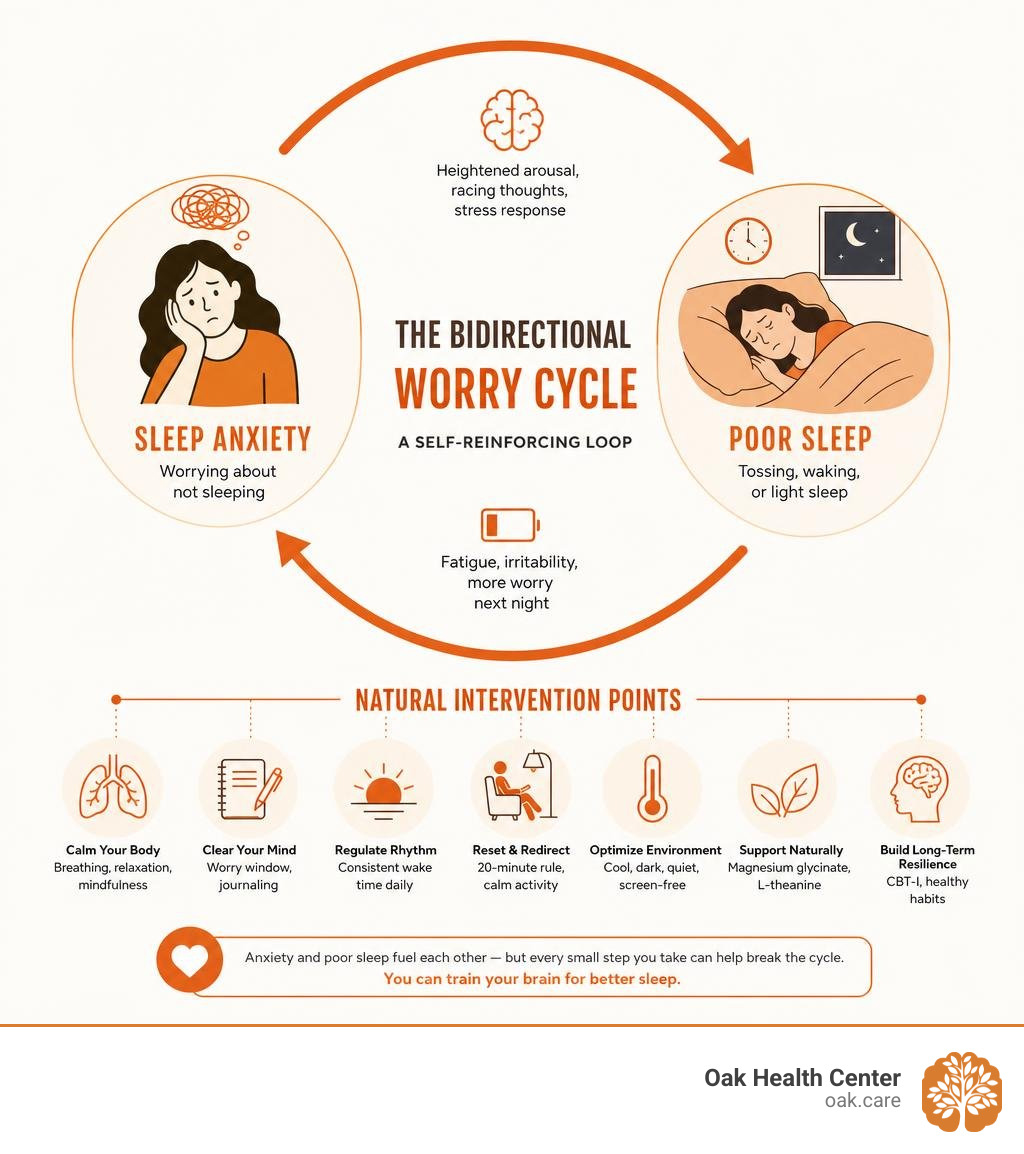
Sleep anxiety is the fear of not being able to sleep — and that fear itself makes sleep harder. It’s a self-reinforcing trap. You lie awake worrying about not sleeping. Not sleeping makes you more anxious. More anxiety makes sleep less likely. Repeat.
You’re not alone in this. 68% of Americans say stress and anxiety interfere with their sleep. And people with insomnia are 17 times more likely to experience anxiety disorders — a number that shows just how tightly these two problems are linked.
The good news? This cycle can be broken — without medication, and without counting sheep.
I’m Andrew Brewer, Practice Manager at Oak Health Center, where I’ve helped build and expand our Sleep Program alongside Dr. Alison Kole and our clinical team. My work supporting the development of evidence-based sleep and anxiety care gives me a understanding of what actually helps people overcome sleep anxiety naturally — and what just sounds good on paper. In this guide, we’ll walk through everything you need to know, from the science behind the anxiety-sleep loop to step-by-step strategies you can use tonight.
Understanding Sleep Anxiety and the Bidirectional Worry Cycle
To beat sleep anxiety, we first have to understand what we are fighting. It is not just “feeling tired but unable to sleep.” It is a complex physiological event where your brain misinterprets the act of going to bed as a threat.

When your brain perceives a threat, it activates your sympathetic nervous system—the “fight-or-flight” response. This triggers a flood of cortisol and adrenaline, raising your heart rate, tightening your muscles, and putting your mind on high alert. This state of hyperarousal is the biological opposite of what your body needs to ease into restful slumber.
Sleep Anxiety vs. Insomnia and Nighttime Worry
It is easy to confuse sleep anxiety with general insomnia or typical nighttime worry, but they are distinct experiences:
- Insomnia is primarily a sleep disorder characterized by difficulty falling or staying asleep, even when the environment is perfect for rest.
- Nighttime worry is simply the act of thinking about your daily stressors—like finances, chores, or work—once the distractions of the day fade.
- Sleep Anxiety (which can sometimes escalate to somniphobia, an intense fear of sleep itself) is specifically focused on the act of sleeping. You are not just worried about your bills; you are worried about whether you will fall asleep, how tired you will be tomorrow, and the physical sensations of lying awake.
This creates a brutal, self-reinforcing loop. When you experience sleep anxiety, your amygdala becomes hyperactive. In fact, research shows that sleep-deprived brains experience up to a 60% increase in amygdala reactivity, making you significantly more vulnerable to emotional distress. This biological trap is explored in detail in our guides on Understanding the Anxiety Sleep Connection and How Anxiety, Depression, and Sleep Problems Feed Each Other.
Common Causes and Triggers of Bedtime Dread
Why does this dread settle in right as you turn off the lights? Several physical and emotional triggers are usually at play:
- Lack of Daytime Distractions: During the day, your brain is occupied by work, family, and screens. At night, the sudden silence leaves a vacuum. Without external stimuli, your mind fills the quiet by surfacing unresolved stresses.
- Conditioned Bedtime Dread: If you have spent weeks tossing and turning, your brain begins to associate your bed with frustration and panic rather than safety and rest.
- Physical Health Conditions: Underlying medical issues can trigger physical anxiety symptoms. For example, hyperthyroidism (an overactive thyroid gland) accelerates your metabolism, mimicking panic attacks with a racing heart and restlessness.
- Hormonal Fluctuations: Shifts in estrogen and progesterone, particularly during menopause, can spike nighttime cortisol and trigger nocturnal panic attacks.
To learn more about the physical symptoms and diagnostic criteria for this condition, you can refer to the Cleveland Clinic’s resource on Sleep Anxiety: What It Is, Causes, Symptoms & Treatment.
How to Overcome Sleep Anxiety Naturally
Overcoming sleep anxiety naturally is not about forcing your mind to go blank. In fact, trying to force sleep is one of the most reliable ways to stay awake. Instead, we must work with our biology by regulating the nervous system, establishing circadian consistency, and building up “sleep pressure” (our body’s natural biological hunger for sleep).

When we train our nervous system to associate the evening with safety rather than struggle, we open the door for sleep to happen naturally. You can read more about this relationship in our article on When Anxiety Keeps You Up: Understanding the Link Between Sleep and Anxiety Disorders.
Cognitive Behavioral Strategies to Overcome Sleep Anxiety Naturally
Cognitive Behavioral Therapy for Insomnia (CBT-I) is widely recognized as the gold-standard, non-medication treatment for sleep disorders. You do not need to be in a formal clinic to start using some of its most powerful principles tonight:
- Stimulus Control (The 20-Minute Rule): If you are lying in bed awake for more than 20 minutes, get out of bed. Go to a dimly lit room and do something quiet and screen-free (like reading a physical book or knitting). Do not return to bed until you feel genuinely sleepy. This breaks the brain’s association between the mattress and frustration.
- Paradoxical Intention: This is a classic cognitive strategy where you give yourself permission to stay awake. Instead of telling yourself, “I must sleep now,” tell yourself, “I am just going to lie here comfortably and keep my eyes open.” By removing the pressure to sleep, you dramatically lower your performance anxiety, which often allows sleep to take over naturally.
- Scheduled “Worry Time”: Dedicate 10 to 15 minutes in the late afternoon to sit down with a notebook and write down everything you are worried about, along with a tiny next step for each item. When these thoughts inevitably bubble up at midnight, you can gently remind your brain, “We already processed that today, and the plan is in the notebook.”
For a deeper look at behavioral shifts to calm your mind, check out the NPR guide on 4 ways to calm your sleep anxiety : NPR.
Somatic and Breathing Exercises to Overcome Sleep Anxiety Naturally
While cognitive strategies target your thoughts, somatic exercises target your physical body, sending direct “safety signals” to your brain.
- The 4-7-8 Breathing Technique: Developed by Dr. Andrew Weil, this exercise acts as a natural tranquilizer for the nervous system. Inhale quietly through your nose for 4 seconds, hold your breath for 7 seconds, and exhale completely and audibly through your mouth for 8 seconds. Repeat this for 4 to 8 cycles. The prolonged exhale is the secret key—it triggers your vagus nerve to slow your heart rate.
- Progressive Muscle Relaxation (PMR): Starting at your toes, tense a muscle group tightly for 5 seconds, then release it completely while noticing the sensation of relaxation. Move systematically up your body—calves, thighs, stomach, hands, shoulders, and face. This physically releases the subconscious tension that anxiety stores in your muscles.
- Non-Sleep Deep Rest (NSDR): NSDR protocols (similar to Yoga Nidra) use guided body scans and slow breathing to guide your brain waves down from active beta states into deeply relaxed alpha and theta states. It teaches your nervous system how to transition into relaxation without the immediate pressure of falling asleep.
To explore more somatic techniques for quieting a racing mind, see the Cleveland Clinic’s advice on How To Stop Your Mind from Racing and Get To Sleep.
Designing an Anxiety-Calming Sleep Routine, Supplements, and Tracking Protocol
A chaotic evening routine creates a chaotic mind. To naturally lower nighttime cortisol, we need to design a predictable evening flow that signals to our hormones that the sun has set and it is safe to rest.
Step-by-Step Evening Wind-Down Protocol
Consistency is far more valuable than perfection. Rather than obsessing over a strict bedtime, focus on a consistent wind-down window to transition your body from daytime productivity to nighttime rest. For more context on why prioritizing this transition matters, explore our resource on Sleep and Mental Health: Why You Can’t Afford to Ignore It.
- 6 Hours Before Bed (The Caffeine Cutoff): Caffeine has a half-life of 5 to 7 hours and a quarter-life of up to 12 hours. A cup of coffee at 2:00 PM can still be blocking your brain’s sleep receptors at midnight. Keep your caffeine consumption strictly to the morning.
- 2 Hours Before Bed (Dim the Lights): Overhead lighting suppresses melatonin production. Switch to warm, low-level lamps and turn off bright, blue-spectrum overhead lights.
- 90 Minutes Before Bed (The Warm Shower Shift): Take a warm bath or shower. Your core body temperature needs to drop by 1 to 2 degrees to trigger sleep onset. When you step out of a warm shower into a cool room, your blood vessels dilate, rapidly dumping heat and mimicking your body’s natural pre-sleep cooling process.
- 30 Minutes Before Bed (Screens Off completely): The blue light from phones and tablets tricks your brain into thinking it is midday, delaying melatonin release by hours. Swap the phone for a physical book or journal.
Natural Supplements and Remedies: Evidence vs. Risks
Many people looking to overcome sleep anxiety naturally turn to supplements. While some are backed by solid clinical evidence, it is crucial to understand their limitations and use them safely. Always consult a healthcare provider before starting a new supplement regimen, especially if you are taking other medications. You can read more about natural symptom management in our guide on Managing Anxiety Without Medication: When Psychotherapy Is Enough.
| Supplement | Best Used For | How It Works | Potential Risks / Limitations |
|---|---|---|---|
| Magnesium Glycinate | Muscle relaxation & general anxiety relief | Supports GABA pathways in the brain; highly bioavailable and gentle on the stomach. | Can cause mild digestive upset in very high doses. Avoid magnesium oxide, which is poorly absorbed. |
| L-Theanine | Quieting a racing mind at bedtime | Promotes alpha brain waves (associated with meditation) without causing daytime drowsiness. | Generally very safe, but can occasionally cause mild headaches if taken in excess. |
| Ashwagandha | Reducing chronic, stress-induced cortisol | An adaptogenic herb that helps regulate the body’s long-term stress response. | Needs to be taken consistently for 2–4 weeks to show results. Not recommended during pregnancy. |
| Melatonin | Shifting circadian rhythms (jet lag, shift work) | Signals to the body that it is nighttime; does not directly reduce sleep anxiety. | Most over-the-counter doses (5–10mg) are far too high. Ideal physiological dosing is 0.3mg to 0.5mg. |
| CBD (Cannabidiol) | Tension and sleep maintenance | Interacts with the endocannabinoid system to reduce physical tension. | Lacks strict regulatory oversight; quality and dosing can vary widely between brands. |
Mindful Sleep Tracking and Avoiding Orthosomnia
In our high-tech world, many of us turn to smartwatches and rings to track our sleep. However, for anxious sleepers, these devices can easily do more harm than good.
This phenomenon is known as orthosomnia—an unhealthy obsession with achieving “perfect” sleep data. When you wake up, check your device, and see a low sleep score, it can trigger immediate daytime anxiety. This anxiety then makes you worry more about sleep the following night, worsening your insomnia.
Sleep trackers are not medical-grade devices; they estimate sleep stages based on movement and heart rate. Focus on how you subjectively feel when you wake up, rather than what your screen tells you. If tracking your sleep makes you anxious, put the wearable away and keep a simple, pen-and-paper sleep diary for a few weeks instead.
To learn more about the risks of sleep tracker fixation, read the NPR feature on 4 ways to end the cycle of sleep anxiety – NPR.
Frequently Asked Questions about Sleep Anxiety
Why does my anxiety spike right when I am trying to fall asleep?
During the day, your brain is busy processing external information. When you lie down in a dark, quiet room, those distractions disappear. This sudden lack of daytime distractions allows the thoughts and worries you pushed aside during the day to rise to the surface. Furthermore, your brain may have developed a conditioned dread of the bed, meaning it associates lying down with the frustration of insomnia, triggering an automatic physical stress response.
How long does it take to naturally reverse sleep anxiety?
Nervous system regulation takes time and consistency. While some somatic techniques (like 4-7-8 breathing) can provide immediate relief tonight, retraining your brain to associate the bed with safety typically takes 2 to 4 weeks of consistent practice. Be patient with your body; you are rewiring years of learned patterns.
Can sleep anxiety cause physical symptoms like a racing heart?
Absolutely. Because sleep anxiety activates your fight-or-flight response, it is very common to experience physical symptoms like a racing heart, shallow breathing, muscle tension, sweating, and even nocturnal panic attacks that wake you up suddenly. These are physical responses to adrenaline and cortisol, not signs of physical danger.
Reclaiming Your Nights with Oak Health Center
While natural strategies and sleep hygiene are incredibly powerful, they are sometimes only part of the puzzle. If your sleep anxiety has persisted for more than a month, causes severe distress, or significantly impacts your ability to function during the day, it is time to seek professional support.
At Oak Health Center, we believe that quality sleep is a cornerstone of mental wellness. We provide comprehensive, compassionate mental healthcare across Southern California, with physical locations in Beverly Hills, Fullerton, Laguna Hills, Rancho Cucamonga, and South Pasadena, alongside statewide virtual teletherapy services.
Our specialized Sleep Program led by Dr. Alison Kole is designed to help you break the cycle of sleep anxiety for good. By combining expert medical evaluation with evidence-based therapies like CBT-I, we make it simple and convenient for you to access the personalized support you deserve.
If you are ready to stop fighting the night and start waking up refreshed, explore our Sleep Specialty Page or reach out to us today to schedule a consultation. Let’s work together to help you find peace, rest, and a better life.