


What Are the Different Types of Psychotherapy?
The types of psychotherapy available today range from structured, skills-based approaches to open-ended, insight-driven conversations — and knowing the difference can help you find the right fit faster.
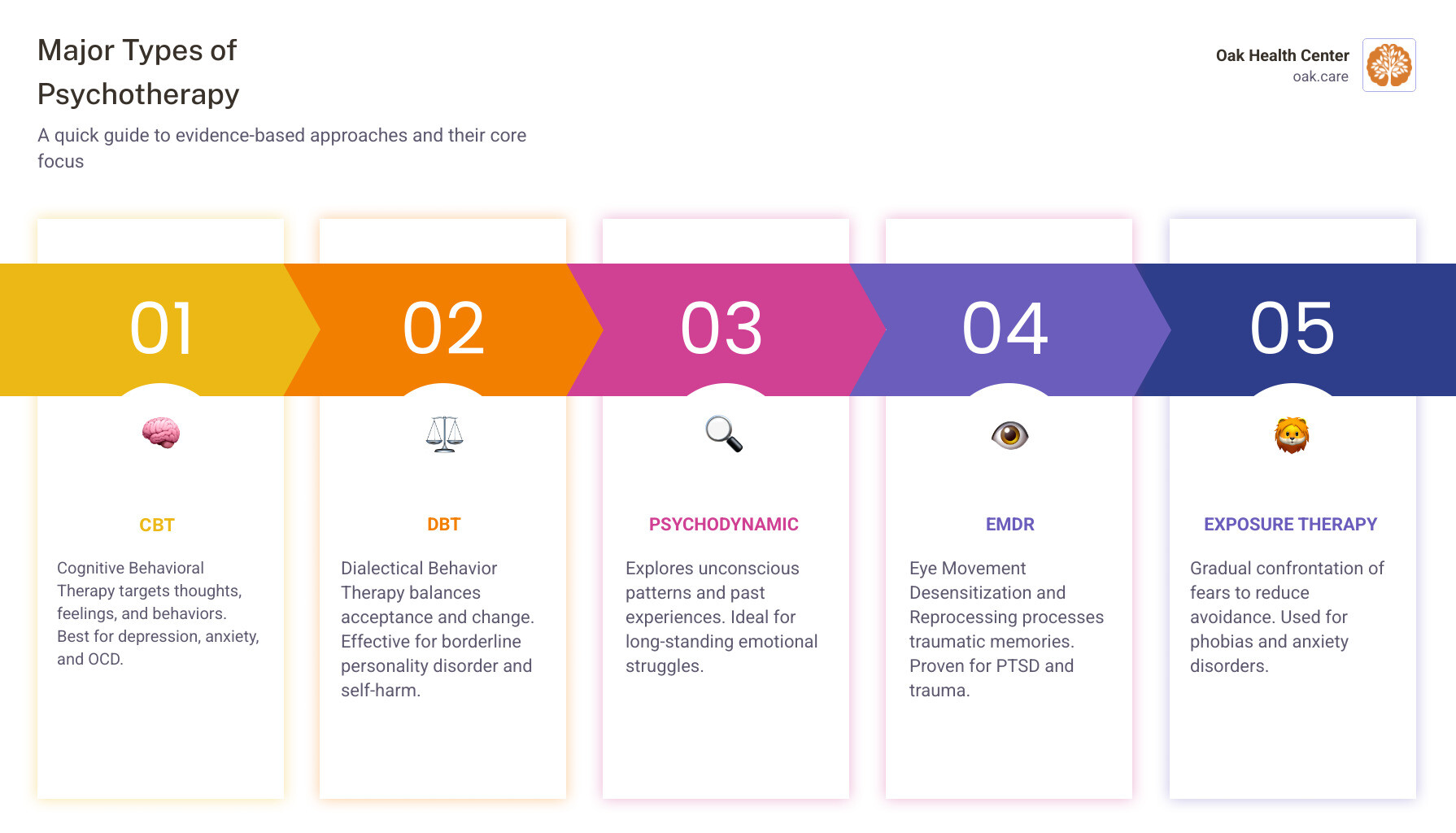
Here’s a quick overview of the major types:
| Type | Core Focus | Best Known For |
|---|---|---|
| Cognitive Behavioral Therapy (CBT) | Thoughts, feelings, behaviors | Depression, anxiety, OCD |
| Dialectical Behavior Therapy (DBT) | Acceptance + change | Borderline personality disorder, self-harm |
| Psychodynamic Therapy | Unconscious patterns, past experiences | Long-standing emotional struggles |
| EMDR | Processing traumatic memories | PTSD, trauma |
| Exposure Therapy | Gradual confrontation of fears | Phobias, anxiety disorders |
| Interpersonal Therapy (IPT) | Relationships and social skills | Depression, grief, life transitions |
| Acceptance and Commitment Therapy (ACT) | Psychological flexibility, values | Anxiety, chronic pain, stress |
| Humanistic Therapy | Self-growth, personal meaning | Low self-esteem, identity concerns |
Most people searching for therapy don’t know where to start — and that’s completely normal. There are hundreds of recognized therapeutic approaches, but only about a dozen have strong research backing. The good news: most people who receive psychotherapy do experience meaningful improvement.
Whether you’re dealing with anxiety, burnout, relationship strain, or just a persistent feeling that something’s off, there’s likely a therapy approach designed for exactly what you’re going through.
I’m Andrew Brewer, Practice Manager at Oak Health Center, where I’ve helped grow our clinical programs — including psychotherapy services — to reach thousands of patients across Southern California. While my background is in operations rather than clinical care, working closely alongside our providers has given me a practical, systems-level understanding of how different types of psychotherapy are structured, delivered, and matched to patient needs. Let’s break it all down in plain language so you can make a confident, informed decision.
Related content about types of psychotherapy:
What is Psychotherapy? (Understanding Clinical Talk Therapy)
At its most basic level, psychotherapy — often simply called “talk therapy” — is a collaborative, evidence-based treatment process. It relies on psychological principles to help individuals identify, understand, and change troubling emotions, thoughts, and behaviors.
But how does it differ from other forms of support, like counseling or life coaching?
While these terms are sometimes used interchangeably in casual conversation, they have distinct clinical and practical boundaries:
- Psychotherapy: This is a deeper, often long-term clinical process. It focuses on identifying chronic, unconscious patterns, treating diagnosed mental health conditions (like clinical depression, generalized anxiety, or bipolar disorder), and resolving past traumas. It is always conducted by a licensed healthcare professional.
- Counseling: Counseling is typically briefer, more structured, and focused on resolving a specific, current problem or life transition. Examples include grief counseling, short-term substance abuse recovery support, or navigating a career change.
- Life Coaching: Coaching is not a clinical treatment and does not address or treat mental illness. Instead, it is a future-focused, goal-oriented modality designed to help individuals optimize their personal or professional performance.
To practice clinical psychotherapy, professionals must obtain rigorous academic degrees, complete thousands of hours of supervised clinical training, and pass stringent state licensing exams. Depending on who you see, your therapist’s credentials might look like this:
- Psychologists (Ph.D. or Psy.D.): Doctoral-level professionals trained extensively in psychological testing, research, and talk therapy.
- Licensed Marriage and Family Therapists (LMFTs): Master’s-level clinicians specializing in relationship dynamics, family systems, and interpersonal patterns.
- Licensed Clinical Social Workers (LCSWs): Master’s-level therapists trained to view mental health through a systemic lens, connecting clinical therapy with community resources.
- Licensed Professional Clinical Counselors (LPCCs): Master’s-level clinicians focused on individual counseling and psychotherapy.
- Psychiatrists (M.D. or D.O.): Medical doctors who specialize in mental health. While they are fully trained to provide talk therapy, they primarily focus on psychiatric evaluations and prescribing medication.
Regardless of the professional’s specific title, every clinical therapy relationship is bound by strict ethical and legal standards. Chief among these is confidentiality. What you say in a therapy session stays in that session. Therapists are legally prohibited from sharing your information with anyone — employers, family members, or friends — without your explicit, written consent. The only exceptions to this rule occur in rare, immediate safety emergencies (such as a risk of harm to yourself or others) or when legally mandated by a court.
To learn more about what to expect during your first session, check out our Step-by-Step Guide to Psychotherapy. For a deeper clinical look at how these professions operate, you can read the Overview of psychotherapies.
The Major Types of Psychotherapy and How They Work
If you feel like there are more types of psychotherapy than there are actual therapists, you aren’t entirely wrong! Clinicians half-jokingly assert that the sheer number of specialized modalities can feel overwhelming to a beginner.
Think of a theory of psychotherapy as a roadmap. Just as a driver needs a map to navigate a new city, a therapist uses a theoretical framework to understand a client’s struggles, identify the root causes of their distress, and map out a path toward healing.
Despite the vast number of specialized techniques, decades of clinical research have revealed a fascinating truth known as the Common Factors Theory. Developed by researcher Jerome Frank, this theory suggests that the shared elements across different types of therapy are actually what drive the majority of positive patient outcomes.
The most powerful “common factor” is the therapeutic alliance — the trust, empathy, and collaborative partnership built between you and your therapist. Research shows that this alliance typically takes about 3 to 5 sessions to stabilize, and a strong alliance is one of the single best predictors of successful treatment.
To help you navigate these options, the National Institute of Mental Health (NIMH) Guide to Psychotherapies offers a wealth of information.
Below is a clinical comparison matrix detailing the core mechanics, typical durations, and target conditions for the most widely practiced modalities:
| Modality | Core Mechanism | Typical Duration | Best Suited For |
|---|---|---|---|
| Cognitive Behavioral Therapy (CBT) | Restructuring negative thought patterns and modifying behaviors. | 12 to 20 sessions | Depression, Anxiety, OCD, Insomnia, Eating Disorders |
| Dialectical Behavior Therapy (DBT) | Balancing acceptance (validation) with change (skills-building). | 6 to 12 months | Borderline Personality Disorder, Chronic Self-Harm |
| Psychodynamic Therapy | Exploring unconscious conflicts and childhood experiences. | Open-ended (months to years) | Chronic depression, personality issues, relationship patterns |
| Exposure Therapy | Gradual, controlled confrontation of feared stimuli. | 8 to 15 sessions | Specific phobias, PTSD, severe anxiety |
| EMDR | Dual bilateral stimulation to reprocess traumatic memories. | 8 to 12 sessions | PTSD, acute trauma, phobias |
| Acceptance & Commitment (ACT) | Developing psychological flexibility through values-based action. | 8 to 16 sessions | Chronic pain, workplace stress, anxiety |
Cognitive and Behavioral Types of Psychotherapy
Behavioral and cognitive therapies emerged as scientific, action-oriented alternatives to older, more philosophical models of therapy. Today, they represent some of the most heavily researched and widely accessible treatments in the world.
Cognitive Behavioral Therapy (CBT)
CBT is built on a straightforward premise: our thoughts, feelings, and behaviors are deeply interconnected. If we can change the way we think, we can change the way we feel and act.
Developed in the mid-1960s by pioneers like Aaron Beck and Albert Ellis, CBT focuses on identifying “cognitive distortions” — irrational, negative thought patterns like “I can’t do anything right” or “Everything is going to go wrong.” In a CBT session, you and your therapist work collaboratively to challenge these thoughts and replace them with realistic, balanced perspectives.
But CBT isn’t just about “positive thinking”; it is highly active. You will often be asked to complete “homework,” such as keeping a thought journal or practicing behavioral experiments. Remarkably, studies of CBT have shown that individuals undergoing this treatment exhibit actual, measurable changes in brain activity, proving that the therapy physically improves brain functioning.
Dialectical Behavior Therapy (DBT)
Originally developed by Dr. Marsha Linehan to treat chronically suicidal individuals with borderline personality disorder (BPD), DBT is a highly structured variation of CBT.
The word “dialectical” refers to the central tension in the therapy: the balance between acceptance and change. A DBT therapist works to validate your current emotional pain (accepting you exactly as you are) while simultaneously teaching you concrete skills to change self-destructive behaviors.
DBT typically combines weekly individual therapy with structured group skills-training sessions. These sessions focus on four core pillars:
- Mindfulness
- Distress tolerance
- Emotion regulation
- Interpersonal effectiveness
According to clinical studies published in the Mental Health Clinician, undergoing a full course of DBT can reduce subsequent clinical consideration and prescription needs by up to 90%, offering long-lasting, life-saving improvements.
Exposure Therapy
A specialized branch of behavior therapy, exposure therapy is designed to help individuals confront their deepest fears. When we are afraid of something — whether it is spiders, public speaking, or a traumatic memory — we naturally avoid it. While avoidance brings short-term relief, it actually strengthens the fear over time.
In exposure therapy, a therapist helps you safely, gradually, and systematically confront your triggers in a controlled environment. This can be done through “systematic desensitization” (slowly working your way up a fear hierarchy) or “flooding” (confronting the feared situation directly). Over time, your brain learns that the feared stimulus is not actually dangerous, a process known as habituation. This approach is highly effective for phobias, obsessive-compulsive disorder (OCD), and PTSD.
If you’re interested in learning how these behavioral strategies can help manage symptoms without pharmaceuticals, read our guide on Managing Anxiety Without Medication.
Relational and Somatic Types of Psychotherapy
While cognitive-behavioral therapies focus heavily on conscious thoughts and behaviors, relational and somatic therapies look deeper — exploring unconscious motivations, relationship dynamics, and how the body physically holds emotional stress.
Psychodynamic Therapy
This modality is the direct descendant of Sigmund Freud’s traditional psychoanalysis, though it has been significantly modernized. While classical psychoanalysis often required patients to lie on a couch three to five times a week for several years, modern psychodynamic therapy is much more streamlined and conversational.
The core goal of psychodynamic therapy is to bring unconscious conflicts, defense mechanisms, and patterns into conscious awareness. By exploring your past experiences, developmental history, and childhood relationships, you can begin to see how old wounds are dictating your current behaviors.
In these sessions, therapists pay close attention to transference — a phenomenon where a patient unconsciously projects feelings about parental figures or past relationships onto the therapist. By analyzing these dynamics in real-time within a safe, non-judgmental environment, you can heal deep-seated emotional wounds.
Interpersonal Therapy (IPT)
Unlike psychodynamic therapy, which looks backward at childhood, Interpersonal Therapy (IPT) is highly present-focused. IPT is built on the belief that our mental health is intimately tied to our relationships and social support networks.
Typically lasting just 12 to 16 sessions, IPT focuses on helping you resolve current interpersonal conflicts, navigate difficult life transitions (like divorce, retirement, or job loss), cope with complex grief, or overcome social isolation. By improving your communication skills and building stronger, healthier social connections, you can rapidly alleviate symptoms of depression and anxiety.
Eye Movement Desensitization and Reprocessing (EMDR)
EMDR is a specialized, highly effective trauma treatment. Developed in the late 1980s by Dr. Francine Shapiro, EMDR helps the brain process traumatic memories that have become “stuck” in the nervous system.
During an EMDR session, you will be asked to briefly focus on a painful traumatic memory while your therapist guides you through bilateral stimulation — typically in the form of side-to-side eye movements, alternating hand taps, or audio tones. This rapid, back-and-forth sensory input is believed to mimic the brain’s natural processing state during REM sleep.
By stimulating both hemispheres of the brain while recalling the trauma, EMDR helps “file” the memory away correctly, dramatically reducing the emotional distress and physical panic associated with the event. Though there is some ongoing clinical debate regarding whether the benefit comes from the bilateral eye movements themselves or the exposure inherent in the treatment, the World Health Organization (WHO) and the APA fully endorse EMDR as a first-line treatment for PTSD.
For an academic deep dive into these diverse theoretical frameworks, you can explore the Clinical Tree Overview of the Psychotherapies.
Choosing the Right Format: Individual, Group, Couples, and Family
Just as there are many theoretical types of psychotherapy, there are also several different structural formats in which therapy can be delivered. Choosing the right format depends entirely on the nature of your concerns, your personal goals, and your comfort level.
- Individual Therapy: The most common format, consisting of one-on-one sessions between you and your therapist. This format provides a highly personalized, private space to explore complex personal issues at your own pace.
- Group Therapy: Led by one or more licensed therapists, group therapy brings together a small group of individuals (typically 5 to 10 people) who are facing similar challenges, such as grief, substance abuse, or social anxiety. Group therapy is highly cost-effective and provides a powerful sense of community, letting you know you are not alone in your struggles.
- Couples Therapy: Designed for romantic partners looking to improve communication, resolve chronic conflicts, rebuild trust after infidelity, or navigate major life transitions. Modalities like the Gottman Method are frequently used to help couples break unhealthy communication loops.
- Family Systems Therapy: This format views the family as an interconnected emotional unit. Rather than treating one “problem” individual in isolation, family therapy brings family members together to understand how their behavioral patterns, boundaries, and communication styles affect the entire household system.
To learn more about these formats, read about Therapy Types and Modalities on Psychology Today.
Additionally, modern technology has made accessing these formats easier than ever. If you’re wondering whether virtual sessions could work as well as traditional office visits for your chosen format, take a look at our comparison guide on Teletherapy vs In-Person.
Frequently Asked Questions about Psychotherapy
Can psychotherapy be combined with medication?
Yes, absolutely. In fact, for many moderate-to-severe mental health conditions, combining psychotherapy with psychiatric medication is considered the gold standard of care.
While medications like antidepressants, mood stabilizers, or anti-anxiety drugs can help regulate brain chemistry and alleviate severe physical symptoms, they cannot teach you coping skills, help you process trauma, or resolve relationship conflicts. Talk therapy is what addresses those underlying psychological drivers.
The synergistic effects of combined treatment are well-documented. For instance, the landmark STAR*D trial (and subsequent psychiatric research) demonstrated that for major depression, the combination of antidepressants and psychotherapy produces remission rates roughly 20 percentage points higher than either treatment alone.
At Oak Health Center, our team includes both psychiatrists (who manage medications) and licensed therapists (who provide talk therapy) working hand-in-hand to ensure your treatment is fully coordinated and holistic.
How long does therapy typically take to work?
There is no one-size-fits-all answer, as the duration of therapy depends heavily on the severity, complexity, and history of the issues you are facing.
Standard therapy sessions typically last 45 to 60 minutes and occur once a week or once every two weeks.
- Short-term therapies (like CBT, ACT, or IPT) are highly structured and typically run anywhere from 8 to 20 sessions.
- Long-term therapies (like psychodynamic therapy or treatment for complex, chronic trauma) can span several months to years.
When it comes to seeing progress, research on treatment trajectories shows that most symptom change in short-term therapies actually occurs in the first 8 sessions, with diminishing gains thereafter. This rapid early improvement is heavily influenced by how quickly a strong therapeutic alliance is built. If you aren’t feeling any shift or benefit by session 8 to 12, it is highly recommended to openly discuss this with your therapist or consider adjusting your therapeutic modality.
For a deeper look at planning your treatment timeline, refer to the National Mental Health Authority Guide on Psychotherapy Types.
What are the most common misconceptions about talk therapy?
Despite the growing cultural acceptance of mental healthcare, several outdated myths about psychotherapy still persist:
- Myth 1: “Therapy is only for severe mental illness.”
- The Reality: While therapy is highly effective for severe clinical disorders, it is equally valuable for managing daily life stressors, navigating career transitions, coping with grief, improving relationships, or simply building better self-awareness. You do not need to be in crisis to benefit from therapy.
- Myth 2: “Therapy is just talking about your childhood indefinitely.”
- The Reality: While understanding your history is important, the majority of modern evidence-based practices (like CBT, DBT, and ACT) are active, present-focused, and highly goal-oriented.
- Myth 3: “Therapy is a passive process where the therapist tells you what to do.”
- The Reality: Therapy is a highly collaborative partnership. It is not a procedure done to you; it requires your active commitment, honesty, and willingness to practice new skills outside of session.
For a detailed look at the empirical research debunking these myths and proving therapy’s robust efficacy, check out the APA Research on Psychotherapy Efficacy.
Conclusion
Understanding the different types of psychotherapy is the first step toward taking control of your mental wellness journey. There is no single “perfect” therapy; the right choice is simply the one that aligns best with your unique goals, your personality, and the specific challenges you are facing.
Whether you thrive in highly structured, practical environments like CBT, or find deeper healing through relational models like psychodynamic therapy, support is readily available.
At Oak Health Center, we believe that accessing compassionate, high-quality mental healthcare should be as simple and stress-free as possible. We offer comprehensive, personalized psychiatric and psychotherapy services tailored to your individual needs.
If you are ready to take the next step, we welcome you to visit us at any of our five convenient Southern California locations:
- Beverly Hills, CA
- Fullerton, CA
- Laguna Hills, CA
- Rancho Cucamonga, CA
- South Pasadena, CA
We also offer secure, convenient virtual therapy services for residents living anywhere across the state of California.
Ready to begin your journey toward emotional growth and healing? Explore our Psychotherapy Services and schedule your initial consultation with our team today.