


When Antidepressants Aren’t Enough: A Guide to Professional Alternative Treatments for Depression
If you’re reading this, you’ve probably already tried the standard route — and it hasn’t fully worked.
Here’s a quick overview of the top professional options, ranked by effectiveness and safety:
| Rank | Treatment | Best For | Speed of Relief |
|---|---|---|---|
| 1 | TMS Therapy | Most treatment-resistant cases | 2–6 weeks |
| 2 | ECT | Severe, psychotic, or life-threatening depression | Days to 1 week |
| 3 | Ketamine / Esketamine | Rapid relief, suicidal ideation | Hours to days |
| 4 | Psychotherapy (CBT, etc.) | Long-term foundation, mild to moderate | Weeks to months |
| 5 | Emerging options (tACS, immune therapy) | Specialized cases | Varies |
That’s the short answer. Keep reading for the full breakdown.
The reality is sobering: traditional antidepressants relieve symptoms in only about one-third of patients. Up to 70% of people don’t achieve full remission on their first medication. And less than 2% succeed after a third or fourth antidepressant trial.
You are not failing treatment. Treatment is failing you.
That gap is exactly why professional alternative approaches exist — and why more clinicians are turning to them as first-choice options rather than last resorts.
This guide ranks the best evidence-based professional alternatives available in 2026, using real clinical data on response rates, remission rates, safety profiles, and how well each treatment fits into a busy life.
I’m Andrew Brewer, Practice Manager at Oak Health Center, where I’ve helped build and expand programs including TMS and specialty psychiatry services. My work sits at the intersection of operations and clinical care, giving me a front-row view of what alternative treatments for depression actually look like in practice — and which ones produce real, lasting results for patients. Let’s walk through what the evidence says.
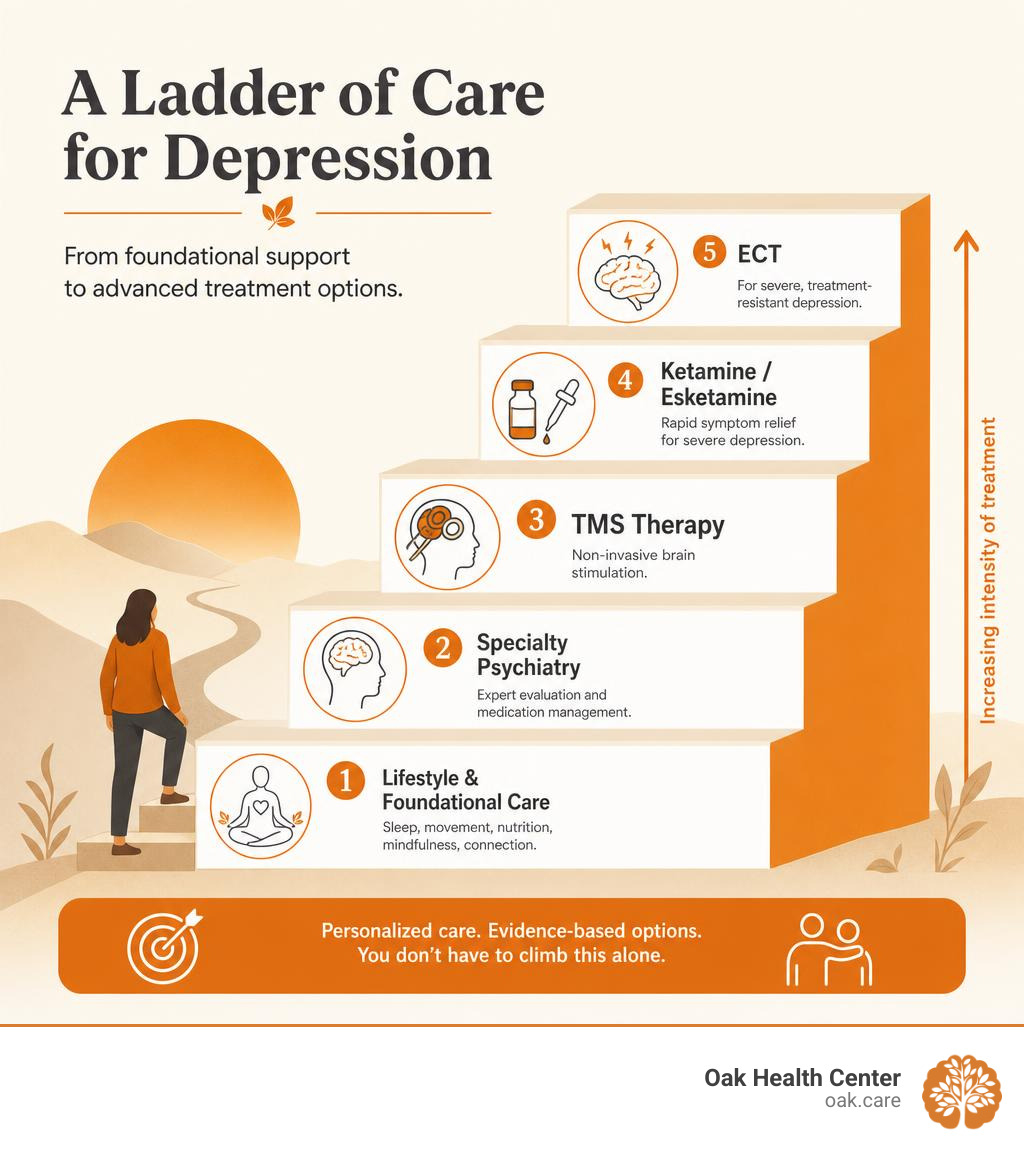
Alternative treatments for depression basics:
How We Ranked Professional Alternative Treatments for Depression
When standard medications fail, deciding on a next step can feel overwhelming. To cut through the noise, we ranked these professional treatments using a strict set of clinical criteria:
- Effectiveness: What percentage of patients experience a significant drop in symptoms (response rate) or see their symptoms disappear entirely (remission rate)?
- Speed: How quickly does the treatment begin to lift the fog of depression?
- Safety & Side Effects: What are the physical and cognitive risks, and how well do patients tolerate the treatment?
- Durability: How long do the positive effects last after the treatment protocol ends?
- Treatment Burden: How much does the schedule disrupt daily life (e.g., daily clinic visits vs. weekly therapy)?
This ranking is designed with clinical safety as the top priority. Before starting any of these options, patients must undergo a thorough medical evaluation, including screening for bipolar disorder (to prevent triggering manic episodes), an assessment of suicide risk, and a comprehensive review of current medications.
To help you visualize how these options compare, here is a breakdown of the leading professional alternative treatments:
| Treatment | Primary Mechanism | Clinical Remission Rate | Common Side Effects | Best Suited For |
|---|---|---|---|---|
| TMS (Transcranial Magnetic Stimulation) | Targeted magnetic pulses to the brain’s mood centers | 30% – 78.6% (protocol dependent) | Mild headache, scalp tingling | Treatment-resistant depression; patients seeking a non-invasive, medication-free option |
| ECT (Electroconvulsive Therapy) | Brief controlled seizure under general anesthesia | ~65% | Temporary memory loss, confusion | Severe, psychotic, or life-threatening depression |
| Ketamine / Esketamine | NMDA receptor modulation to boost glutamate and neuroplasticity | 15% – 40% (long-term varies) | Dissociation, temporary blood pressure spike | Rapid symptom relief; acute suicidal ideation |
| Psychotherapy (CBT) | Cognitive and behavioral restructuring | Varies (61% – 87% response) | Emotional discomfort during sessions | Mild-to-moderate depression; long-term relapse prevention |
| tACS (Emerging) | Low-intensity alternating electrical currents to sync brain waves | ~27% (early clinical trials) | Mild fatigue, temporary sleepiness | Patients seeking portable, non-invasive neuromodulation |
What “Alternative” Means in Professional Depression Care
In a clinical setting, “alternative” does not mean unproven home remedies. Instead, it refers to evidence-based, non-antidepressant medical treatments. These include advanced brain stimulation, specialized psychotherapies, clinical ketamine protocols, and structured lifestyle medicine.
True professional alternative care always begins with a comprehensive medical review. Many physical conditions mimic or worsen depression. A thorough evaluation must rule out underlying thyroid issues, sleep disorders, substance use, and nutritional deficiencies before a targeted alternative treatment plan can be designed. For a deeper look at this process, read our guide on understanding treatment-resistant depression.
When Antidepressants Fail: Who Should Consider These Options?
If you have tried at least two different antidepressant medications at adequate doses for the correct duration and still have not found relief, you meet the clinical criteria for treatment-resistant depression (TRD).
You should also consider alternative treatments if you experience intolerable side effects from standard medications, have a partial response that still leaves you highly impaired, or struggle with comorbid anxiety. For those navigating these challenges, understanding what treatment-resistant depression means is the first step toward finding a specialized care plan that actually works.
Ranked: The Best Professional Options When Antidepressants Fail
#1 TMS Therapy: Best Overall Balance of Effectiveness, Safety, and Convenience
Transcranial Magnetic Stimulation (TMS) ranks as our top professional alternative treatment for depression. It offers an exceptional balance of high clinical efficacy, an outstanding safety profile, and minimal disruption to your daily routine.
TMS is an FDA-cleared, non-invasive treatment that uses targeted magnetic pulses to stimulate underactive nerve cells in the brain’s mood-regulating region—specifically the dorsolateral prefrontal cortex (DLPFC). Because it is entirely non-invasive, it requires no anesthesia, no sedation, and has absolutely no systemic side effects. You can drive yourself to and from sessions and immediately return to work or school.
Standard repetitive TMS (rTMS) protocols typically show a response rate of about 50% and a remission rate of over 30% in patients who have failed multiple medications. However, when rTMS is combined with structured psychotherapy, those numbers climb significantly, reaching a 66% response rate and a 55% remission rate.
Even more remarkable are the advances in accelerated TMS protocols, such as the SAINT-iTBS (Stanford Neuromodulation Therapy) protocol. In double-blind randomized controlled trials, 85.7% of patients responded to SAINT-iTBS, and 78.6% achieved full remission in just five days of treatment. One month after completing the protocol, 60% of those patients remained in complete remission.
To learn more about how this technology works, check out our resource on how TMS therapy works or view our dedicated TMS service information.
Why TMS Ranks First Among Alternative Treatments for Depression
Traditional antidepressants are systemic—meaning the chemical circulates throughout your entire body, leading to common side effects like weight gain, emotional blunting, fatigue, and sexual dysfunction. These side effects are a major reason why up to 60% of patients discontinue their second-generation antidepressants.
TMS is entirely different. It is a highly localized, targeted neuromodulation. By delivering magnetic pulses directly to the left prefrontal cortex, it treats the depression circuit without affecting the rest of your body. It is completely cognition-sparing, meaning it does not cause memory issues or brain fog. Furthermore, accelerated protocols have compressed what used to be a 4-to-6-week treatment window into just one week, offering rapid relief without the 4-to-8-week delay typical of oral medications.
How TMS Works and How Success Rates Compare With Medication
At its core, TMS works by restoring normal electrical activity in the brain. The magnetic pulses stimulate the DLPFC, which in turn reactivates deeper neural pathways connected to the limbic system—the brain’s emotional control center.
Unlike medications, which require constant daily dosing and often cause a high rate of adverse-event discontinuations, TMS is delivered in a structured series of brief outpatient sessions (usually 20 to 30 sessions for standard protocols, or multiple sessions per day for accelerated protocols). For a detailed comparative analysis of these outcomes, you can review the ACP clinical evidence review, which highlights the efficacy of nonpharmacologic interventions.
#2 ECT: Best for Severe, Psychotic, or Life-Threatening Depression
Electroconvulsive Therapy (ECT) remains the gold standard for treating severe, psychotic, or catatonic depression, as well as acute suicidality where immediate intervention is required.
During ECT, a patient is placed under general anesthesia and given a muscle relaxant while a brief, highly controlled electrical current is applied to the brain, triggering a mild seizure. This seizure alters brain chemistry and rapidly resets overactive neural networks.
- Efficacy: ECT boasts some of the highest success rates in psychiatry, with an approximate 80% response rate and a 65% remission rate in treatment-resistant populations. Many patients experience a noticeable lift in symptoms within the very first week.
- Drawbacks: Because it requires general anesthesia, ECT must be performed in a hospital or specialized surgical center. The primary side effects include temporary post-treatment confusion, headaches, and mild-to-moderate memory loss, which typically improves over the weeks following treatment.
While the medical stigma surrounding ECT has decreased due to modern anesthesia and ultra-brief pulse delivery, the treatment still carries a higher cognitive and logistical burden than TMS. It is generally reserved for patients who need rapid, life-saving symptom reduction or those who have not responded to other brain stimulation therapies.
#3 Ketamine and Esketamine: Fastest Symptom Relief, but Requires Careful Monitoring
Ketamine and its FDA-approved nasal spray counterpart, esketamine, have transformed the treatment landscape for severe depression due to their unmatched speed of action.

While traditional antidepressants target monoamines like serotonin and norepinephrine, ketamine targets glutamate, the brain’s primary excitatory neurotransmitter. By blocking NMDA receptors, ketamine triggers a rapid cascade of neuroplasticity, essentially helping the brain grow new synaptic connections and repair pathways damaged by chronic stress and depression.
- Efficacy & Speed: Many patients experience a dramatic reduction in depressive symptoms and suicidal thoughts within hours of their first session. Clinical trials show a 60% benefit rate at three days post-infusion.
- The Catch: Ketamine’s rapid effects are often temporary. Without ongoing maintenance, relapse rates are high, with many patients experiencing a return of symptoms within 2 to 4 weeks.
- Side Effects: Ketamine can cause temporary dissociation (feeling detached from your body), mild elevations in blood pressure, and nausea during administration. Because of these effects and the potential for misuse, it must be administered under strict medical supervision in a certified clinic.
To extend the duration of ketamine’s benefits, many providers pair the medication with behavioral therapy. For a comprehensive look at how these two approaches work together, you can read the Ketamine-assisted psychotherapy systematic review.
#4 Psychotherapy: Best Long-Term Foundation and Best Medication Alternative for Many Patients
For mild-to-moderate depression, or as a vital partner to brain stimulation therapies, professional psychotherapy is one of the most powerful, medication-free tools available.
Cognitive Behavioral Therapy (CBT) is the most thoroughly researched psychotherapeutic modality for depression, showing clinical response rates between 61% and 87%. CBT helps patients identify, challenge, and restructure negative thought patterns and maladaptive coping mechanisms. Other evidence-based therapies include:
- Behavioral Activation (BA): Focuses on breaking the cycle of depression by systematically scheduling positive, rewarding activities.
- Interpersonal Psychotherapy (IPT): Addresses depression by resolving underlying relationship conflicts, grief, or major life transitions.
- Acceptance and Commitment Therapy (ACT): Encourages patients to accept their thoughts and feelings rather than fighting them, while committing to actions that align with their personal values.
When combined with neuromodulation therapies like TMS, psychotherapy helps solidify clinical gains. While TMS physically repairs and reactivates the brain’s mood networks, therapy provides the cognitive tools needed to build healthy habits, manage stress, and prevent future relapses.
#5 Emerging Neuromodulation and Specialty Options: Promising but Not First-Line for Most Patients
The field of psychiatry is constantly evolving, and several novel therapies are currently showing promise in clinical trials.
Transcranial Alternating Current Stimulation (tACS)
Unlike TMS, which uses magnetic fields, tACS uses low-intensity alternating electrical currents delivered through a portable headset to synchronize the brain’s natural electrical rhythms (specifically alpha oscillations).
In a recent multicenter randomized clinical trial, active 10 Hz HD-tACS targeting the bilateral DLPFC produced a 48% reduction in depression scores compared to just 24% in the sham group. The active group achieved a 43% response rate and a 27% remission rate. Side effects were mild—mostly temporary fatigue and sleepiness—though two cases of transient hypomania occurred in drug-naïve participants, resolving within days. For more detailed data, see the published Portable tACS clinical trial.
Immune-Targeted Care
An exciting frontier in mental health is the link between chronic systemic inflammation and depression. Approximately one in three depressed individuals has elevated inflammatory markers, such as interleukin-6 (IL-6).
A pilot trial using the anti-inflammatory drug tocilizumab (typically used for arthritis) to target the IL-6 pathway showed a 54% remission rate compared to 31% for the placebo group. This represents a major shift toward personalized, biomarker-based psychiatric care. Read more about this research in the Emerging immune-targeted depression research news release.
Evidence-Based Non-Medical Supports to Combine With Professional Care
While professional medical treatments are essential for overcoming clinical depression, lifestyle modifications and complementary therapies can serve as powerful supportive tools. These non-medical approaches help build resilience, improve overall physical health, and protect your mental well-being over the long term.
Exercise, Sleep, Diet, Mindfulness, and Light Therapy
- Exercise: Regular physical activity is the safest and most accessible “natural antidepressant” we have. Three large-scale meta-analyses confirm that consistent exercise significantly reduces depression scores. Aerobic exercise and strength training stimulate the release of endorphins and promote neuroplasticity—specifically encouraging hippocampal growth, much like long-term antidepressant use. We recommend aiming for a 30-minute moderate walk five days a week.
- Sleep Hygiene: Up to 90% of people with depression experience insomnia or sleep disturbances, which can actively worsen mood and emotional regulation. Maintaining a consistent sleep-wake schedule (even on weekends), keeping your bedroom cool and dark, and avoiding screens for 30 minutes before bed are simple but highly effective ways to support your circadian rhythm.
- Nutrition: The gut-brain connection plays a direct role in neurotransmitter production and systemic inflammation. Transitioning toward a Mediterranean-style diet rich in vegetables, whole grains, lean proteins, fermented foods, and omega-3 fatty acids can improve mood stability and overall vitality.
- Mindfulness & Journaling: Daily mindfulness practices help calm an overactive nervous system and reduce chronic rumination. Journaling—especially writing down both your daily challenges and your accomplishments—is an excellent tool for reflecting on your progress and practicing self-compassion.
To learn more about how these lifestyle adjustments fit into a comprehensive recovery plan, explore our article on holistic depression care.
Supplements and Complementary Therapies: Helpful for Some, Risky Without Guidance
Approximately 40% of adults with depression use Complementary and Alternative Medicine (CAM) therapies, though many do not disclose this to their primary care physicians. While some supplements have strong clinical backing, they are not without risks and can cause dangerous drug interactions.
- St. John’s Wort: A large meta-analysis of 29 randomized controlled trials found St. John’s wort to be as effective as standard antidepressants for mild-to-moderate depression, with fewer side effects. However, it is a potent enzyme inducer that can cause life-threatening serotonin syndrome if combined with SSRIs, and it can render oral contraceptives, immunosuppressants, and chemotherapy drugs ineffective.
- Folate & L-Methylfolate: Folate is essential for neurotransmitter synthesis. Folate deficiency is strongly associated with severe, refractory depression, and deficient patients are six times less likely to respond to standard antidepressants. Supplementation has been shown to reduce depressive scores in multiple clinical trials.
- Omega-3 Fatty Acids: Rich in EPA and DHA, omega-3 supplements have been shown to reduce depressive scores across 16 clinical trials, helping to restore healthy cell membrane fluidity in the brain.
- SAM-e & Vitamin D: Oral SAM-e has demonstrated antidepressant efficacy in small clinical trials, while correcting a Vitamin D deficiency is a simple, evidence-backed way to support overall mood and immune health.
- Acupuncture & Massage: While a systematic review of 30 randomized trials found limited direct efficacy for acupuncture in treating clinical depression, many patients find it and massage therapy highly beneficial for reducing muscle tension, improving sleep, and lowering physical stress.
Before starting any supplement, it is crucial to consult a professional to ensure there are no dangerous interactions with your current medications. You can review the clinical evidence on these options in the CAM evidence review.
Frequently Asked Questions About Alternative Treatments for Depression
What Is the Most Effective Alternative Treatment When Antidepressants Don’t Work?
For most patients with treatment-resistant depression, TMS (Transcranial Magnetic Stimulation) offers the best overall balance of high efficacy, safety, and convenience. It is non-invasive, has no systemic side effects, and allows you to return to your normal daily activities immediately.
For severe, psychotic, or life-threatening depression where immediate intervention is required, ECT remains the most effective option. If rapid, short-term relief is needed to bridge a crisis, ketamine is highly effective, while psychotherapy provides the essential cognitive foundation for long-term health.
How Fast Do TMS, ECT, Ketamine, and Therapy Work?
- Ketamine: Can relieve depressive symptoms and suicidal thoughts within hours to days.
- ECT: Often produces noticeable improvement within the first week of treatment.
- TMS: Standard protocols typically take 2 to 6 weeks to show full therapeutic effects, though accelerated protocols (like SAINT-iTBS) can achieve remission in as little as 5 days.
- Psychotherapy: Typically takes several weeks to months to build lasting coping skills and cognitive habits.
- Exercise: Can provide an immediate, temporary mood boost, but requires consistent practice over several weeks for lasting structural changes in the brain.
Are Alternative Treatments for Depression Safe Long Term?
Yes, when administered under professional medical supervision. TMS has an outstanding long-term safety profile with no cognitive side effects. ECT is highly safe, though it requires ongoing monitoring for temporary memory changes. Ketamine is safe when delivered in a clinical setting, but it carries a risk of psychological dependence if used recreationally or without strict medical guidelines.
Warning Signs That Require Immediate Professional Help
If you or a loved one experiences any of the following symptoms, please seek urgent medical attention or contact the Suicide & Crisis Lifeline by calling or texting 988:
- Thoughts of self-harm or suicide
- A sudden, severe worsening of depression or anxiety
- Extreme agitation, panic attacks, or impulsivity
- New-onset mania or hypomania (e.g., racing thoughts, extreme energy, decreased need for sleep)
- Signs of psychosis, such as hallucinations or severe delusions
Conclusion: How to Choose the Right Treatment Path
Finding the right path through depression is a highly personal journey. The best approach depends on your unique symptoms, how many treatments you have tried in the past, your medical history, and your daily schedule.
If you are ready to explore professional alternatives to traditional medication, we are here to help. At Oak Health Center, we provide comprehensive, compassionate mental healthcare designed to make support easy to access. With five convenient locations across Southern California—including Beverly Hills, Fullerton, Laguna Hills, Rancho Cucamonga, and South South Pasadena—as well as statewide virtual services, our team of experienced psychiatrists and therapists is ready to help you build a personalized, effective treatment plan.
Don’t settle for a treatment plan that isn’t working or causes side effects that disrupt your life. Contact us today to schedule psychiatry support and take your next step toward lasting recovery.