

Understanding the gad 7 and phq 9 Screening Tools
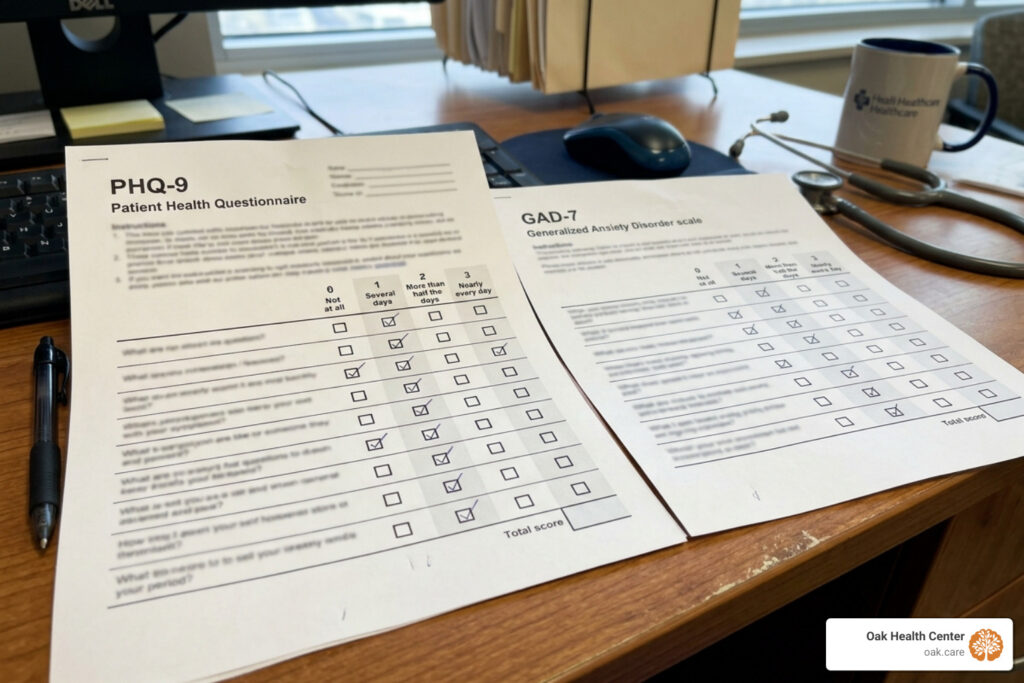
When you visit a healthcare provider, whether at one of our five Southern California locations or through a virtual consultation, you might be handed a short questionnaire. Often, this isn’t just one form, but two: the gad 7 and phq 9. These instruments are considered the “gold standard” for brief clinical assessments because they are evidence-based and align directly with the Diagnostic and Statistical Manual of Mental Disorders (DSM-5) criteria.
The PHQ-9 (Patient Health Questionnaire-9) is specifically designed to measure the frequency and severity of depressive symptoms. It covers nine core areas, including anhedonia (little interest in doing things), sleep disturbances, energy levels, and appetite changes. By contrast, the GAD-7 (Generalized Anxiety Disorder-7) focuses on the hallmarks of anxiety, such as uncontrollable worry, restlessness, irritability, and a sense of impending doom.
As noted by the National Mental Health Authority, these tools are incredibly user-friendly and field-tested in busy office practices. They were developed by Drs. Robert L. Spitzer, Janet B.W. Williams, and Kurt Kroenke with a grant from Pfizer in 1999. Because they are in the public domain, they have been translated into over 70 languages, making them accessible to diverse populations across California and the world.
Standard Cut-off Scores for gad 7 and phq 9
One of the most helpful aspects of the gad 7 and phq 9 is the standardized scoring system. Both tools use a “cut-off” method to help clinicians categorize the severity of a patient’s symptoms. This allows us to move beyond vague feelings and look at concrete data points.
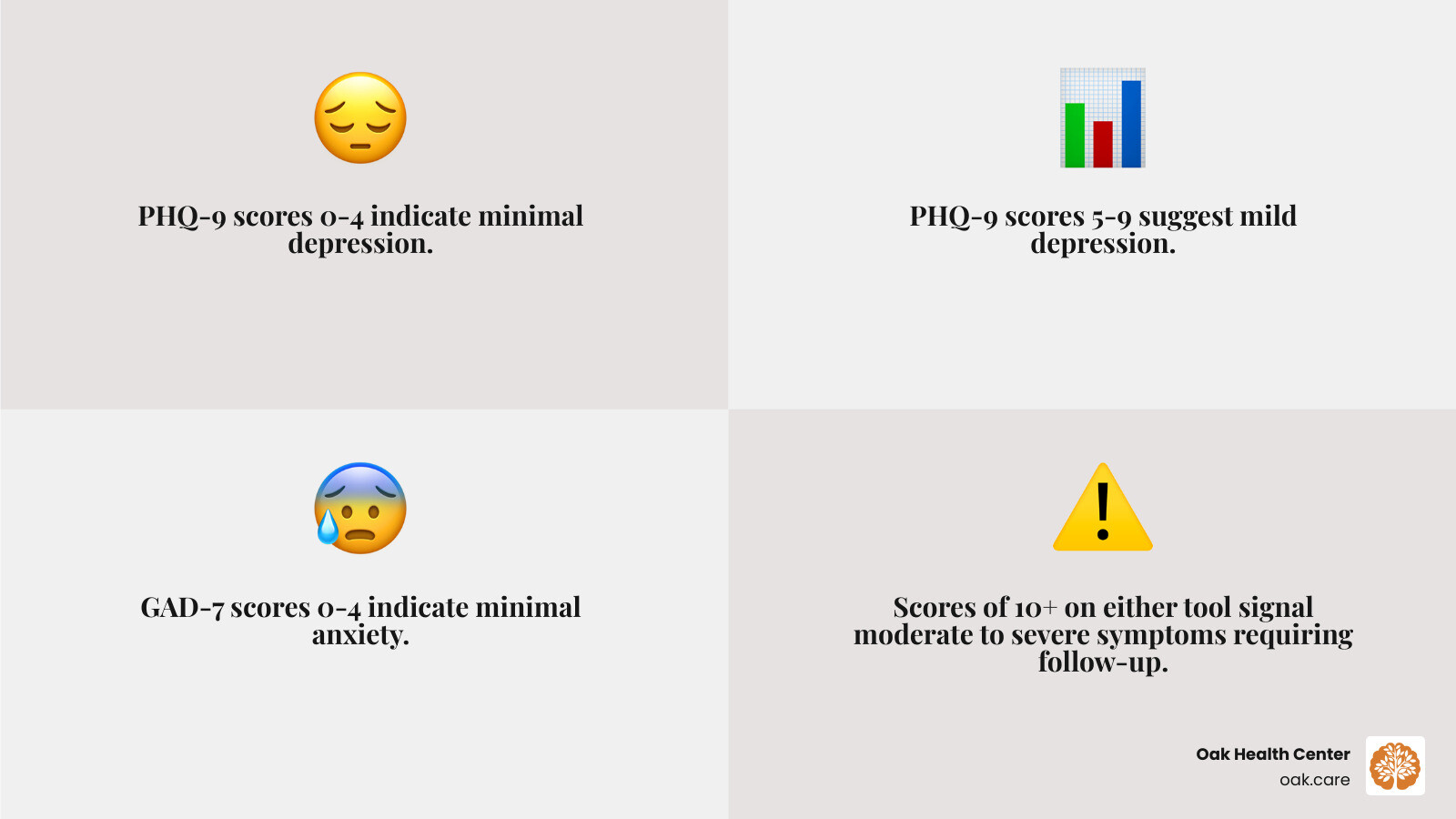
For the PHQ-9, the total score ranges from 0 to 27. The generally accepted severity categories are:
- 0–4: Minimal or no depression
- 5–9: Mild depression
- 10–14: Moderate depression
- 15–19: Moderately severe depression
- 20–27: Severe depression
The GAD-7 follows a similar logic with a total score range of 0 to 21:
- 0–4: Minimal anxiety
- 5–9: Mild anxiety
- 10–14: Moderate anxiety
- 15–21: Severe anxiety
In clinical research, a cut-off score of 10 is often used as the “yellow flag” for both instruments. For example, a PHQ-9 score of 10 or higher has demonstrated an 88% sensitivity and 88% specificity for major depression. However, some studies on specific populations, such as university students, suggest that a slightly lower cut-off of 9 for the GAD-7 may be more effective at identifying those at risk.
Administration and Scoring: How to Interpret Your Results
The beauty of the gad 7 and phq 9 lies in their simplicity. They are self-administered, meaning you fill them out yourself based on your own internal experience. Each item asks how often you have been bothered by a specific problem over the last 2 weeks.
You choose from four frequency-based responses:
- Not at all (0 points)
- Several days (1 point)
- More than half the days (2 points)
- Nearly every day (3 points)
After you finish the questions, the points are summed to create your total score. If you find your scores are in the moderate to severe range, it may be time to consult with a professional. At Oak Health Center, we use these scores to help guide our psychiatry services, ensuring that your treatment plan is tailored to the actual intensity of your symptoms. You can find more details on these scoring guidelines to see how clinicians tally the results.
Interpreting the Functional Impairment Question
There is one final question on both the PHQ-9 and GAD-7 that doesn’t add points to your numerical score but is arguably the most important for your doctor. It asks: “How difficult have these problems made it for you to do your work, take care of things at home, or get along with other people?”
This is known as the functional impairment question. It acts as a global indicator of your quality of life. You might score a “moderate” 12 on the PHQ-9, but if you mark that these symptoms make life “Extremely difficult,” it tells us that your symptoms are having a profound impact on your ability to function. Conversely, someone might have a higher symptom score but still be “Not difficult at all” in their daily functioning. This distinction helps us prioritize care and determine if immediate intervention, such as psychotherapy or medication management, is necessary.
The Science of Screening: Reliability and Validity
You might wonder if a simple 7 or 9-question form is actually accurate. The answer is backed by significant scientific data. In psychometrics, we look for two things: reliability (does the test give consistent results?) and validity (does it measure what it claims to measure?).
The gad 7 and phq 9 excel in both areas. For instance, research conducted on university student populations—who often face high stress—showed a Cronbach’s alpha (a measure of internal consistency) of 0.86 for the PHQ-9 and 0.91 for the GAD-7. These are very high scores, indicating the tools are highly reliable.
Furthermore, Confirmatory Factor Analysis (CFA) has confirmed that both tools have a strong one-factor structure. This means the PHQ-9 is excellent at isolating depression, and the GAD-7 is excellent at isolating anxiety. In studies comparing these tools against more intensive clinical interviews like the CIS-R, the PHQ-9 (at a cut-off of 10) showed 71% sensitivity and 66% specificity for recognizing students at risk. The GAD-7 (at a cut-off of 9) showed 73% sensitivity and 70% specificity. These stats prove that while the forms are short, they are mathematically powerful. You can view a fillable version of the form to see the structure for yourself.
Clinical Limitations and the Importance of Follow-Up
While we love the gad 7 and phq 9 for their efficiency, they are not perfect. It is vital to remember that these are screening tools, not diagnostic tools. A high score on the PHQ-9 does not automatically mean you have Major Depressive Disorder; it means you have symptoms that warrant a conversation with a professional.
One limitation is the risk of “false positives.” Because the tools have lower specificity in certain populations, someone might score high due to temporary situational stress (like finals week for a student or a difficult project at work) without actually meeting the clinical criteria for a chronic mental health disorder.
The most critical part of the PHQ-9 is Item 9, which asks about thoughts of self-harm or being better off dead. This is a “red flag” item. If a patient scores anything above a 0 on Item 9, or even if they leave it blank, clinical protocol requires an immediate safety assessment. At Oak Health Center, we take this very seriously. If you’re unsure if your symptoms require this level of attention, we have resources to help you determine when it’s time to see a psychiatrist.

Practical Implementation: Tips for Clinicians and Students
In practice, the gad 7 and phq 9 are often used to bridge the “diagnostic gap”—the space between a person feeling “off” and receiving help. For students in California, the prevalence of these symptoms is notable. Recent data showed that 45% of students scored in the moderate-to-severe range on the PHQ-9, and 38% on the GAD-7. Furthermore, nearly 30% of students reported suicidal ideation on Item 9, highlighting the need for proactive screening.
For those who feel their symptoms are deeply intertwined, clinicians sometimes use a composite measure called the PHQ-ADS. This combines the scores of both the PHQ-9 and GAD-7 into a single number to represent overall “psychological distress.” This can be helpful because it acknowledges that depression and anxiety often feed into each other.
If you are preparing for a mental health check-up, you can get a head start by looking at our intake questionnaire form or reading about what to expect in your first therapy appointment. Being familiar with these tools can make the process feel much less intimidating.
Why Doctors Pair the gad 7 and phq 9
Why not just pick one? The primary reason is comorbidity. In mental health, depression and anxiety are like two sides of the same coin. They co-occur so frequently (30–50% of the time) that screening for only one would mean missing half the picture for many patients.
Clinicians often refer to the “SAD triad”—the co-occurrence of Somatic (physical), Anxiety, and Depressive symptoms. By using both the gad 7 and phq 9, we can:
- Identify the “Internalizing Construct”: This is a fancy way of saying we look at the broad “negative affect” or emotional distress you are feeling.
- Monitor Treatment Progress: These tools aren’t just for the first visit. By taking them every few weeks, we can see if your scores are dropping, which tells us if your therapy or medication is working.
- Improve Efficiency: It takes less than five minutes to complete both. In a busy medical environment, this is the fastest way to ensure no one’s mental health needs fall through the cracks.
Frequently Asked Questions about Mental Health Screeners
Can the PHQ-9 or GAD-7 provide a formal diagnosis?
No. These tools are designed to screen for symptoms and measure their severity. A formal diagnosis requires a clinical interview with a licensed professional who considers your medical history, physical health, and life circumstances. They are the “thermometer,” not the “diagnosis.”
What should I do if I score high on both assessments?
A high score on both indicates significant emotional distress. Since anxiety and depression often overlap, this is very common. The best next step is to schedule an evaluation with a mental health professional. They can help determine if you are dealing with comorbid conditions and create a comprehensive treatment plan that addresses both.
Are these screening tools free for public use?
Yes. The PHQ-9 and GAD-7 are in the public domain. This means they are free to download, print, and use by both patients and clinicians without paying a licensing fee. This accessibility is part of why they have become the industry standard for mental health screening.
Conclusion
The gad 7 and phq 9 are powerful allies in the journey toward mental wellness. They provide a clear, objective vocabulary for feelings that often feel vague or overwhelming. Whether you are a student navigating the pressures of university life or an adult managing the complexities of work and home, these tools offer a snapshot of your mental health that can lead to life-changing support.
At Oak Health Center, we believe that mental healthcare should be accessible and compassionate. With five locations across Southern California—including Beverly Hills, Fullerton, Laguna Hills, Rancho Cucamonga, and South Pasadena—as well as virtual services throughout the state, we are here to help you interpret your results and take the next step.
If your scores have been weighing on you, don’t wait for things to get “worse” before seeking help. You can schedule a psychotherapy appointment today and start turning those scores into a plan for recovery.