

BrainsWay Deep TMS: A Treatment Option for Depression
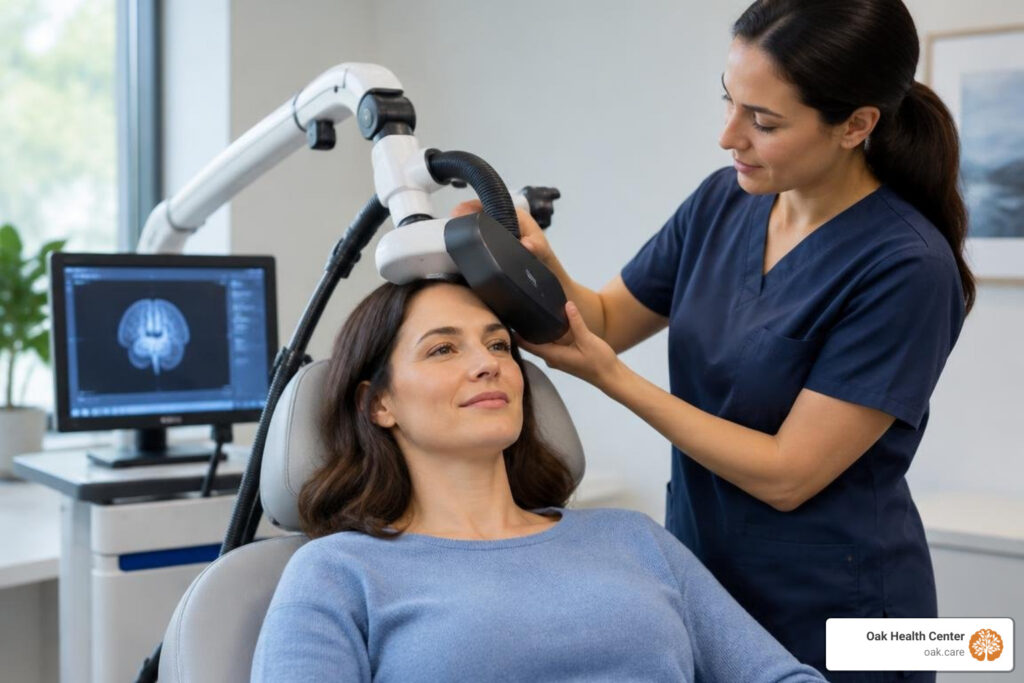
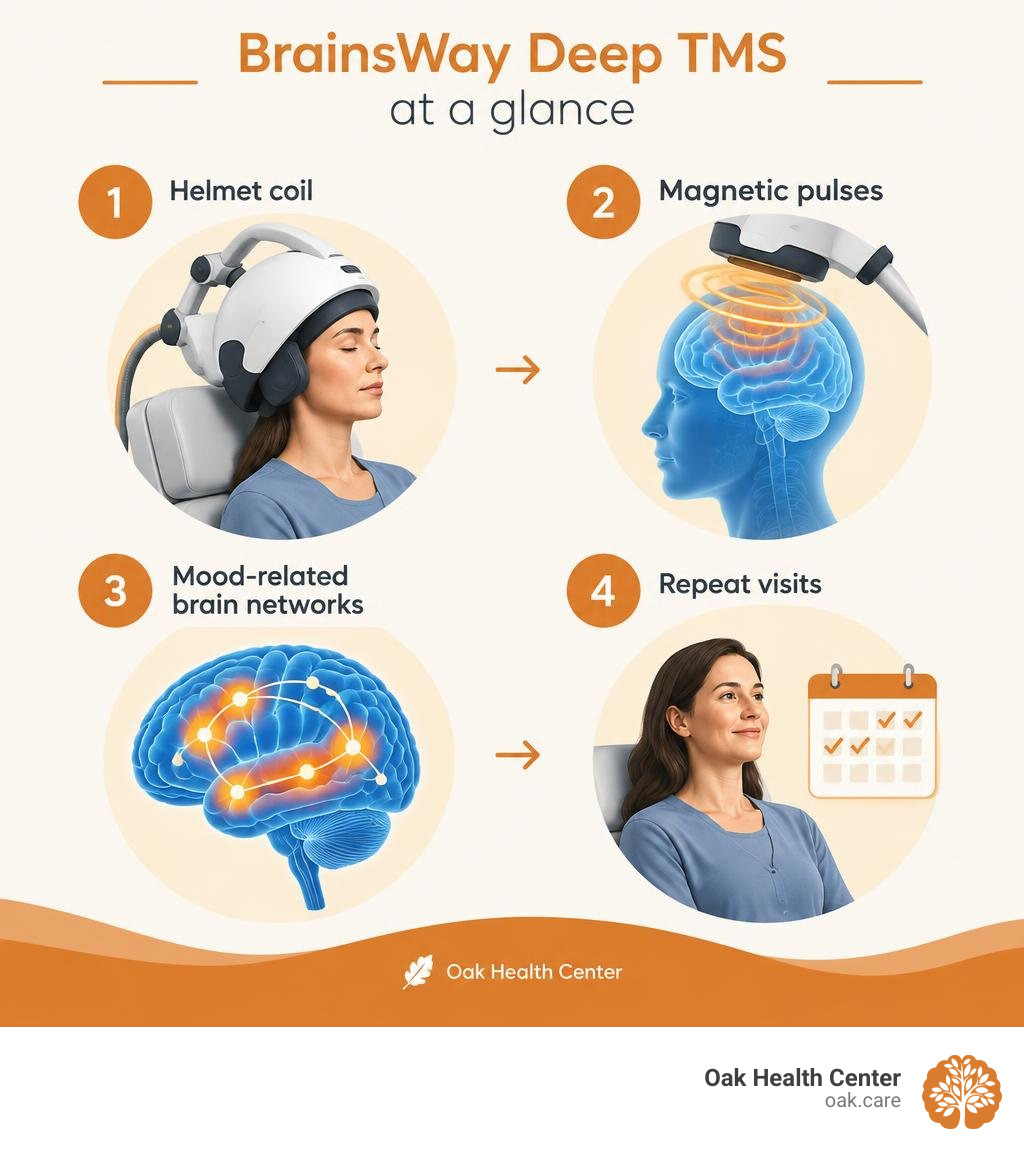
BrainsWay Deep TMS is a noninvasive treatment for adults with major depression that has not improved enough with antidepressant medication. A coil in a helmet sends magnetic pulses that stimulate brain networks involved in mood. Treatment does not require anesthesia, and patients can usually return to their day afterward.
The guide below explains how the treatment works, what a course of care may involve, and what the evidence says about its benefits and risks.
I’m Andrew Brewer, Practice Manager at Oak Health Center. I’ve helped our clinical team develop and expand TMS services, and I’ll use that experience to put brainsway deep tms research into clear, practical terms.
Understanding Brainsway Deep TMS: Mechanism and Coil Architecture
Clinical neuromodulation operates on a simple principle of neurophysics: rapidly alternating magnetic fields pass through the skull without resistance, inducing gentle electrical fields in underlying neural tissue. When these electrical currents reach cortical neurons, they trigger action potentials, depolarizing neuronal membranes and encouraging synaptogenesis across dysregulated mood circuits.
Traditional neuromodulation forms the foundation of modern transcranial magnetic stimulation. However, standard systems sometimes struggle to reach deeper structural hubs without creating intense surface stimulation. BrainsWay Deep Transcranial Magnetic Stimulation (dTMS) addresses this anatomical challenge through patented, multi-channel coil geometries housed in a cushioned helmet.
Rather than focusing on a single point of cortical tissue, dTMS utilizes specialized H-coil configurations that wrap around the cranium. These coils generate overlapping magnetic vectors that summate at depth while minimizing electric field decay along superficial layers. This broader, deeper field activates extensive cortico-limbic networks, including connections between the dorsolateral prefrontal cortex (DLPFC) and deeper subgenual cingulate structures responsible for emotional regulation.
The Physics of H-Coils vs. Traditional Figure-8 Coils
To appreciate how dTMS functions, it helps to examine how TMS therapy works for depression across different hardware designs. Conventional TMS platforms typically rely on planar, figure-8 coils (sometimes called butterfly coils). These coils create concentrated, focal stimulation where two circular wire loops meet.
While focal stimulation is precise, standard figure-8 coils experience rapid electrical field attenuation as distance from the scalp increases. Attempting to reach deeper structures by increasing stimulator intensity on a figure-8 coil often produces uncomfortable superficial nerve and muscle stimulation.
In contrast, the BrainsWay H-coil uses non-planar winding geometries oriented along multiple planes. This spatial distribution reduces the buildup of charge accumulation on the brain’s surface. As a result, the electric field decays much more gradually with depth, stimulating a wider anatomical volume without causing excessive discomfort on the scalp.
| Specification / Parameter | Standard Figure-8 Coil | BrainsWay H1-Coil (Deep TMS) |
|---|---|---|
| Effective Stimulation Depth | ~1.5 cm into cortical tissue | Up to 4.5 cm below cortical surface |
| Stimulation Field Geometry | Highly focal point | Broad, volumetric, bilateral spread |
| Tolerance to Positioning Variation | Low (requires millimeter precision) | High (broader field accounts for anatomical variation) |
| Structure Target Capacity | Superficial cortical convexities | Deep cortical sulci & white-matter tracts |
| Apparatus Housing | Articulating arm positioned by technician | Ergonomic helmet with integrated cooling |
Penetration Depth: Stimulating 4.5 cm Below the Cortical Surface
Standard figure-8 coils deliver therapeutic electrical fields approximately 1.5 cm beneath the skull. While this reaches superficial convexities of the prefrontal cortex, many critical nodes of the brain’s emotional circuitry reside further inward within deep cortical sulci.
Peer-reviewed research into Treating Clinical Depression with Repetitive Deep Transcranial Magnetic Stimulation Using the Brainsway H1-coil (Feifel & Pappas, 2016) confirms that at 120% of the patient’s motor threshold, the H1-coil generates an electric field reaching up to 4.5 cm deep.
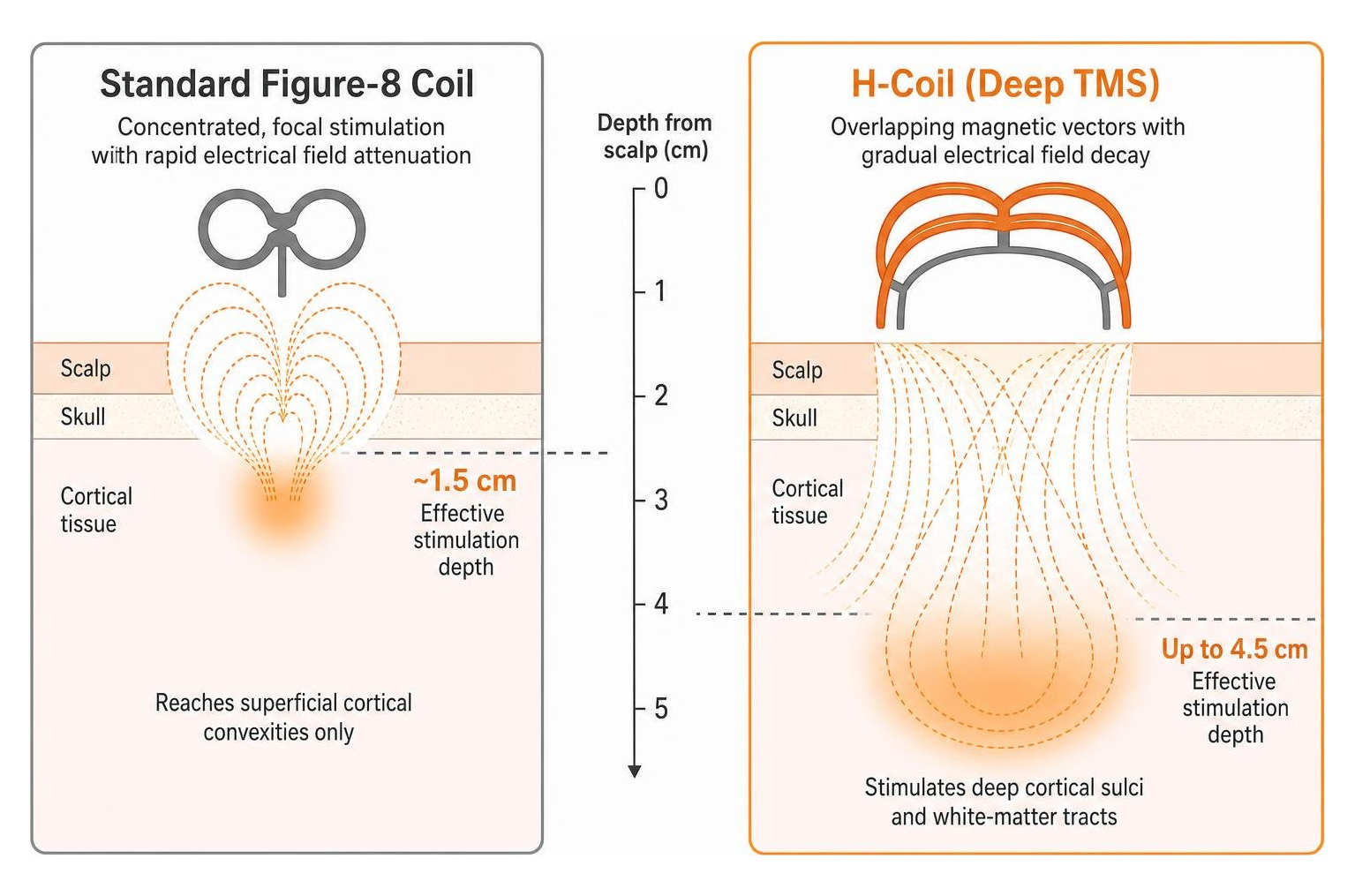
This depth enables direct modulation of deeper prefrontal axons and lateral networks. By recruiting both superficial and deeper neuronal pathways simultaneously, dTMS engages broader cortico-striatal-thalamic-cortical loops, offering a distinct physical approach for patients with complex mood disorders.
Clinical Indications, FDA Clearances, and Efficacy Evidence
For individuals navigating treatment-resistant illness, understanding what treatment-resistant depression really means is often the first step toward exploring advanced therapies. BrainsWay Deep TMS holds clearances from the U.S. Food and Drug Administration (FDA) across multiple indications, established through rigorous clinical trials and formal 510(k) Premarket Notification regulatory pathways.
The system was first FDA-cleared for Major Depressive Disorder (MDD) in adult patients who failed to achieve satisfactory improvement from prior antidepressant medications in their current depressive episode. It serves as a vital non-pharmacological pathway for individuals seeking sustainable mood stabilization.
Clinical Evidence Supporting Brainsway Deep TMS for Depression
The clinical benchmark for dTMS in major depression was established in a pivotal double-blind, multicenter, randomized, sham-controlled trial led by Levkovitz and colleagues. In this study of 181 patients with treatment-resistant depression, individuals receiving active dTMS demonstrated statistically significant improvements compared to sham controls.
As detailed in clinical literature on Treating Clinical Depression with Repetitive Deep Transcranial Magnetic Stimulation Using the Brainsway H1-coil – PMC (Feifel & Pappas, 2016), active dTMS produced a significantly higher remission rate (defined as a Hamilton Depression Rating Scale [HDRS-21] score below 10; p = 0.0051) than sham treatment.
Patients often begin exhibiting measurable reductions in depressive symptoms after 3 to 4 weeks of consistent sessions, with full therapeutic response or remission frequently consolidating around weeks 5 and 6. For patients exploring our ultimate guide to treatment-resistant depression, these multi-center findings demonstrate the clinical viability of deep neurostimulation.
Expanding Clearances: OCD and Other Neuropsychiatric Conditions
Beyond major depression, the versatility of H-coil architecture has allowed BrainsWay to expand its therapeutic scope across neuropsychiatric medicine. In June 2019, the FDA cleared Deep TMS for the treatment of Obsessive-Compulsive Disorder (OCD), utilizing a specialized H7-coil configuration.
While the H1-coil targets lateral prefrontal pathways for depression, the H7-coil directs magnetic fields toward the medial prefrontal cortex and anterior cingulate cortex—neural structures central to OCD symptom pathways.
Clinical research is also examining dTMS applications for post-traumatic stress disorder (PTSD), smoking cessation, and bipolar depression, underscoring how breaking the resistance with new depression treatments continues to advance outpatient psychiatric care.
Treatment Protocols: High-Frequency vs. iTBS Theta Burst
To maximize flexibility for busy patients, dTMS offers multiple validated stimulation protocols. As documented in the Brainsway 510(k) FDA clearance summary (K203735), modern systems can deliver both traditional high-frequency stimulation and rapid intermittent theta-burst stimulation (iTBS).
Comparing Standard 18 Hz and Accelerated Brainsway Deep TMS Protocols
Historically, standard dTMS for depression utilized an 18 Hz high-frequency protocol. Each session delivered 1,980 pulses over approximately 20 minutes (2-second pulse trains separated by 20-second inter-train intervals across 55 total sequences).
On April 23, 2021, the FDA cleared the BrainsWay iTBS protocol following a comprehensive non-inferiority clinical trial. In this study, 66 subjects received iTBS and 80 subjects received standard high-frequency dTMS. The trial established that delivering 600 pulses via iTBS over just 3 minutes produced clinical outcomes non-inferior to the classic 20-minute protocol (measured by changes in HDRS-21 scores within a predetermined 3-point margin).
| Protocol Parameter | Standard High-Frequency (18 Hz) | Accelerated iTBS Protocol |
|---|---|---|
| Session Duration | ~20 minutes, 10 seconds | ~3 minutes, 9 seconds |
| Total Pulses per Session | 1,980 magnetic pulses | 600 magnetic pulses |
| Stimulation Pattern | 18 Hz (2 sec on, 20 sec off, 55 trains) | 3-pulse bursts at 50 Hz, repeated at 5 Hz |
| Dosing Intensity | 120% of Resting Motor Threshold | 120% of Resting Motor Threshold |
| Clinical Equivalence | Established clinical benchmark | Proven non-inferior on HDRS-21 |
The Step-by-Step H1-Coil Clinical Procedure and Motor Threshold Titration
Undergoing dTMS is an outpatient, step-by-step process designed around safety, comfort, and accurate dosing:
- Pre-Session Preparation: Patients remove metallic accessories, put in protective earplugs, and sit comfortably in an ergonomic treatment chair.
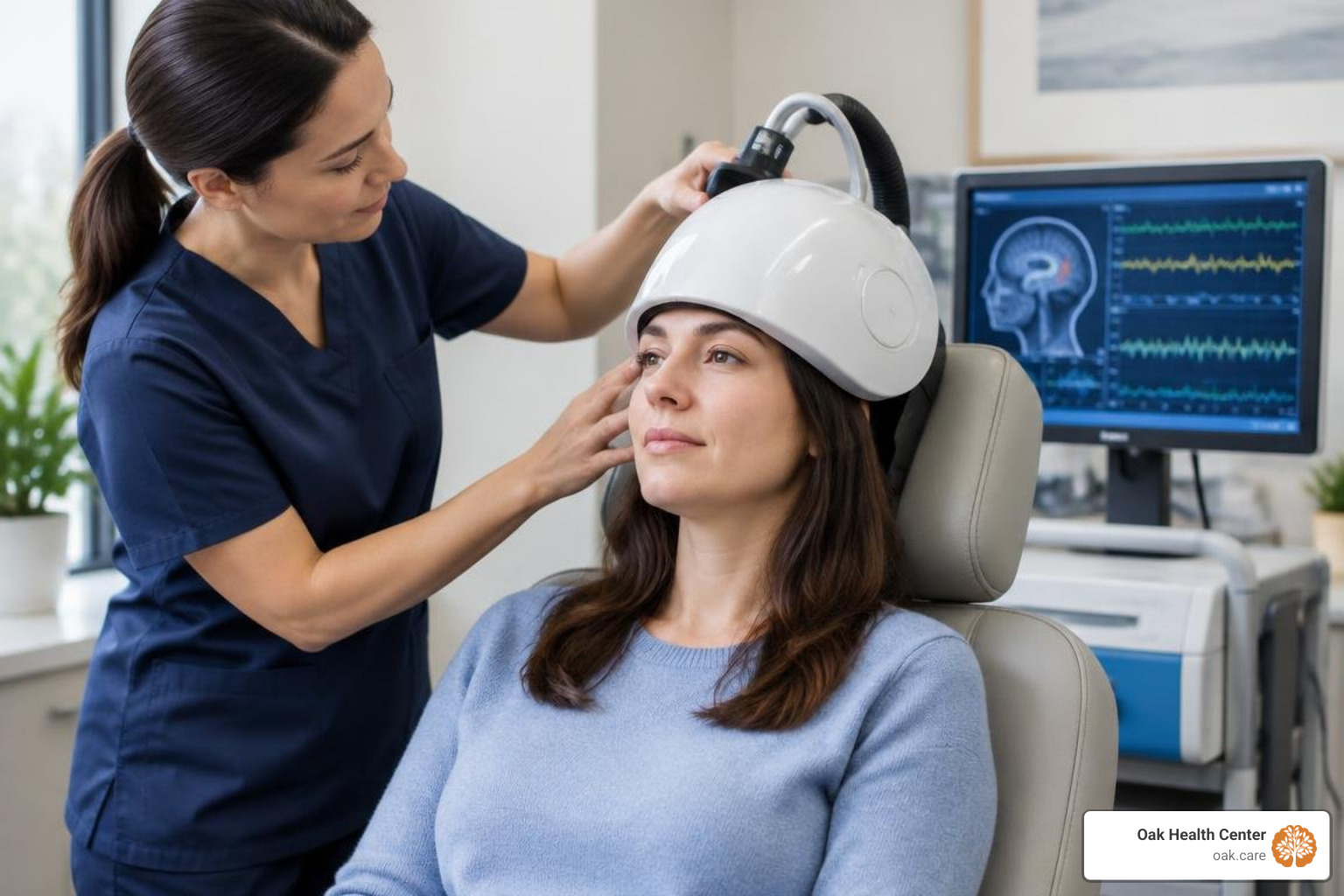
- Cap Placement and Measurement: A fitted cap is positioned on the patient’s head, marked with anatomical reference points along the nasion-inion axis to ensure consistent alignment.
- Motor Threshold (MT) Determination: The clinician delivers single test pulses over the motor cortex to find the patient’s resting motor threshold—the minimum stimulation intensity that elicits an involuntary twitch in the abductor pollicis brevis (thumb) muscle in at least 5 out of 10 trials.
- Targeting and Titration: The helmet is positioned over the left prefrontal cortex (typically 6 cm anterior to the motor hotspot). Stimulation intensity begins at 100% of MT during the initial session and titrates up to the target therapeutic dose of 120% MT over subsequent appointments.
- Treatment Delivery: The internal cooling system maintains helmet temperatures below 14°C while delivering treatment pulses. Clinicians recalibrate the motor threshold weekly to maintain precise dosing throughout the 6-week acute phase.
Safety Profile, Side Effects, and Comparative Outcomes
BrainsWay Deep TMS has a favorable safety profile supported by extensive international clinical trials. According to clinical consensus from the Anxiety and Depression Association of America, TMS is well-tolerated and free of the systemic complications often seen with oral medications, such as weight gain, sexual dysfunction, or gastrointestinal upset.
The most common side effects are mild and temporary:
- Localized scalp discomfort or mild tingling during stimulation
- Light tension headaches following early sessions (readily managed with over-the-counter pain relievers)
- Mild facial muscle twitching during active pulse trains
Because treatment does not involve sedation, patients do not experience post-treatment grogginess or memory disruption. With modern screening procedures, the risk of an induced seizure remains exceptionally low—under 0.1% across clinical populations.
Deep TMS as a Non-Invasive Treatment
dTMS is noninvasive and does not require general anesthesia, muscle relaxants, or post-treatment recovery periods. Patients can drive themselves to and from appointments and resume their normal daily schedules immediately.
When considering treatment options, reviewing a TMS therapy financial breakdown and costs helps clarify insurance coverage and authorization requirements across major commercial carriers and Medicare.
Ongoing Research: Insights from the ReDeeMD Clinical Trial
Academic institutions continue to compare different TMS modalities directly. A notable ongoing study is the ReDeeMD clinical trial (Repetitive Versus Deep Transcranial Magnetic Stimulation for Major Depression trial, ClinicalTrials.gov Identifier: NCT05902312).
This randomized controlled trial directly compares standard repetitive TMS using the 3-minute iTBS protocol (600 pulses) against Deep TMS using the 18 Hz protocol (1,980 pulses over 20 minutes) in patients with treatment-resistant depression.
Researchers are evaluating whether the deeper, broader magnetic field of the H-coil reduces positioning sensitivity and enhances response rates compared to standard focal coils. These comparative trials provide valuable objective data to help clinicians tailor neuromodulation protocols to individual patient needs.
Frequently Asked Questions About Deep Transcranial Magnetic Stimulation
How long does a standard BrainsWay Deep TMS course take?
A full acute treatment course consists of 30 sessions administered 5 days a week over 6 weeks. Following this acute series, clinicians may recommend a brief taper phase of 2 sessions per week for several weeks to help sustain long-term mood improvements.
What are the common side effects of BrainsWay Deep TMS?
Side effects are predominantly mild, localized, and transient. Patients occasionally report mild scalp tenderness, brief facial twitching during active pulses, or light headaches during the first week of care. These effects typically subside as the scalp adjusts to stimulation.
How does Deep TMS differ from traditional figure-8 TMS?
Traditional figure-8 TMS focuses magnetic fields onto a small, superficial point approximately 1.5 cm beneath the skull. BrainsWay Deep TMS uses specialized helmet-based H-coils that safely project up to 4.5 cm into neural tissue, stimulating deeper and broader mood-regulating circuits with less sensitivity to minor placement variations.
Conclusion
BrainsWay Deep TMS represents an important advancement in outpatient psychiatric care, pairing established electromagnetic principles with innovative coil engineering to reach deeper cortico-limbic networks. For adults who have not found adequate relief through standard medication or psychotherapy, dTMS offers a non-invasive, well-tolerated, and clinically proven path toward recovery.
At Oak Health Center, our clinical team delivers personalized mental healthcare across our Southern California centers—including Beverly Hills, Fullerton, Laguna Hills, Rancho Cucamonga, and South Pasadena—as well as through comprehensive virtual services statewide. If you or a loved one is navigating treatment-resistant depression, explore our comprehensive psychotherapy and psychiatric services to discover how targeted neurostimulation can support your path to lasting wellness.
References
David Feifel, Katherine Pappas. “Treating Clinical Depression with Repetitive Deep Transcranial Magnetic Stimulation Using the Brainsway H1-coil.” Journal of Visualized Experiments, 2016. DOI 10.3791/53858-v. Feifel D, Pappas K. “Treating Clinical Depression with Repetitive Deep Transcranial Magnetic Stimulation Using the Brainsway H1-coil..” Journal of visualized experiments : JoVE, 2016. PMCID PMC5092131.