


When Antidepressants Stop Working: What You Need to Know About Treatment-Resistant Depression
Treatment-resistant depression affects roughly 30% of people diagnosed with major depressive disorder — meaning millions of people take antidepressants as directed and still don’t feel better.
If that sounds familiar, here is a quick answer before we go deeper:
What is treatment-resistant depression?
Depression that does not improve after trying at least two different antidepressants at the right dose for 6–8 weeks each.
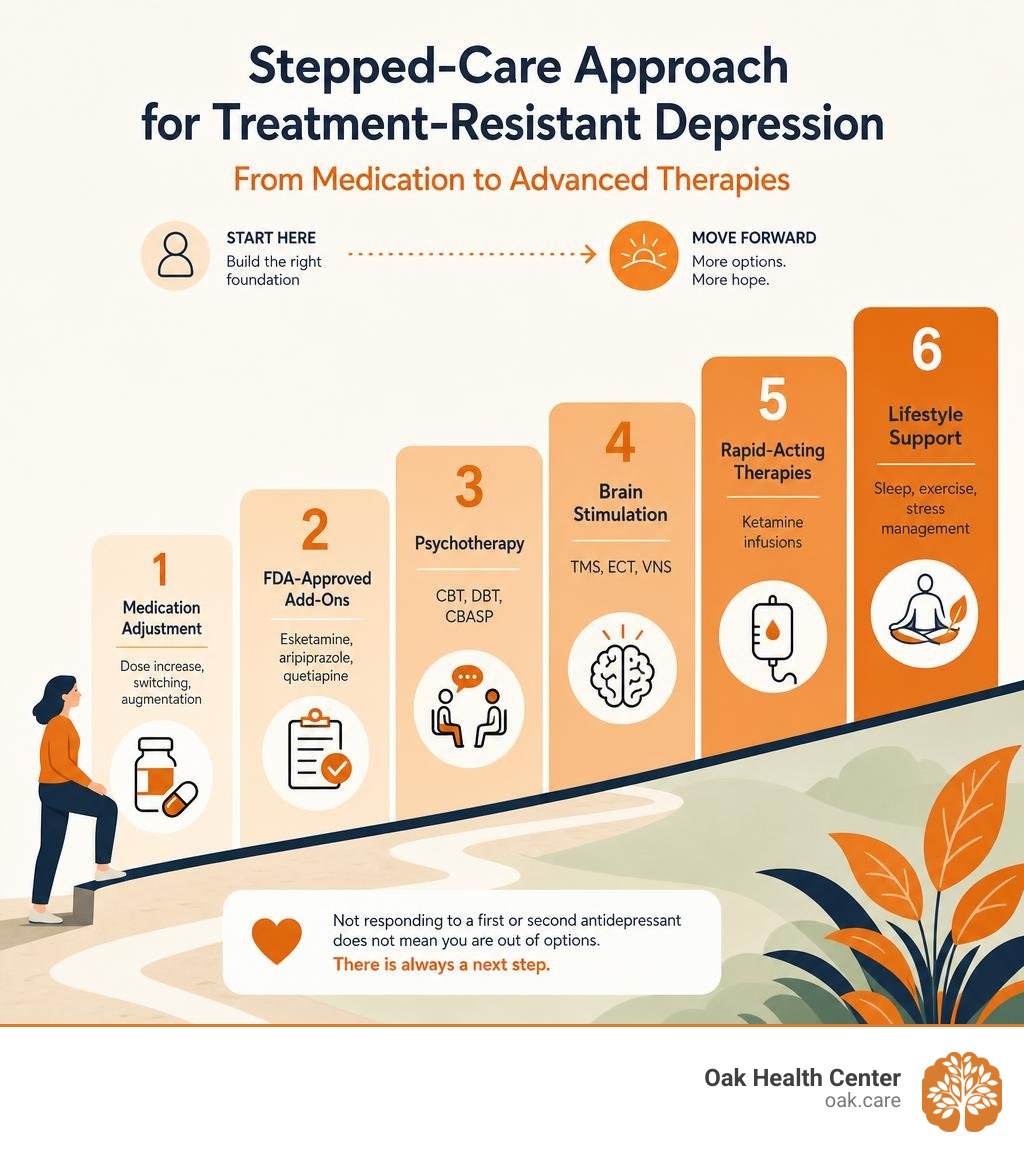
What are the main treatment options?
| Option | Examples |
|---|---|
| Medication adjustment | Dose increase, switching, augmentation |
| FDA-approved add-ons | Esketamine (Spravato), aripiprazole, quetiapine |
| Brain stimulation | TMS, ECT, VNS |
| Rapid-acting therapies | Ketamine infusions |
| Psychotherapy | CBT, DBT, CBASP |
| Lifestyle support | Sleep, exercise, stress management |
Not responding to a first or second antidepressant does not mean you are out of options. It means you likely need a more targeted approach.
Depression is already hard. Trying treatment after treatment without relief makes it harder — and it can leave you wondering if anything will ever work. That frustration is valid, and it is exactly why understanding what is actually happening in your brain and body matters so much.
This guide breaks down everything you need to know: how TRD is defined, what gets misdiagnosed, and which treatments have the strongest evidence behind them.
My name is Andrew Brewer, and I am the Practice Manager at Oak Health Center, where I have helped build and expand programs specifically designed to serve people living with treatment-resistant depression, including our TMS therapy program. My work sits at the intersection of operations and patient care, which means I have seen how the right clinical structure can make a real difference for patients who have felt stuck.
Treatment resistant depression glossary:
- alternative treatments for depression
- meds to treat depression
- depression during pregnancy treatment
Understanding Treatment Resistant Depression: Definition and Staging

When standard treatments fail to lift the heavy weight of depression, it is common to feel like you are doing something wrong. However, the reality is that the brain is a highly complex organ, and a one-size-fits-all approach to mental health rarely works.
In clinical terms, treatment-resistant depression (TRD) is defined as a major depressive episode that does not respond adequately to at least two different antidepressant treatments of adequate dose and duration. In most clinical guidelines, “adequate duration” means taking the medication consistently for at least 6 to 8 weeks.
While that sounds like a straightforward definition, the reality in the scientific community is far more complex. In fact, a landmark Frontiers in Psychiatry study on TRD definitions identified over 150 distinct definitions of TRD across clinical literature. This lack of a single, unified consensus means that how TRD is identified can vary from one clinic to another.
At Oak Health Center, we look beyond the mere counting of failed prescriptions to understand what TRD really means for your daily life. True resistance points to underlying biological differences in how your brain processes neurotransmitters, manages chronic inflammation, or responds to stress hormones.
How Common is Treatment Resistant Depression?
If you feel isolated in your struggle with depression, the numbers show you are far from alone. Approximately 30% of people diagnosed with major depressive disorder (MDD) experience treatment resistance.
To understand the trajectory of depression treatments, we often look to the Sequenced Treatment Alternatives to Relieve Depression (STAR*D) study, the largest and longest clinical trial ever conducted on depression treatments. The STAR*D trial revealed several crucial insights:
- First-Step Success: Only about 37% of patients achieved remission with their first antidepressant (citalopram).
- Cumulative Remission: After sequentially trying up to four different treatment steps over 14 months, the cumulative remission rate reached 67%.
- The Remaining Gap: This means that even after four optimized, sequential treatment trials, about 33% of patients did not achieve full remission.
- Chronic Symptoms: Furthermore, between 10% and 20% of individuals with MDD continue to experience significant, chronic depressive symptoms for two years or longer.
These statistics highlight why it is so important to seek specialized care. Understanding understanding TRD when standard treatments fail is the first step toward finding alternative, highly effective pathways that do not rely solely on traditional oral medications.
Staging Models and the Difficult-to-Treat Framework
To help psychiatrists navigate the complexities of TRD, several clinical staging models have been developed:
- The Thase-Rush Model: One of the earliest frameworks, which stages resistance from Stage 1 (failure of one major antidepressant class) up to Stage 5 (failure of multiple classes plus electroconvulsive therapy).
- The Maudsley Staging Method (MSM): A more multidimensional approach that scores the severity of resistance based on the number of failed treatment trials, the duration of the current depressive episode, and the severity of the symptoms.
While these models provide clinical structure, many modern mental health experts are shifting toward the Difficult-to-Treat Depression (DTD) framework. The DTD model is a compassionate, dimensional approach. Instead of focusing strictly on pharmacological “failures,” it treats depression as a chronic condition where the goal is to minimize symptom burden and maximize functional recovery.
By utilizing tools like the Sheehan Disability Scale (SDS), we can measure how depression impacts your work, social life, and family responsibilities, shifting the focus from perfect symptom elimination to helping you live a meaningful, active life.
The Diagnostic Challenge: Ruling Out Pseudo-Resistance

Before diagnosing someone with true, biologically driven treatment-resistant depression, we must rule out a very common phenomenon known as pseudo-resistance. Pseudo-resistance occurs when a patient appears to have treatment-resistant depression, but their lack of improvement is actually due to other, addressable factors.
According to the UpToDate clinical guidelines on TRD, a thorough diagnostic review is essential. The primary culprits behind pseudo-resistance include:
- Inadequate Dosing or Duration: The medication was never raised to a true therapeutic dose, or it was stopped before the 6-to-8-week window required to see a therapeutic effect.
- Suboptimal Medication Adherence: Studies show that non-adherence rates in major depression range from 30% to 60%. Patients often stop taking their medications or skip doses due to side effects, forgetfulness, or a feeling that the medicine isn’t working yet.
- Misdiagnosis: Sometimes, the underlying condition is not major depressive disorder. For example, individuals with undiagnosed bipolar disorder may experience severe depressive episodes that do not respond to standard unipolar antidepressants (and can sometimes even worsen with them).
- Co-occurring Medical Issues: Underlying physical conditions can mimic or severely worsen depression. A prime example is thyroid disease (such as hypothyroidism), which slows down metabolism and causes profound fatigue, brain fog, and low mood. Other conditions like chronic fatigue syndrome, autoimmune disorders, or vitamin D/B12 deficiencies must also be ruled out.
Identifying Co-occurring Conditions and Adherence Barriers
A key step in our psychiatric evaluations at Oak Health Center is identifying co-occurring mental health conditions that act as barriers to recovery. These include:
- Anxiety Disorders: Conditions like panic disorder, generalized anxiety disorder, or PTSD are highly comorbid with depression and significantly lower the response rate to standard therapies.
- Substance Use: Alcohol and recreational drugs alter brain chemistry and can completely neutralize the benefits of antidepressant medications.
- Undiagnosed ADHD: Chronic struggles with executive dysfunction and focus can lead to a persistent sense of failure, fueling a depressive cycle that standard antidepressants cannot fully resolve.
Additionally, biological differences play a massive role. Genetic variations in the CYP450 liver enzymes can cause up to a 10-fold variation in how rapidly your body metabolizes medications. A “normal” dose might leave one person with zero active drug in their system (ultra-rapid metabolizers) while causing toxic, unbearable side effects in another (poor metabolizers).
Through careful clinical assessment and, when appropriate, therapeutic drug monitoring, we can determine whether the issue is true biological resistance or an adjustment that needs to be made in your treatment plan.
Pharmacological Strategies for Managing TRD
When pseudo-resistance has been ruled out, we must adjust our pharmacological approach. Rather than repeatedly prescribing similar medications, we use targeted strategies to break through the treatment plateau.
| Strategy | Definition | When It Is Used | Pros & Cons |
|---|---|---|---|
| Dose Optimization | Raising the current medication to its maximum safe and tolerated dose. | When a patient has a partial response with minimal side effects. | Pros: Simple, avoids drug interactions. Cons: May increase side effects. |
| Switching Classes | Discontinuing the current medication and starting a drug from a completely different class. | When there is zero response to the current medication or side effects are intolerable. | Pros: Fresh biological mechanism. Cons: Requires a taper period; delay in relief. |
| Augmentation | Adding a non-antidepressant medication to your current antidepressant to boost its effect. | When a patient has a partial response but needs an extra boost to reach remission. | Pros: Fast-acting; targets multiple pathways. Cons: Risk of more side effects; drug interactions. |
To find the right biological path, it helps to understand the full landscape of meds to treat depression. If we decide to switch classes, we may look beyond standard SSRIs and SNRIs to older, highly potent classes like Tricyclic Antidepressants (TCAs) or Monoamine Oxidase Inhibitors (MAOIs). While MAOIs require dietary restrictions to avoid interactions, they remain some of the most effective tools for deeply stubborn depression.
Optimization, Switching, and Augmentation Protocols
Augmentation is often preferred over switching because it preserves any partial progress you have already made. Some of the most evidence-based augmentation strategies include:
- Second-Generation Antipsychotics (SGAs): Medications like aripiprazole, quetiapine, and brexpiprazole are highly effective when added to an antidepressant. Aripiprazole is often chosen first because it has a lower risk of causing drowsiness and weight gain compared to other atypical antipsychotics.
- Lithium Augmentation: Lithium is one of the most thoroughly researched augmentation agents in psychiatry. Studies show that adding lithium to an antidepressant reduces the odds of remaining ill by 56% to 95% and reduces overall suicide risk by an astonishing 88.5%.
- T3 Thyroid Hormone (Liothyronine): Even in patients with normal thyroid levels, adding a small dose of active T3 thyroid hormone can help “jumpstart” the brain’s metabolic and neurotransmitter pathways.
- Symbyax: This is a specialized, FDA-approved combination of olanzapine (an atypical antipsychotic) and fluoxetine (an SSRI) designed specifically for treatment-resistant depression and bipolar depression.
Advanced Brain Stimulation and Neuromodulation
When oral medications and psychotherapy are not enough, we look to the field of neuromodulation. These are advanced treatments that use magnetic fields or mild electrical currents to directly stimulate the brain networks involved in mood regulation.
At Oak Health Center, we are incredibly proud of Oak Health Center’s new TMS program, which brings state-of-the-art, non-invasive treatment directly to our Southern California communities. If you are curious about how this technology works, you can read our detailed breakdown of how TMS works for depression or explore our dedicated Transcranial Magnetic Stimulation services page.
Transcranial Magnetic Stimulation (TMS) and ECT
Let’s look at how these advanced neuromodulation therapies compare:
Repetitive Transcranial Magnetic Stimulation (rTMS)
rTMS uses an electromagnetic coil placed against the scalp to deliver focused magnetic pulses to the prefrontal cortex—the area of the brain that is underactive in people with depression.
- The Experience: You are fully awake, sitting comfortably in a chair, and can drive yourself home immediately after. There is no anesthesia or sedation required.
- Tolerability: It is exceptionally well-tolerated. The discontinuation rate due to side effects is only 4.5% (compared to over 25% for traditional oral antidepressants).
- Innovations: Modern protocols include Theta-Burst Stimulation (iTBS), which delivers the same therapeutic benefits as traditional 10Hz rTMS but reduces session times from 37 minutes down to just 3 minutes.
Electroconvulsive Therapy (ECT)
ECT is the gold standard for rapid, severe depression relief, particularly when there is an immediate risk of self-harm or catatonia.
- The Experience: It is performed under general anesthesia and muscle relaxants. A mild electrical current is passed through the brain to intentionally trigger a brief, controlled seizure.
- Efficacy: It is highly effective, with remission rates reaching 65% to 75% in severely ill patients.
- The Reality: Despite its high efficacy, a recent investigation of American health insurance databases found that only 0.25% of patients with a mood disorder receive ECT, largely due to social stigma, the need for anesthesia, and concerns over temporary short-term memory loss.
Vagus Nerve Stimulation (VNS) & Deep Brain Stimulation (DBS)
VNS involves surgically implanting a small device (similar to a pacemaker) that sends regular electrical pulses to the brain via the vagus nerve. It is typically reserved for long-term, highly chronic cases. DBS, which involves implanting electrodes directly into specific deep-brain structures, is currently being evaluated in clinical trials for the most severe, treatment-refractory cases.
Psychotherapy and Novel Emerging Therapies
While biological treatments are vital, true healing is rarely achieved through medicine alone. Combining advanced physical treatments with psychotherapy creates a synergistic effect that addresses both the hardware (the brain’s biology) and the software (thought patterns, coping mechanisms, and emotional processing).
At Oak Health Center, we offer comprehensive Psychotherapy services tailored to your unique journey. When standard treatments have fallen short, it is important to explore how alternative treatments for depression and holistic ways to treat depression can be woven together to build a robust, lasting recovery plan.
Integrating Psychotherapy with Rapid-Acting Treatments
For individuals with TRD, traditional talk therapy is adapted to focus on deep-seated cognitive patterns and behavioral change. Some of the most effective psychotherapeutic modalities for TRD include:
- Cognitive Behavioral Therapy (CBT): Helps identify and systematically dismantle negative, automatic thought patterns.
- Dialectical Behavior Therapy (DBT): Excellent for developing distress tolerance, emotional regulation, and mindfulness skills.
- Cognitive Behavioral Analysis System of Psychotherapy (CBASP): The only psychotherapy specifically designed for chronic depression, focusing heavily on interpersonal relationships and situational problem-solving.
By integrating these therapies with rapid-acting medical treatments, we can capitalize on periods of improved mood to build long-term relapse prevention strategies and positive lifestyle changes (such as sleep hygiene, regular exercise, and stress management).
The Promise of Ketamine and Psilocybin in Treatment Resistant Depression
The landscape of psychiatric medicine is undergoing a revolution, driven by rapid-acting, novel compounds that target entirely different neurotransmitter systems:
Ketamine and Esketamine (Spravato)
While traditional antidepressants target monoamines like serotonin and norepinephrine, ketamine targets glutamate, the brain’s primary excitatory neurotransmitter.
- Spravato (Esketamine): An FDA-approved nasal spray administered under clinical supervision. It has been shown to initiate rapid symptom relief—often within just two hours.
- Ketamine Infusions: Intravenous (IV) ketamine infusions are highly effective at rapidly reversing severe depressive symptoms and suicidal ideation, promoting rapid synaptic growth (synaptogenesis) in the brain.
Psilocybin Therapy
Psilocybin (the active compound in “magic mushrooms”) is currently undergoing rigorous clinical trials. It works by temporarily resetting hyperactive brain networks (specifically the Default Mode Network) and promoting massive neural plasticity. In 2023, Australia became the first country to approve psilocybin for TRD under highly controlled clinical settings, and research continues to show immense promise in California and across the United States.
These therapies, as detailed in the Cleveland Clinic’s overview of TRD, represent a monumental shift. By targeting neuroplasticity and reducing chronic neuroinflammation, they offer hope to individuals who previously felt they had run out of medical options.
Frequently Asked Questions about Treatment-Resistant Depression
Navigating the road to recovery can feel overwhelming. Here are answers to some of the most common questions our clinical team receives.
What is the difference between pseudo-resistance and true treatment-resistant depression?
Pseudo-resistance refers to a situation where a patient’s depression symptoms do not improve, but the cause is external to their biology—such as taking an inadequate dose of medication, stopping treatment too early, poor adherence, an incorrect diagnosis, or an untreated medical condition like hypothyroidism. True treatment-resistant depression occurs when a patient has taken at least two different classes of antidepressants at therapeutic doses for at least 6 to 8 weeks with perfect adherence, yet their brain biology does not respond to the medication.
How long should I wait to see if an antidepressant is working?
You should generally wait 6 to 8 weeks at a therapeutic dose to fully evaluate if an antidepressant is working. While some people notice mild improvements in sleep or energy within the first 2 weeks, it takes several weeks for the brain to undergo the structural and chemical changes necessary to lift a depressed mood. If you experience severe side effects or feel no change after several weeks, contact your psychiatrist to discuss dosage adjustments or alternative options.
Is ECT safe and how does it compare to TMS?
Yes, modern ECT is exceptionally safe and highly monitored. Unlike historical depictions, modern ECT is performed under general anesthesia and muscle relaxants, meaning the patient is completely asleep and feels no pain.
To compare the two:
- TMS is entirely non-invasive, performed while you are awake, has zero cognitive side effects, and allows you to immediately return to your daily routine.
- ECT is highly effective for severe, life-threatening depression, but requires anesthesia and can cause temporary, short-term memory loss or confusion.
Conclusion
Living with treatment-resistant depression can feel like an endless uphill battle, but a lack of response to standard treatments is not a sign of personal failure. It is simply an indication that your brain requires a different, more sophisticated therapeutic map.
At Oak Health Center, we specialize in providing comprehensive, compassionate, and highly personalized mental healthcare. With physical locations across Southern California—including Beverly Hills, Fullerton, Laguna Hills, Rancho Cucamonga, and South Pasadena—as well as convenient statewide virtual psychiatric services, we make accessing advanced support simple.
Whether you are interested in exploring our state-of-the-art TMS therapy, optimizing your medication regimen, or beginning tailored psychotherapy, our team is here to walk alongside you. You do not have to navigate this journey alone.
Schedule a psychiatric evaluation with us today, and let us help you find the effective, lasting relief you deserve.