

When Depression Doesn’t Get Better: Understanding Drug Resistant Depression Treatment
Drug resistant depression treatment is a critical topic for the millions of people who have tried antidepressants and still feel stuck.
Here is a quick overview of the main treatment options available:
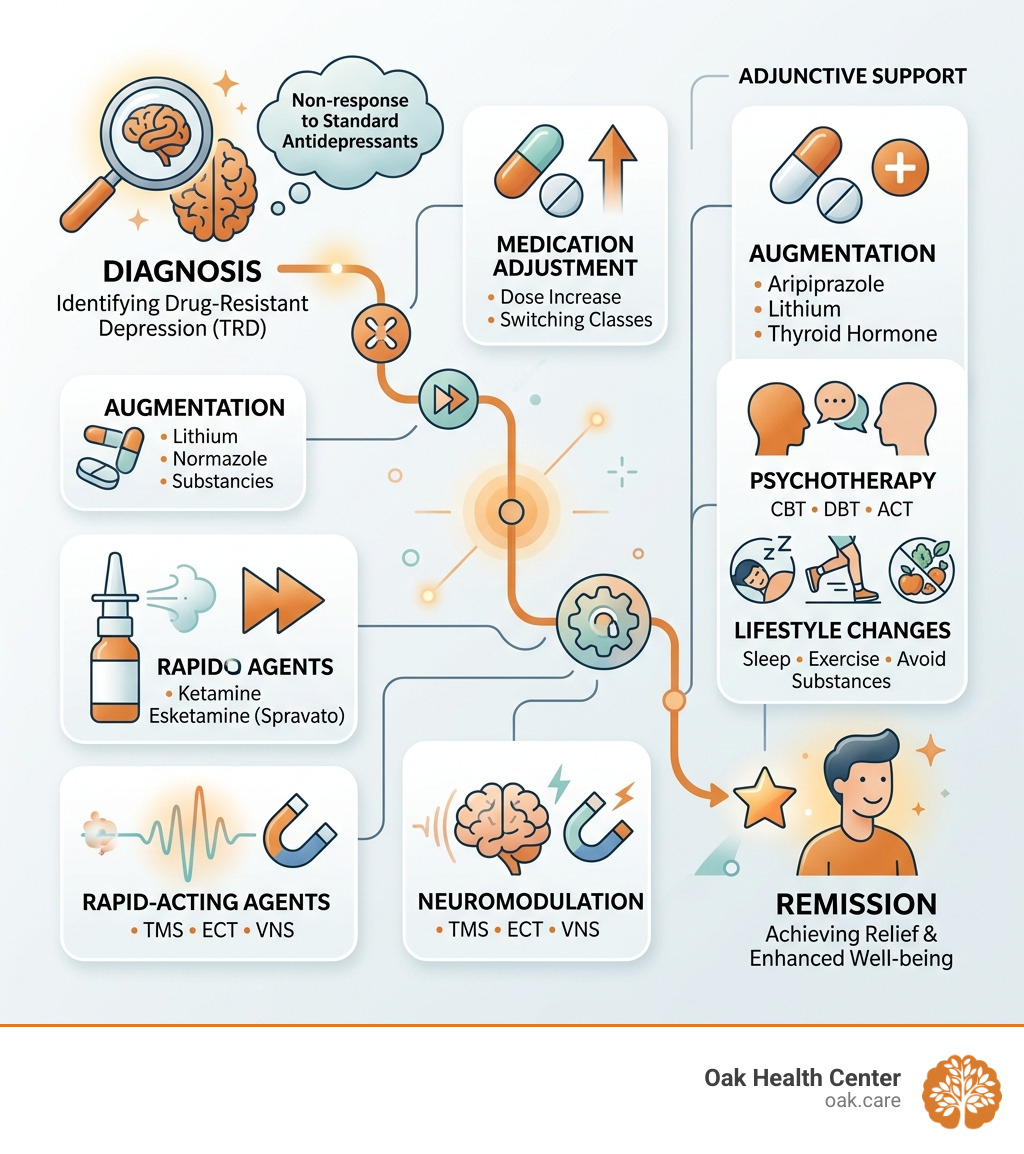
| Treatment Category | Examples | Best For |
|---|---|---|
| Medication adjustment | Dose increase, switching classes | Early-stage non-response |
| Augmentation | Aripiprazole, lithium, thyroid hormone | Partial responders |
| Rapid-acting agents | Ketamine, esketamine (Spravato) | Urgent or severe cases |
| Neuromodulation | TMS, ECT, VNS | Medication-resistant cases |
| Psychotherapy | CBT, DBT, ACT | Adjunctive support at any stage |
| Lifestyle changes | Sleep, exercise, substance avoidance | Ongoing self-management |
Depression is one of the most common mental health conditions in the world. But for roughly one in three people diagnosed with major depressive disorder, standard antidepressants simply do not provide enough relief.
That is not a personal failure. It is a clinical reality with a name — and, importantly, with real solutions.
Antidepressants typically take four to eight weeks to reach full effectiveness. Even then, large studies show that more than half of patients do not achieve full remission after two treatment attempts. If that sounds familiar, you are not alone — and you have not run out of options.
This guide walks you through every major path forward, from medication adjustments to advanced brain stimulation therapies, so you can have a more informed conversation with your care team.
I’m Andrew Brewer, Practice Manager at Oak Health Center, where I’ve helped build and expand programs — including TMS therapy — that directly serve patients navigating drug resistant depression treatment. My work focuses on making sure the right clinical resources are in place so that patients and providers can focus on what matters most: getting better.
Defining Treatment-Resistant Depression (TRD)
When we talk about drug resistant depression treatment, the first step is actually defining what we mean by “resistant.” In the clinical world, this is often called Treatment-Resistant Depression (TRD).

The most widely accepted definition of TRD is when a person has tried at least two different antidepressant medications, at a sufficient dose and for an adequate duration (usually 6-8 weeks), without achieving a satisfactory response or remission. This isn’t just a minor hurdle; statistics show that TRD occurs in approximately 30% to 50% of patients with major depression. In a landmark study of over 3,600 outpatients, recovery occurred in only 37% after the first trial, leaving a significant number of people looking for a “Plan B.”
It’s important to distinguish between “resistance” and “pseudo-resistance.” Sometimes, a medication doesn’t work because the dose was too low, it wasn’t taken consistently, or the diagnosis wasn’t quite right (for example, undiagnosed bipolar disorder can mimic standard depression but requires very different treatment).
At Oak Health, we believe that understanding treatment resistant depression is the key to unlocking the right care. You can also explore what treatment resistant depression really means to get a deeper sense of why the standard “one-size-fits-all” approach often fails. For those interested in the clinical framework, scientific research on TRD definitions highlights how complex these cases can be.
Medication Strategies for Drug Resistant Depression Treatment
If the first two antidepressants didn’t do the trick, we don’t just keep doing the same thing and expecting different results. We pivot. There are two primary pharmacological paths: switching and augmentation.
| Strategy | Action | Goal |
|---|---|---|
| Switching | Stopping the current med and starting a new one in a different class. | Finding a completely different biological pathway. |
| Augmentation | Keeping the current med and adding a second “booster” medication. | Creating a synergistic effect where 1+1=3. |
Switching Classes
If you’ve tried two SSRIs (like Zoloft or Lexapro) without luck, your doctor might suggest switching to an SNRI (like Effexor or Cymbalta) or even an older class like TCAs (Tricyclic Antidepressants). In a pooled analysis, remission occurred in 54% of patients who switched to venlafaxine compared to 45% who stayed within the SSRI class. Sometimes the brain just needs a different chemical “key” to unlock the door.
Synergistic Effects
Augmentation is often preferred when a patient has a partial response—meaning they feel 25% better, but not 100%. By adding a second agent, we can enhance the original medication’s effects. This is a core part of pharmacological treatments for TRD, which emphasizes that we shouldn’t give up on a medication that is doing some good.
Augmenting with Second-Generation Antipsychotics
One of the most effective “boosters” for drug resistant depression treatment is the use of second-generation antipsychotics (SGAs). While the name sounds intense, at low doses, these medications act as powerful antidepressants.
Commonly used SGAs include:
- Aripiprazole (Abilify)
- Quetiapine (Seroquel)
- Olanzapine (Zyprexa)
The data here is compelling. A meta-analysis of over 7,300 patients found that adding an SGA to an antidepressant resulted in a 40% greater response rate than adding a placebo. In the famous STAR*D study, adding aripiprazole led to a 29% remission rate, which was higher than switching to a different monotherapy.
However, we have to be mindful of side effects. These can include weight gain, metabolic changes, and akathisia (a distressing feeling of inner restlessness). We always weigh these risks against the benefit of lifting the depression. For a deep dive into these choices, check out these key considerations in pharmacological management.
The Role of Lithium and Thyroid Hormone in Drug Resistant Depression Treatment
Sometimes, the best tools are the ones we’ve had for decades. Lithium and thyroid hormone (T3) are classic augmentation strategies that remain highly effective for TRD.
- Lithium Carbonate: Long known as a mood stabilizer, lithium is particularly valuable because it has been shown to significantly reduce the risk of suicide in patients with TRD. It requires regular blood monitoring to ensure levels stay in a safe, effective range.
- Thyroid Hormone (T3/Triiodothyronine): Even if your thyroid tests are “normal,” adding a small dose of T3 can sometimes “jumpstart” the brain’s response to antidepressants. Research suggests patients receiving T3 are twice as likely to show a response.
These options are part of a nuanced approach to managing resistance and partial response, ensuring that every biological stone is unturned.
Advanced Interventional Procedures and Neuromodulation
When pills aren’t enough, we look toward interventional psychiatry. This is where some of the most exciting breakthroughs in drug resistant depression treatment have happened in the last decade. These treatments don’t rely on the digestive system; they target the brain directly.
Rapid Relief with Ketamine and Esketamine in Drug Resistant Depression Treatment
If standard antidepressants are a slow-moving freight train, ketamine is a jet engine. While traditional meds take weeks to work on the serotonin or norepinephrine systems, ketamine targets the glutamate system and NMDA receptors, promoting “synaptic plasticity”—essentially helping the brain regrow connections that depression has “pruned” away.
- Ketamine IV Infusion: Often provides relief within hours or days. It is known for its ability to rapidly reduce suicidal ideation.
- Esketamine (Spravato): An FDA-approved nasal spray for TRD. It must be administered in a doctor’s office because of its potential for temporary dissociative effects (feeling “trippy” or disconnected).
Many of our neighbors in Southern California have found success with these methods. You can find more ketamine therapy insights or learn about the specific Spravato therapy protocols to see if they fit your needs.
Brain Stimulation: rTMS, ECT, and VNS
Neuromodulation uses magnetic pulses or electrical currents to stimulate specific mood-regulating areas of the brain.
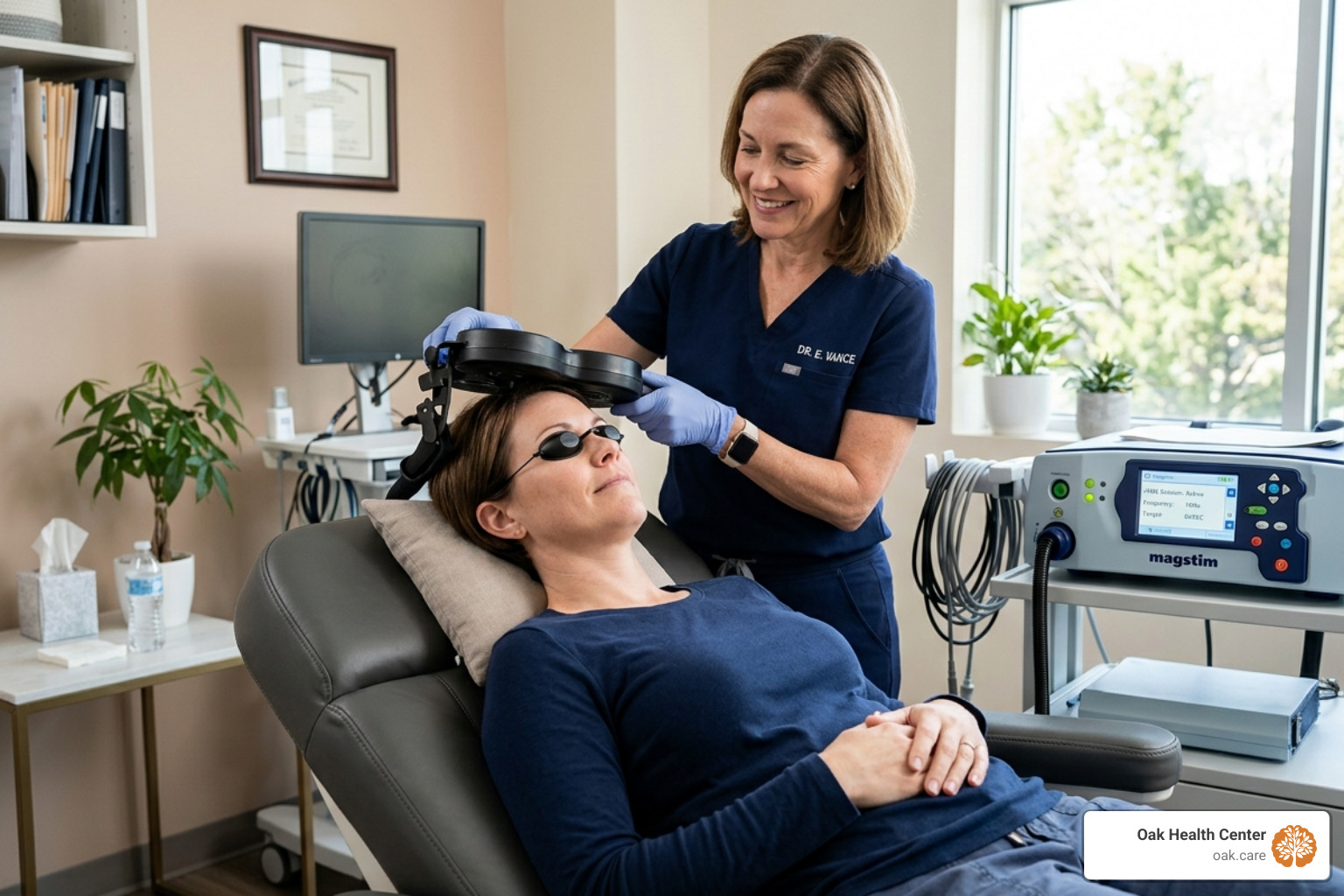
- Transcranial Magnetic Stimulation (TMS): This is a non-invasive, “awake” procedure. A magnetic coil is placed against the scalp, sending pulses to the prefrontal cortex. There is no anesthesia, no seizures, and you can drive yourself home afterward. At Oak Health, we’ve seen incredible results, which is why we’re so proud of our new TMS program launch. If you’re curious about the science, we’ve broken down how TMS therapy works.
- Electroconvulsive Therapy (ECT): Still the “gold standard” for the most severe, life-threatening depression. It is performed under general anesthesia and induces a brief, controlled seizure. While it has a stigma, modern ECT is safe and incredibly effective for those who have failed everything else.
- Vagus Nerve Stimulation (VNS): Involves a small device implanted under the skin (like a pacemaker) that sends regular pulses to the brain via the vagus nerve.
For those in the Southern California area, we offer comprehensive TMS services at our clinics to provide a local, accessible option for these advanced treatments.
Holistic Support: Psychotherapy and Lifestyle Changes
We often say that “pills don’t give you skills.” Even the most effective drug resistant depression treatment works better when paired with psychotherapy and healthy habits.
The Power of “Talk Plus Meds”
Psychotherapy is rarely enough on its own for TRD, but as an adjunctive treatment, it is vital.
- CBT (Cognitive Behavioral Therapy): Helps identify and change the “stuck” thought patterns that depression thrives on.
- DBT (Dialectical Behavior Therapy): Excellent for emotional regulation and managing suicidal thoughts.
- ACT (Acceptance and Commitment Therapy): Focuses on living a value-driven life even when symptoms are present.
Lifestyle as Medicine
Your brain is part of your body. If the body is under stress, the brain will struggle to heal.
- Sleep Hygiene: Insomnia is a major driver of depression. Fixing sleep can sometimes be the “secret ingredient” to making a medication work.
- Exercise: It’s not just about “endorphins”; exercise increases BDNF, a protein that acts like “Miracle-Gro” for brain cells.
- Substance Avoidance: Alcohol is a depressant. Using it to “numb” depression often makes the underlying condition much harder to treat.
- Stress Management: Techniques like mindfulness or yoga help lower cortisol, which can interfere with antidepressant response.
The Mayo Clinic’s guide to TRD emphasizes that these lifestyle changes aren’t just “nice to have”—they are essential components of long-term remission.
Frequently Asked Questions about TRD
How long should I wait for an antidepressant to work?
You should typically wait 4 to 8 weeks at a therapeutic dose. Many people stop too early because they don’t feel a change in the first ten days. Remember the “therapeutic threshold”—the medication needs time to build up and actually change the brain’s chemistry. If you feel nothing after 6 weeks, it’s time to talk to your doctor about a change.
What is pharmacogenetic testing for depression?
This is a simple cheek-swab test that looks at your genes (like CYP2D6 and CYP2C19) to see how your body metabolizes certain drugs. While it can’t tell us which drug will work, it can tell us which ones you might process too quickly (making them ineffective) or too slowly (making side effects more likely). It’s a tool for personalized prescribing.
When should I see a specialist for drug resistant depression treatment?
If you have tried two different antidepressants and are still struggling to function—whether that’s at work, in your relationships, or just getting out of bed—it is time to see a psychiatrist or a TRD specialist. Primary care doctors are great, but TRD often requires the specialized knowledge of someone who spends all day, every day, navigating these complex treatment algorithms.
Conclusion
Managing drug resistant depression treatment can feel like an exhausting journey, but the most important thing to remember is that the “resistance” belongs to the condition, not to you. With the right combination of medication, advanced interventional procedures like TMS or Ketamine, and a solid foundation of therapy and lifestyle support, remission is possible.
At Oak Health Center, we are dedicated to providing that comprehensive, compassionate care. Whether you visit us at our locations in Beverly Hills, Fullerton, Laguna Hills, Rancho Cucamonga, or South Pasadena—or connect with us through our virtual services across California—we are here to help you find the path that works for you.
We believe in shared decision-making. You are the expert on your life, and we are the experts on the clinical options. Together, we can aim for more than just “getting by”—we can aim for true remission. If you’re ready to explore the next step in your recovery, we invite you to learn more about our comprehensive psychiatry services. You don’t have to navigate this alone.