


Young Adults Are Struggling More Than Anyone Admits
Young adult therapy is professional mental health support designed for people ages 18 to 35 who are navigating the messy, high-pressure stretch of life between adolescence and full adulthood.
Here’s what you need to know at a glance:
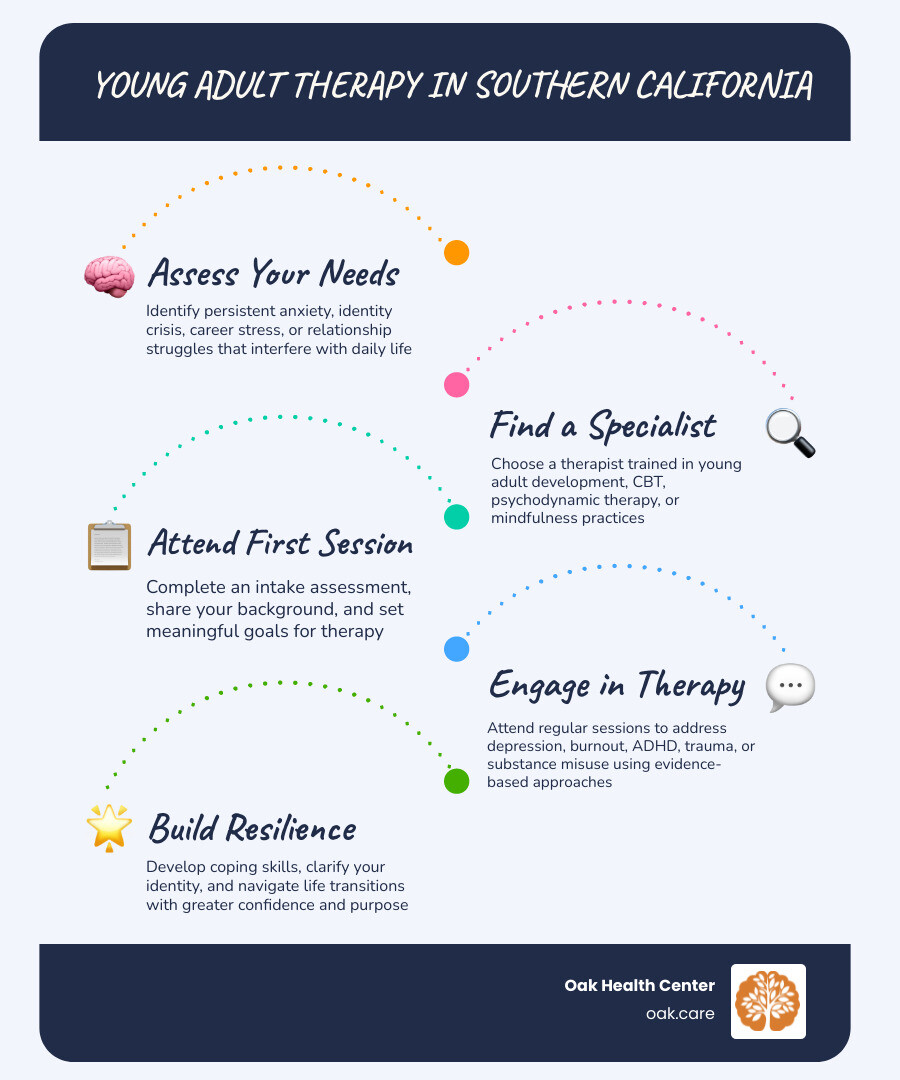
- Who it’s for: Anyone 18–35 dealing with anxiety, identity questions, career stress, relationship changes, or major life transitions
- What it addresses: Depression, burnout, ADHD, trauma, substance misuse, and the general overwhelm of “adulting”
- How it works: Regular sessions with a licensed therapist using approaches like CBT, psychodynamic therapy, or mindfulness
- Where to start: A consultation with a therapist who specializes in young adult development
Your twenties and early thirties are supposed to be exciting. But for a lot of people, they’re exhausting.
You’re figuring out your career, your relationships, your identity — sometimes all at once. And if you’re in Southern California, you’re doing it in one of the most , high-expectation environments in the country.
The pressure is real. And it’s more common than you think.
Many young adults are highly educated and constantly connected, yet still struggle to find purpose or feel like they’re falling behind. The transition to independence is far harder than most people anticipate — and existing mental health services often aren’t built with this specific age group in mind.
That’s exactly why young adult therapy exists.
I’m Andrew Brewer, Practice Manager at Oak Health Center, where I’ve helped grow our provider team and expand clinical programs to better serve patients — including the young adults who make up a significant part of our community. My work at Oak Health Center has given me a close-up view of how the right mental health support can genuinely change the trajectory of someone’s twenties.
What is Young Adult Therapy and Who is It For?

Young adult therapy is a specialized branch of mental healthcare tailored specifically to the developmental, emotional, and social needs of individuals aged 18 to 35.
It is a common misconception that therapy is only for those experiencing severe clinical crises. In reality, a significant portion of young adults seek therapy to navigate the everyday, heavy-hitting challenges of “adulting.” In a world dominated by curated social media feeds, young adults often find themselves trapped in comparison loops. You might look at your peers and think everyone else has their career, relationships, and finances perfectly figured out, leaving you feeling uniquely isolated.
This phase of life is marked by intense pressure to perform, succeed, and establish a permanent identity. Our self-selected peer groups—often filled with high achievers—can make us feel like we are constantly falling short. Young adult therapy provides a non-judgmental space to sift through these societal expectations and figure out what actually matters to you.
Here is a look at the most common stressors young adults face today:
- Identity and Purpose: Deciding who you want to be, uncovering your core values, and finding meaning beyond just paying bills.
- Academic and Career Pressure: Navigating high-stakes college environments, landing your first “real” job, or coping with corporate burnout.
- Relationship Dynamics: Managing dating app fatigue, establishing boundaries with family, navigating breakups, or coping with loneliness.
- Financial and Independence Stress: Dealing with high cost-of-living adjustments in Southern California, managing student debt, and stepping away from parental financial support.
- Mental Health Conditions: Managing diagnosed conditions like anxiety, depression, or late-identified ADHD.
How Young Adult Therapy Addresses Modern Stressors
In our modern landscape, young adults face a unique cocktail of existential anxiety and practical life changes. We live in a highly connected era, yet rates of loneliness and isolation among young adults are at historic highs. When you are transitioning into independent living or starting a new career, the lack of a built-in community (like the one you had in high school or college) can make life feel incredibly daunting.
Through our psychotherapy services, we help you build a personalized toolkit to manage these shifts. Therapy helps you address:
- Existential Anxiety: Sifting through the “What am I doing with my life?” questions without spiraling.
- Career Beginnings: Overcoming imposter syndrome and setting healthy boundaries between your work and personal life.
- Relationship Changes: Learning how to communicate your needs clearly in romantic partnerships, friendships, and professional settings.
- Moving Out: Adjusting to the quiet (and the responsibilities) of living on your own or navigating roommate conflicts.
Rather than just treating symptoms, our goal is to help you understand the root of your stress so you can build long-term resilience.
The Transition from College to the Workforce
The leap from college student to working professional is one of the most abrupt transitions a person can experience. In college, your life has a clear structure: syllabi tell you exactly what is expected, semesters have defined end dates, and your social circle lives within walking distance.
Once you graduate, that structure vanishes.
Many young adults experience a profound sense of grief and confusion after college. You may face the financial reality of moving back home with your parents to save money, which can trigger feelings of regression or a loss of autonomy. Alternatively, you might find yourself in a new city, trying to manage entry-level work stress while building a brand-new social network from scratch.
Therapy provides a crucial landing pad during this transition. It gives you a space to process the loss of your college identity, develop practical time-management strategies, and create a realistic roadmap for your career and financial independence.
Why Young Adult Therapy is Essential for Modern Life Transitions
We often think of adulthood as a light switch that magically flips on your 18th birthday. In reality, it is a long, gradual developmental process.
Neuroscientific research shows that the human prefrontal cortex, which governs decision-making, risk assessment, and emotional regulation, continues to develop until around age 25. This means that during the exact years you are expected to make major, life-defining decisions (like choosing a career path, taking on financial debt, or committing to long-term relationships), your brain is still actively under construction.
When you combine this biological reality with the systemic pressures of the modern world, it becomes clear why so many young adults feel overwhelmed. You are learning to navigate complex family dynamics, establish your own autonomy, and build a life that aligns with your values, all while your neurological foundation is still solidifying.
Why Young Adult Therapy is Distinct from Child or Geriatric Care
Therapy is not one-size-fits-all. The therapeutic approach that works for a child or an older adult is rarely effective for someone in their twenties or early thirties.
For children, therapy is often highly collaborative with parents and focuses heavily on behavioral modification or emotional expression. For older adults, therapy may focus on legacy, coping with physical health changes, or processing retirement.
Young adult therapy, however, is uniquely focused on:
- Identity Exploration: Actively figuring out who you are, independent of your parents’ expectations or societal pressures.
- Intense Self-Focus: Learning how to make decisions for yourself, establish boundaries, and take accountability for your choices.
- Navigating Instability: Developing coping mechanisms for a life stage characterized by frequent changes in housing, jobs, and relationships.
This transition requires a delicate balance of developing personal autonomy while still maintaining supportive connections. For those looking for specialized frameworks that bridge the gap from adolescence to early adulthood, finding comprehensive care models that support both young adults and their families during these pivotal years is essential.
Effective Modalities and Specialized Services for Young Adults
At Oak Health Center, we believe in utilizing evidence-based treatment modalities tailored to your unique goals. We don’t just sit and nod; we collaborate with you to find practical, actionable solutions. Some of the most effective therapeutic approaches we offer through our comprehensive Services include:
- Cognitive Behavioral Therapy (CBT): This is a highly practical, action-oriented approach. CBT helps you identify negative thought patterns (like “I’m going to fail at this job”) and challenge them, replacing them with more balanced, realistic perspectives. It is incredibly effective for anxiety, panic, and everyday stress management.
- Psychodynamic Therapy: If you find yourself repeating the same unhealthy relationship patterns or feeling held back by unexplained guilt or shame, psychodynamic therapy can help. This insight-oriented approach explores how your past experiences and early family dynamics influence your current behaviors.
- Mindfulness Practices: Mindfulness helps you anchor yourself in the present moment. This is especially useful for young adults who struggle with chronic overthinking, digital burnout, and existential dread.
- Specialized ADHD Support: Many young adults—particularly women—reach their twenties only to realize that their lifelong struggles with organization, focus, or emotional regulation are actually symptoms of late-diagnosed ADHD. We offer specialized assessments and behavioral coaching to help you understand your brain and build systems that actually work for you.
- Trauma-Informed Care & Substance Misuse Support: If you are carrying unresolved trauma or using substances like alcohol or drugs to cope with stress, we offer compassionate, specialized care to help you heal and build healthier coping mechanisms.
Navigating Logistics: First Sessions, Insurance, and Virtual vs. In-Person Care

Taking the first step to start therapy can feel overwhelming. Between figuring out insurance, choosing between virtual or in-person sessions, and finding a therapist you actually click with, there are plenty of logistical hurdles.
To help you weigh your options, here is a quick breakdown of how virtual and in-person sessions compare:
| Feature | Virtual Therapy (Teletherapy) | In-Person Therapy |
|---|---|---|
| Convenience | Extremely high; log in from home, work, or your car. No commute required. | Requires travel time and coordinating around Southern California traffic. |
| Privacy | Dependent on your environment; requires a quiet, private space of your own. | Guaranteed privacy in a secure, professional office setting. |
| Connection | Highly effective, though some prefer the physical presence of a therapist. | Offers a dedicated physical space away from your daily life to focus entirely on healing. |
| Scheduling | Often more flexible, making it easier to fit into busy college or work schedules. | Limited to office hours and physical room availability. |
What to Expect in Your First Session
Your very first session is primarily about getting to know each other. You don’t need to arrive with a perfect script of what you want to say.
During this initial meeting, your therapist will guide you through an intake process. They will ask about your background, your current stressors, and what you hope to get out of therapy. It is also your opportunity to “interview” the therapist to see if they feel like a good match for your personality and goals. To help ease your mind before you walk through our doors, you can read our detailed guide on What to Expect in Your First Therapy Appointment at Oak Health Center.
Choosing Between Teletherapy and In-Person Sessions
In Southern California, your schedule can get packed quickly. Between commuting, school, work, and trying to maintain a social life, finding an hour to drive to an office can be tough.
That is why we offer both options. Our teletherapy services allow you to meet with your therapist from anywhere in California, providing ultimate convenience. However, if you find that your home is too noisy or you prefer the focused, physical boundary of an office, we welcome you to visit us in person. You can explore our guide on Teletherapy vs In-Person: Which is Right for You? to help you decide which format fits your lifestyle best.
Regardless of which option you choose, working with a professional who understands your background is vital. We encourage you to learn about Why Culturally Competent Therapy Matters to see how our diverse Team respects and integrates your unique cultural background into your care plan.
Understanding Insurance and Costs
We believe that mental healthcare should be accessible and transparent. Navigating insurance can be incredibly confusing, especially if you are managing your own policy for the first time.
At Oak Health Center, we accept a wide variety of insurance plans to help keep your out-of-pocket costs as low as possible. If we are out-of-network for your specific plan, we can provide you with a “superbill”—an itemized receipt that you can submit to your insurance company for potential reimbursement. To check your benefits and see how we can work with your provider, please visit our Insurance page.
Frequently Asked Questions about Young Adult Therapy
How do I know if I need therapy or if this is just normal “adulting” stress?
It is completely normal to feel stressed, anxious, or tired occasionally. However, if your stress is causing functional impairment—meaning it is affecting your ability to perform at work or school, maintain relationships, or care for your physical health—it is time to seek support. Persistent anxiety, overwhelming sadness, or feeling “stuck” for weeks at a time are clear signs that therapy can help.
What should I expect during my first appointment?
You can expect a warm, welcoming environment where we focus on building a strong therapeutic alliance. Your therapist will ask about your background history, your current mental health symptoms, and your personal goals. This is a collaborative conversation, not an interrogation. For more details, check out our main FAQ page.
Can I use my parents’ insurance for my sessions?
Yes! Under current laws, young adults can remain on their parents’ health insurance plans until age 26. In most cases, you can use this dependent coverage to pay for your therapy sessions. If you have concerns about privacy or want to verify your specific policy, our administrative team is happy to help you check your benefits before your first session.
Conclusion
Your twenties and early thirties are a time of incredible transformation. While this stage of life comes with its fair share of challenges, you do not have to navigate them alone.
At Oak Health Center, we are dedicated to providing compassionate, comprehensive mental healthcare tailored to the unique realities of young adulthood. With multiple convenient physical offices throughout Southern California and flexible statewide virtual services, we make it easy to get the support you deserve.
Ready to take the next step toward a more balanced, purposeful life? We encourage you to look at our Locations page, read more about our providers, or Contact us directly today.
If you are in the Los Angeles area, you can easily Schedule a consultation at our South Pasadena location to match with a therapist who truly understands your journey.