


What Is Behavior Therapy for ADHD — and Does It Actually Work?
Behavior therapy for ADHD is a structured, evidence-based treatment that teaches children (and their parents) practical skills to manage attention, impulsivity, and hyperactivity — without relying solely on medication.
Here’s what you need to know at a glance:
| Question | Quick Answer |
|---|---|
| What is it? | A treatment that changes behaviors through structured routines, rewards, and consistent consequences |
| Who is it for? | Children, adolescents, and adults with ADHD |
| Is it effective? | Yes — clinical studies show an effect size of ~0.74 for behavioral treatments |
| Is it first-line? | Yes — for children under 6, it is the recommended first choice before medication |
| Who does the work? | Parents are the primary agents of change for young children |
| How long does it take? | Parents typically attend 8–16 sessions with a therapist |
Unlike medication, behavior therapy doesn’t just manage symptoms in the moment. It builds lifelong skills that children carry with them as they grow.
And unlike play therapy or traditional talk therapy, it focuses on changing the environment around the child — not just the child’s internal emotions. That distinction matters a lot, especially for younger kids who aren’t yet developmentally ready to change their own behavior without help.
I’m Andrew Brewer, Practice Manager at Oak Health Center, where I’ve helped grow our clinical programs and provider teams to better serve families navigating challenges like behavior therapy for ADHD. In this guide, I’ll walk you through everything you need to know — from core techniques to school-based strategies — so you can take confident next steps for your child.
Understanding Behavior Therapy for ADHD: Core Principles and Efficacy
When we talk about behavior therapy for ADHD, we are talking about a highly structured, evidence-based treatment program. Many parents come to us at Oak Health Center feeling overwhelmed by the daily chaos of ADHD — the forgotten homework, the sudden meltdowns, and the constant feeling of being ignored. They often ask, “Can we really change these behaviors without just relying on a pill?”
The answer is a resounding yes. While medication can target the core biological symptoms of ADHD, it doesn’t teach a child how to organize their backpack, manage their time, or control their impulses. That is where behavioral interventions step in.
According to clinical research, behavioral treatments have a documented clinical effect size of approximately 0.74, proving their efficacy in non-pharmacological management. Rather than trying to cure the neurological roots of ADHD, these therapies teach kids practical coping mechanisms to manage their symptoms and prevent secondary challenges, such as low self-esteem or academic failure.
To understand why kids with ADHD act the way they do, it helps to understand a concept known as neuroeconomics. This is the idea that children with attention difficulties selectively allocate their energy and effort toward tasks they are highly confident will pay off immediately. If a task feels too difficult, boring, or lacks a clear, immediate reward, their brain struggles to find the motivation to initiate it. Behavioral therapy restructures the child’s environment so that positive actions provide immediate, predictable “payoffs,” helping them allocate their effort more effectively.
For a deeper dive into how clinical studies evaluate these interventions, you can read the Scientific research on ADHD treatment efficacy.
How Behavior Therapy for ADHD Differs from Talk and Play Therapy
A common point of confusion for families is the difference between behavior therapy and other popular modalities like talk therapy or play therapy.
Traditional talk therapy relies on a client’s ability to sit, reflect on their internal emotions, and verbally process their feelings. Play therapy uses creative play to help children express what they cannot put into words. While both of these approaches are incredibly valuable for conditions like anxiety or trauma, they are generally not effective for treating ADHD in young children.
Here is why: ADHD is fundamentally a disorder of executive functioning, not emotional expression. A child with ADHD usually knows what they are supposed to do; they simply struggle to execute it in the moment.
| Feature | Behavior Therapy | Talk / Play Therapy |
|---|---|---|
| Primary Focus | Environmental adaptation, key relationships, and actionable skill-building | Internal emotional processing, self-expression, and self-awareness |
| How It Works | Modifies triggers and consequences to build new behavioral habits | Uses verbal reflection or creative play to explore inner feelings |
| Parental Role | Extremely high; parents are trained as the primary delivery agents | Low to moderate; sessions are primarily one-on-one with the child |
| Efficacy for ADHD | High; strongly backed by clinical research as a first-line treatment | Low; not proven to improve core ADHD symptoms in young children |
By shifting the focus from internal reflection to external adaptation, behavior therapy changes how key people and places in a child’s life respond to them. To learn more about how these symptoms manifest in daily life, explore our guide on ADHD in children.
Why Parent Training is the First-Line Treatment for Young Kids
For children under the age of 6, parent training in behavior management is the recommended first-line treatment. In fact, major medical organizations recommend that behavioral therapy be tried before prescribing ADHD medications to preschoolers.
Why is parent training considered the gold standard for this age group? It comes down to developmental maturity. Young children do not have the cognitive maturity to self-regulate or apply abstract therapy concepts to their daily lives without immediate, real-time guidance. They cannot sit in a therapist’s office for 50 minutes, learn a skill, and then magically apply it at home.
Therefore, behavior therapy is most effective in young children when it is delivered by parents. Programs like Parent-Child Interaction Therapy (PCIT), the Positive Parenting Program (Triple P), and the Incredible Years Program focus entirely on training the adults.
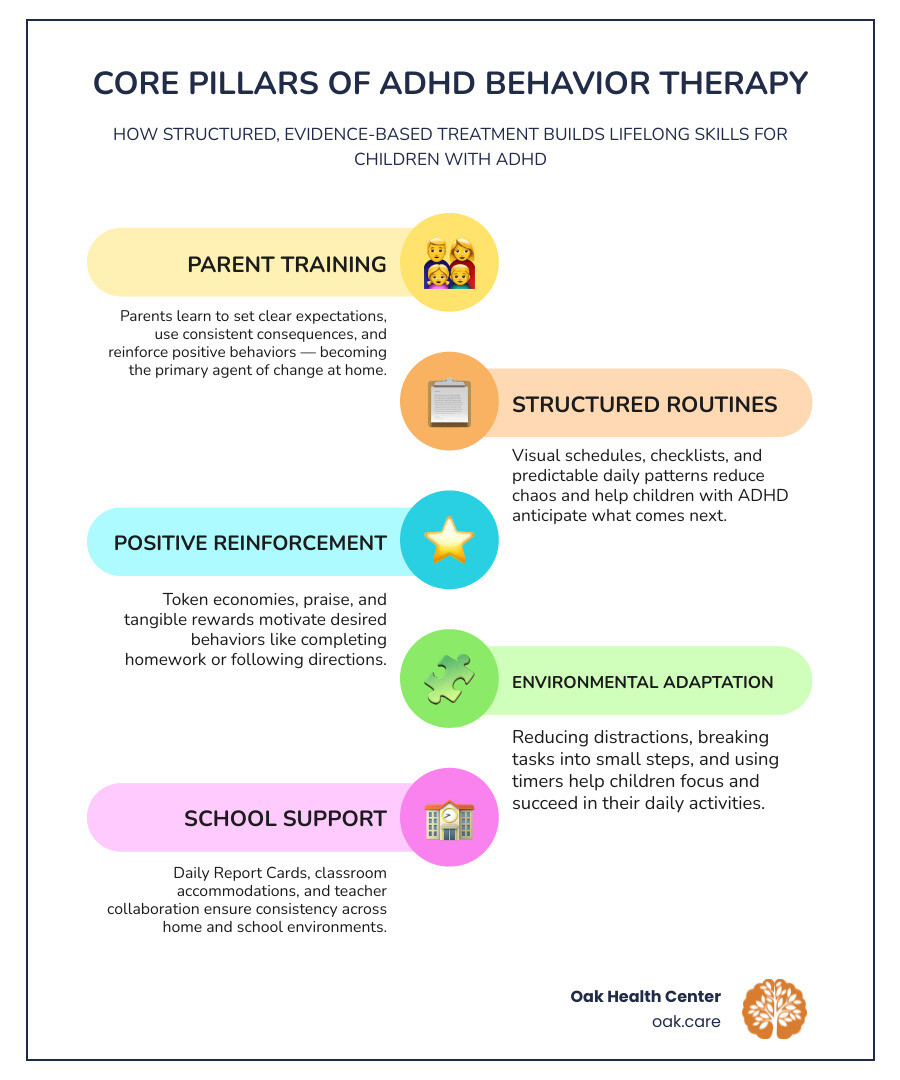
In these programs, parents learn how to establish highly structured routines, use positive reinforcement, and implement consistent, calm discipline. PCIT, for example, is designed for children aged 2 to 7 and focuses heavily on building a strong, positive parent-child relationship. The therapist often observes the parent and child playing through a one-way mirror, providing real-time coaching via a wireless earpiece. The program is unique because it is not completed after a set number of weeks; rather, it is complete when parents can actively demonstrate that they have mastered the skills.
You can explore the peer-reviewed evidence supporting these approaches in this Research on parent-led behavioral interventions.
Core Techniques: Antecedent vs. Consequent Interventions
At the heart of behavior therapy for ADHD is a simple framework: analyzing what happens before a behavior (antecedents) and what happens after a behavior (consequences). By systematically adjusting these two variables, we can reshape how a child reacts to their daily environment.
Antecedent-Based Techniques (Modifying the Triggers)
Antecedents are the environmental triggers that set the stage for behavior. For a child with ADHD, a chaotic environment virtually guarantees chaotic behavior. Antecedent techniques focus on organizing the environment to prevent problem behaviors from happening in the first place.
- Structured Routines: Keep your child on a strict daily schedule with consistent times for waking, eating, homework, and sleeping.
- Visual Checklists: Create and prominently display visual schedules on the refrigerator or bedroom door. A checklist for the morning routine (e.g., brush teeth, put on shoes, pack backpack) compensates for weak working memory.
- Limiting Choices: Reduce overwhelm by giving your child only two or three options at a time (e.g., “Would you like apples or bananas?” rather than “What do you want to eat?”).
- Reducing Distractions: Keep digital screens, tablets, and loud music turned off during mealtimes and homework sessions.
- Dedicated Stations: Designate a specific, logical spot near the front door for your child’s school backpack and shoes to prevent morning disorganization.
Consequent-Based Techniques (Modifying the Responses)
Consequences are the reactions that follow a behavior, which either reinforce it (making it more likely to happen again) or discourage it.
- Immediate Praise: Children with ADHD need immediate feedback. If your child stays focused on their homework for ten minutes, praise them immediately rather than waiting until the end of the night.
- Planned Ignoring: For minor, attention-seeking disruptive behaviors (like whining or foot-tapping), intentionally look away and ignore the behavior. When the child stops, immediately give them positive attention.
- Calm Discipline: Use clear, predictable consequences like brief time-outs or the temporary removal of a privilege. Physical punishment, such as spanking, is highly counterproductive and does not teach self-regulation.
When teachers implement these strategies in the classroom, the results are highly encouraging. Research shows that both antecedent- and consequent-based techniques in behavioral teacher training show medium to large effect sizes (d = 0.89 and 0.93, respectively) in reducing daily teacher-rated problem behaviors.
What To Expect During Behavior Therapy for ADHD Sessions
If you decide to enroll in a parent behavior therapy program, you might be wondering what the actual process looks like. First and foremost, you should expect to be an active participant. As clinical psychologists often note, parents sometimes expect to drop their child off at a therapist’s office and wait in the lobby. In reality, behavioral interventions require a massive, active investment of parental effort.
A typical parent training program consists of 8 to 16 weekly sessions. During these sessions, you can expect:
- Goal Setting: You and the therapist will identify and define 1 to 2 specific, target problem behaviors to focus on (e.g., “refusing to get dressed in the morning” rather than “being defiant”).
- Skill Instruction: The therapist will teach you specific strategies, such as how to give clear, single-step commands or how to structure a reward system.
- Active Practice: You will role-play these strategies with the therapist during the session to ensure you feel confident.
- Homework Assignments: You will be given specific “homework” to practice these techniques at home with your child between sessions.
- Progress Monitoring: At each follow-up session, you will review what worked, what didn’t, and flexibly adjust the strategy.
To prepare for your family’s therapeutic journey, read our detailed guide on what to expect in your first therapy appointment.
Token Economies and Positive Reinforcement
One of the most powerful and widely used behavioral techniques for ADHD is the Token Economy. This is a systematic reward program designed to provide the immediate, visual reinforcement that the ADHD brain craves.
To set up a Token Economy at home:
- Identify Target Behaviors: Choose 3 to 5 positive behaviors you want to encourage. Write them in positive, actionable terms (e.g., “Pack schoolbag the night before” instead of “Don’t forget your homework”).
- Award Tokens: Every time your child successfully performs a target behavior, immediately give them a token (this can be a sticker, a plastic coin, or points on a chart).
- Exchange for Rewards: Establish a “menu” of rewards that tokens can be exchanged for. These can be tangible prizes or, even better, non-material privileges (e.g., 15 minutes of screen time, picking what’s for dinner, or a special weekend outing).
When implementing a token system, it is crucial to focus primarily on positive reinforcement. Some systems use a concept called response cost, where tokens are taken away as a consequence for negative behavior. However, clinical studies show that relying too heavily on taking away rewards can cause behavioral deterioration and resistance, especially in children with high emotional reactivity. Positive reinforcement should always remain the primary driver of the system.
For a deeper look into how these systems are clinically combined with Cognitive Behavioral Therapy, you can read this Study on CBT and Token Economy systems.
The Role of Schools and Multimodal Treatment
For school-aged children, behavior therapy cannot exist in a vacuum. Because children spend a massive portion of their waking hours in the classroom, coordinating strategies between home and school is essential for long-term success.
| Treatment Type | How It Affects ADHD | Key Benefits | Limitations |
|---|---|---|---|
| Behavior Therapy | Teaches skills to manage and cope with symptoms | Builds lifelong organizational skills; no medical side effects | Requires significant time and consistent effort from parents/teachers |
| Medication | Directly reduces core neurological symptoms | Highly effective at improving immediate attention and reducing hyperactivity | Benefits stop when medication is discontinued; potential physical side effects |
| Multimodal (Combined) | Combines skill-building with neurological symptom reduction | Yields the highest overall functional improvement and quality of life | Requires coordinating multiple providers and treatments |
Classroom Accommodations and Teacher Training
Functional impairment in school — whether it’s academic struggles, difficulty sitting still, or social challenges with peers — is often the primary reason parents seek professional help.
Teachers can support behavior therapy by establishing clear classroom accommodations, which are often formalized through IEPs (Individualized Education Programs) or 504 Plans. Effective classroom strategies include:
- The Daily Report Card (DRC): This is a highly successful tool where the teacher rates specific, pre-determined behavioral goals (e.g., “stayed in seat during reading”) on a simple card. The child brings the card home, and parents provide rewards based on the teacher’s feedback.
- Visual Timers: Using physical or digital timers helps students manage transitions and understand how much time they have left for a task.
- Movement Breaks: Allowing the student to take brief, scheduled breaks (e.g., delivering a folder to the front office or stretching in the back of the room) helps them regulate hyperactive energy.
- Seating Placement: Seating the child close to the teacher and away from distracting windows or doors.
Even brief teacher-focused interventions can make a massive difference. A clinical trial demonstrated that a brief, two-session behavioral training program for teachers led to significant, stable improvements in classroom ADHD symptoms and functional impairment for up to three months.
To explore the clinical data on these classroom-based strategies, review this Research on behavioral teacher training techniques.
Behavior Therapy vs. Medication: A Multimodal Approach
A common debate among parents is whether to use behavior therapy or medication to treat ADHD. Some parents are hesitant to use medication due to potential side effects like appetite loss or sleep issues; in fact, preference studies show that up to 70.5% of parents express a strong initial desire to avoid medication.
However, the landmark Multimodal Treatment Study of Children with ADHD (MTA Study) found that a combined approach — using both behavior therapy and carefully managed medication — yields the best overall functional outcomes.
Think of it this way: medication can open the “window of focus” by biologically reducing hyperactivity and inattention. But once that window is open, the child still needs to be taught how to learn, organize, and behave. Behavior therapy provides those skills. Furthermore, because behavioral therapy teaches lifelong coping mechanisms, these skills continue to benefit the child long after they stop taking medication.
If you are considering psychiatric support or want to explore combined treatment pathways, you can read more about our psychiatric services.
Frequently Asked Questions about ADHD Behavioral Interventions
Can adults benefit from behavior therapy for ADHD?
Yes, absolutely. While parent training is the focus for young children, adults with ADHD benefit immensely from Cognitive Behavioral Therapy (CBT) tailored specifically for ADHD.
Unlike standard CBT, which focuses heavily on mood and anxiety, ADHD-focused CBT is highly practical. It teaches adults how to overcome executive functioning deficits by utilizing physical planners, establishing time-management systems, breaking large projects into smaller steps, and managing the emotional toll of adult ADHD (such as chronic stress or feeling like an “overachiever” who is constantly falling short).
To learn more about how ADHD presents in adulthood, explore our resource on adult ADHD.
How long does it take to see results from behavior therapy?
Most structured parent behavior therapy programs run for 8 to 16 weeks, and families typically begin noticing gradual improvements within the first month.
However, parents should be prepared for a phenomenon known as an extinction burst — a temporary spike in negative behavior. When you first establish firm boundaries and stop responding to attention-seeking behaviors, your child’s negative behaviors may temporarily get worse as they “test” the new rules. This is completely normal. Consistency is key; if you remain firm, the negative behaviors will begin to decrease steadily.
How do I find a qualified ADHD behavioral therapist?
When looking for a behavioral therapist, it is important to find a provider who is specifically trained in evidence-based parent training programs.
Look for clinical psychologists, licensed family therapists, or clinical social workers who hold certifications in programs like PCIT (Parent-Child Interaction Therapy), Triple P, or the Incredible Years. You should ask potential providers if they actively involve parents in sessions and if they assign practice activities to complete at home.
To guide your search, read our helpful tips on finding mental health providers.
Conclusion
At Oak Health Center, we know that navigating ADHD can feel like an uphill battle. But you don’t have to navigate it alone, and you don’t have to rely on a single treatment pathway. By utilizing behavior therapy for ADHD, you can empower your child with the self-regulation, organizational skills, and confidence they need to thrive.
Our mission is to provide comprehensive, compassionate mental healthcare with simplified access. We offer specialized support across our five convenient Southern California locations — including Beverly Hills, Fullerton, Laguna Hills, Rancho Cucamonga, and South Pasadena — as well as statewide virtual consultations across California.
Whether you are looking for parent training, psychological assessments, or a comprehensive multimodal treatment plan, our team of dedicated clinicians is here to help your family find peace amid the chaos.
To take the first step, we invite you to Learn more about our Behavior Therapy Program and schedule a consultation with us today.