


Why Choosing the Right Psychotherapy Courses Matters in 2026
Psychotherapy courses range from short 10-week introductions to six-year postgraduate clinical training programs — and choosing the wrong one can cost you years of time and thousands of dollars.
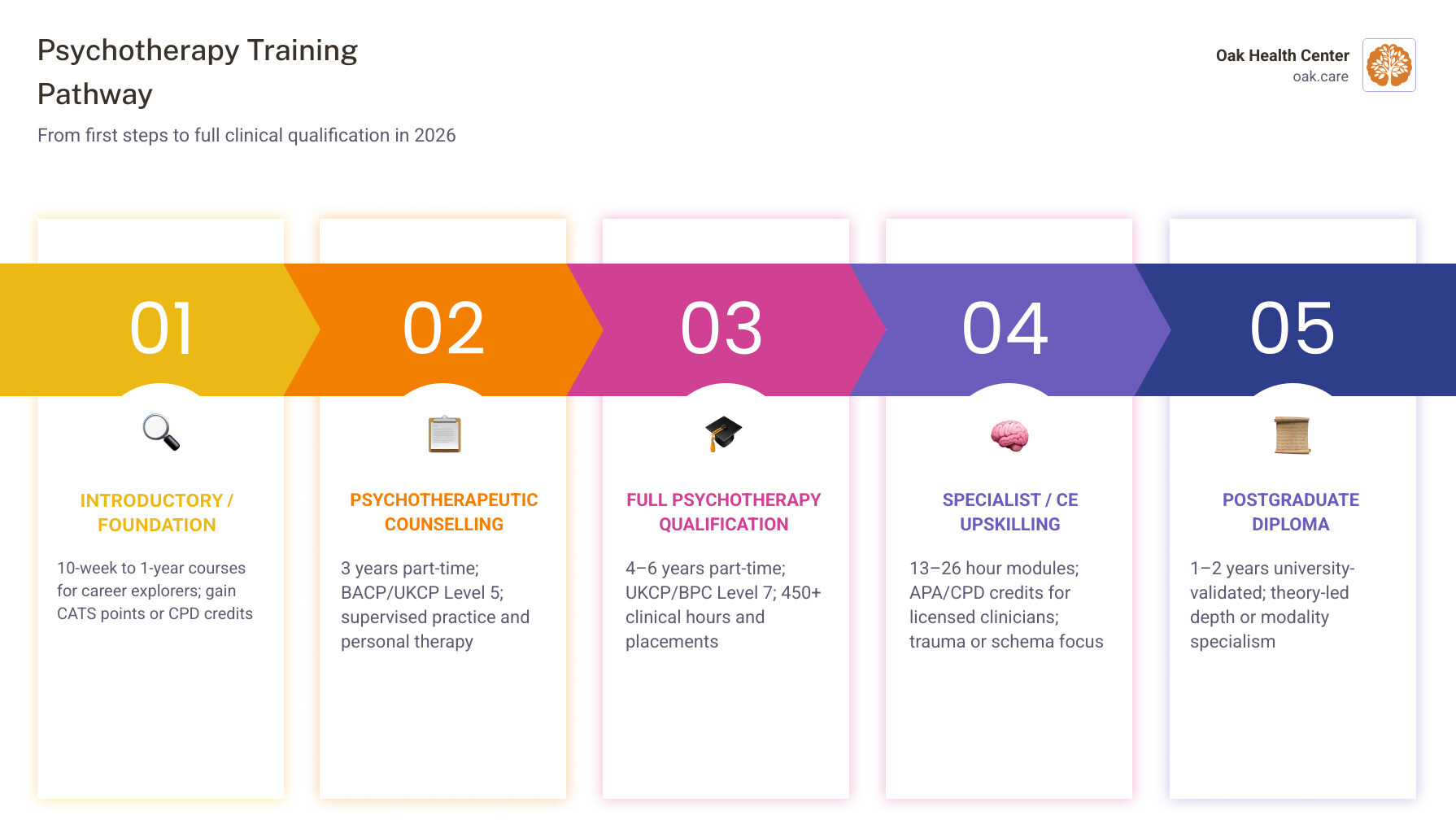
Here’s a quick overview of the main types to help you compare at a glance:
| Training Type | Typical Duration | Best For | Example Accreditation |
|---|---|---|---|
| Introductory / foundation | 10 weeks – 1 year | Career explorers, helpers | CATS points, CPD |
| Psychotherapeutic counselling | 3 years part-time | Counselling practice | BACP, UKCP Level 5 |
| Full psychotherapy qualification | 4–6 years part-time | Clinical psychotherapy | UKCP, BPC Level 7 |
| Specialist / CE upskilling | 13–26 hours | Licensed clinicians | APA, CPD credits |
| Postgraduate diploma | 1–2 years | Theory-led or specialist depth | University-validated |
The field has expanded significantly. You can now train in modalities ranging from EMDR and schema therapy to ACT, polyvagal theory, and psychoanalytic psychotherapy — online or in person, beginner to advanced.
One thing is clear: not all programs are equal. Accreditation, supervised hours, personal therapy requirements, and placement support vary widely. Understanding those differences before you enroll is critical.
I’m Andrew Brewer, Practice Manager at Oak Health Center, where I’ve helped grow clinical operations and expand specialized mental health programming — experience that gives me a practical lens on how psychotherapy courses translate into real clinical careers. In this guide, I’ll break down the top programs by training goal so you can make a confident, informed choice.
Best Psychotherapy Courses by Training Goal
The best course depends less on what sounds impressive and more on what you actually want to do. Are you aiming for full clinical qualification? Adding trauma tools to an existing license? Testing whether psychodynamic ideas are your thing before committing three years and a small mountain of tuition bills?
A simple way to think about psychotherapy courses is this:
| Goal | Best Course Type | What to Check |
|---|---|---|
| Become a qualified psychotherapist | Full postgraduate clinical training | Accreditation, placement support, personal therapy rules |
| Become a psychotherapeutic counsellor | Counselling-focused professional training | Scope of practice, client complexity, hours required |
| Explore a modality | Introductory or foundation course | Whether it leads anywhere practical |
| Add specialist skills | CE/CPD training | Credit approval, clinical level, evidence base |
| Deepen theory | PGDip or theory-led study | Whether it is clinical or non-clinical |
Best psychotherapy courses for complete professional qualification
If your goal is independent therapeutic practice, look for training that leads to recognized professional registration rather than a nice-looking certificate and a vague sense of hope.
In the UK-style pathway referenced in the research, accredited psychotherapy training often takes 3 to 6 years part-time and may require roughly 450 hours of supervised clinical practice. Full psychotherapy training is usually level 7, while psychotherapeutic counselling is commonly level 5 and somewhat narrower in scope. That difference matters if you want to work with more complex presentations, longer-term therapy, or in specialist services.
The strongest full-qualification programs usually include:
- Weekly seminars
- Clinical placement support
- Ongoing supervision
- Personal therapy
- Formal assessments and case studies
- Clear accreditation routes
A good example of a rigorous clinical model is Psychodynamic Counselling and Psychotherapy — Birkbeck, University of London, a three-year part-time MSc with placement, supervision, and required personal therapy. It is a strong fit for people who want structured psychodynamic training with real clinical depth.
Best psychotherapy courses for psychodynamic and psychoanalytic depth
If you are drawn to attachment, unconscious processes, transference, and the question “why do I keep doing this even when I know better?” then psychodynamic and psychoanalytic training may be your lane.
These programs tend to emphasize:
- Early development
- Relational patterns
- Unconscious communication
- Defense mechanisms
- Transference and countertransference
- Reflective capacity
For a shorter entry point, Psychodynamic Counselling: An Introduction | Oxford Lifelong Learning, University of Oxford offers a 10-week in-person introduction covering Freud, Klein, Bowlby, Winnicott, and Bion. It is a practical “try before you commit” option.
For a more substantial professional route, the Birkbeck course above includes once-weekly in-person personal therapy, prior helping-role experience, and a two-year placement component. That is not casual learning. It is proper clinical formation.
Best psychotherapy courses for evidence-based trauma work
Trauma training is one of the fastest-growing categories in 2026, and for good reason. Clinicians increasingly want methods that go beyond talking about symptoms and actually help process traumatic memory, dissociation, and chronic nervous system dysregulation.
Popular trauma-focused training areas include:
- EMDR
- Complex trauma treatment
- AIP model applications
- IFS-informed integration
- Neurofeedback
- Polyvagal-informed stabilization
Some advanced trauma video courses in the research received high user ratings, including:
- 4.8/5 from 3,587 users for a top EMDR course for complex trauma
- 4.7/5 from 1,089 users for highly purchased recent courses
- 4.6/5 from 17,628 users for popular video courses over the last 24 months
That does not automatically make them qualification pathways, but it does suggest strong demand for trauma-specialist upskilling.

When reviewing trauma courses, we recommend checking whether they teach:
- Stabilization before memory processing
- Dissociation screening
- Case conceptualization for complex PTSD
- Ethical limits for non-licensed or early-career learners
- Integration with broader treatment planning
Best psychotherapy courses for schema, ACT, and integrative practice
If you like structured tools but do not want therapy to feel like filling out a tax form, schema therapy and ACT are often excellent middle paths.
Schema therapy blends cognitive, attachment, psychodynamic, and experiential ideas. It is especially relevant for personality disorders, chronic relational problems, and longstanding maladaptive patterns. In the research, a Schema Therapy collection earned a 4.9/5 rating from 3,084 users. Techniques often include:
- Schema assessment
- Mode work
- Chair work
- Imagery rescripting
- Limited reparenting concepts
ACT, by contrast, focuses on psychological flexibility. Instead of trying to delete painful thoughts, it teaches clients to relate differently to them through:
- Acceptance
- Mindfulness
- Values clarification
- Self-as-context
- Committed action
- Exposure-based methods where relevant
Integrative programs can be especially useful for working clinicians because they help bridge modalities rather than forcing loyalty to one theoretical tribe.
Best psychotherapy courses for existential and theory-led study
Not every worthwhile course is a clinical qualification. Some are better suited for reflective practitioners, allied professionals, or future applicants who want academic depth first.
PGDip in Psychotherapy Studies | NPSC Ltd is a good example of a theory-led, existentially oriented option. It is fully online, typically takes one year part-time in its core structure with flexible completion, and focuses on meaning, ethics, development, culture, and research methods. Importantly, it does not by itself confer professional registration.
That makes it useful for:
- Career changers exploring the field
- Professionals wanting conceptual depth
- Applicants preparing for later clinical training
- People who want psychotherapy theory without immediate licensure goals
Best psychotherapy courses for CE, CPD, and specialist upskilling
Already qualified? Then you probably do not need another three-year program. You need targeted training that sharpens your work this year, not in 2029.
The research highlights several specialist upskilling formats:
- 26 CPD/CE credits for a 26-hour Polyvagal Theory course
- 16 CPD/CE credits for a Still Face and Mirror Neurons course lasting just under 16 hours
- 13 CPD/CE credits for an Interpersonal Neurobiology course lasting just over 13 hours
- 36 APA-approved CE credits in a 24-week Control-Mastery Theory certification program
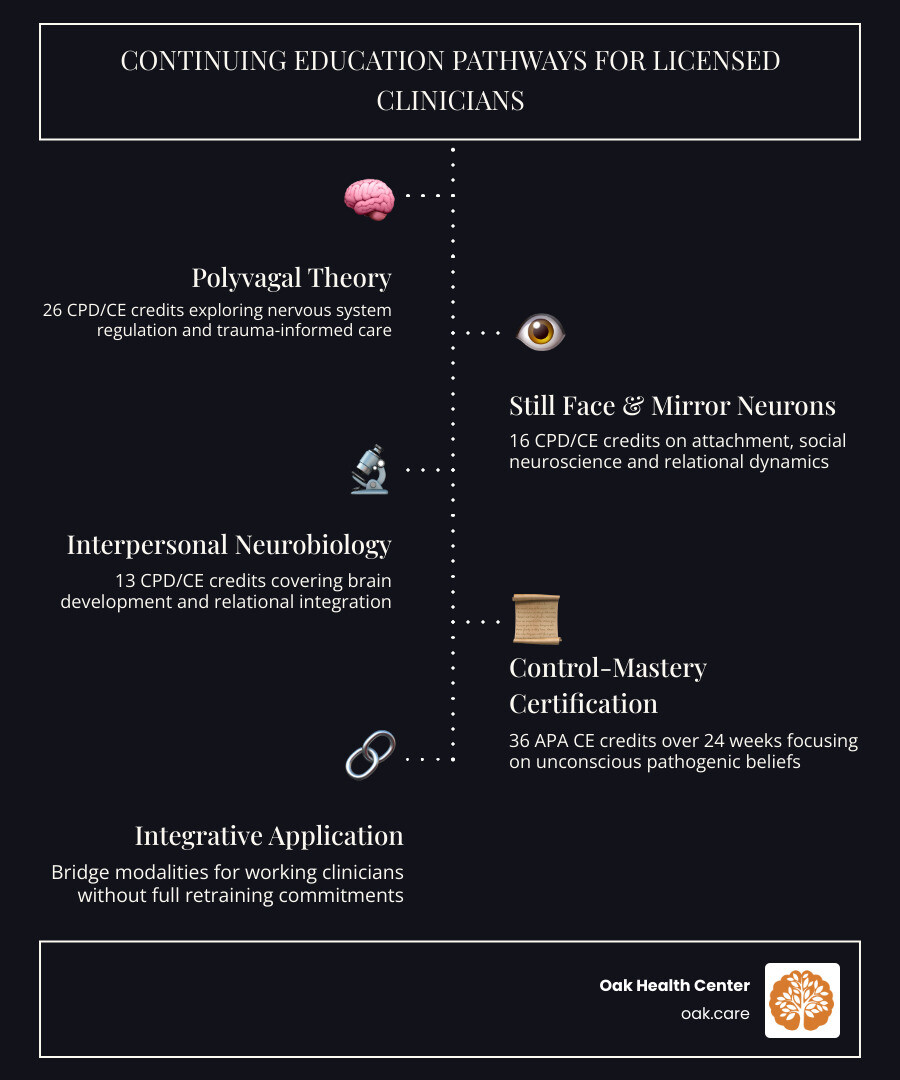
These options are best for licensed clinicians who want practical additions to existing work in trauma, attachment, neuroscience, or case formulation.
How Psychotherapy Courses Differ by Modality and Approach
The big modalities do not just use different techniques. They ask different questions.
Psychodynamic training asks, “What unconscious pattern is repeating?” Trauma training asks, “What happened, and how is the nervous system still carrying it?” ACT asks, “How do we help clients live well even with pain?” Schema therapy asks, “What old life pattern keeps taking over?”
Psychodynamic and psychoanalytic courses
Psychodynamic and psychoanalytic courses often follow a tripartite model:
- Didactic seminars
- Clinical supervision
- Personal therapy
This tradition is rooted in thinkers such as Freud, Klein, Winnicott, and Bowlby. Expect heavy emphasis on:
- Attachment
- Internal object relations
- Defense mechanisms
- Containment
- Developmental history
- The therapeutic relationship as the treatment itself
These courses usually demand more self-reflection than checklist-oriented modalities. Sometimes a lot more. If you dislike examining your own reactions, psychodynamic training may feel like buying a mirror you cannot turn off.
EMDR, schema therapy, and trauma-specialist courses
EMDR-focused courses tend to be more protocol-driven, with attention to phases of treatment, target sequencing, resourcing, desensitization, and reprocessing. The better programs also teach when not to proceed too fast, especially with dissociation or developmental trauma.
Schema therapy builds on developmental wounds and learned coping patterns. It is often especially useful for:
- Personality disorders
- Chronic shame
- Relational instability
- Cluster C presentations
- Longstanding self-criticism
Both modalities can be highly effective, but they feel different in practice. EMDR is often memory-processing focused; schema therapy is pattern-and-relationship focused.
ACT, emotion-focused, and integrative courses
ACT and other integrative approaches often appeal to clinicians who want evidence-based methods without becoming overly manualized.
Common themes include:
- Acceptance of internal experience
- Values-guided behavior change
- Working with shame and anger
- Exposure and emotional processing
- Personalized case formulation
The research also pointed to best practices like bridging IFS and EMDR, using awareness practices to improve effectiveness, and adapting experiential tools like imagery rescripting for Cluster C personality disorders. That reflects a broader trend: modern training is becoming more integrative and less siloed.
Neuroscience-informed psychotherapy courses
Neuroscience-informed curricula are everywhere in 2026, and not just because brain diagrams look great in slide decks.
Key topics include:
- Polyvagal theory
- Neurofeedback
- Interpersonal neurobiology
- Mirror neurons
- Developmental trauma
- Regulation and co-regulation

Used well, these topics can improve case formulation and treatment planning. Used badly, they become “your amygdala is having a bad day” with no actual clinical skill attached. Look for courses that connect neuroscience concepts to observable therapeutic practice.
Entry Requirements, Length, and What Training Really Costs
This is where many applicants get surprised. The tuition is usually only part of the story.
Typical duration and structure of psychotherapy courses
Based on the research, common timelines include:
- 10 weeks for introductory courses
- 1 year for foundation or introductory certificates
- 2 years for some specialist postgraduate or psychodynamic programs
- 3 years part-time for many counselling and psychodynamic clinical routes
- 4 to 6 years part-time for full psychotherapy qualification including all requirements
A typical structure may include:
- Weekly lectures or seminars
- Skills practice groups
- Personal development or experiential groups
- Clinical placement
- Individual or group supervision
- Written assignments and case studies
Requirements: supervised hours, personal therapy, and CPD
Requirements vary a lot, which is exactly why shopping by title alone is risky.
Examples from the research include:
- Approximately 450 hours of supervised clinical practice in a UKCP-style accredited pathway
- 200 hours of clinical case work in one psychodynamic couple and individual program
- Weekly supervision of 90 minutes for at least 36 weeks per year in one course
- Once-weekly personal therapy required before and throughout some psychodynamic programs
- Attendance thresholds such as 75 percent minimum in introductory courses
Personal therapy is common in psychodynamic and psychoanalytic training because self-awareness is considered part of clinical competence, not an optional side quest.
Costs beyond tuition
Here are some real cost examples from the research:
- £375 course fee plus £60 assessment fee for a short Oxford introduction
- £4,840 for a one-year part-time introductory psychodynamic course
- £4,560 per year for a theory-led psychotherapy studies diploma
- £8,550 per year for some multi-year postgraduate psychodynamic programs
- $850 to $1,175 for a 24-week certification program depending on status
- Personal therapy estimated at £45 to £90 per session in one program
- Personal indemnity insurance estimated at £55 to £100 annually
- Extra costs can include books, travel, placement-related expenses, application fees, and supervision not covered by tuition
Before enrolling, we suggest building a full budget with:
- Tuition
- Personal therapy
- Supervision
- Insurance
- Textbooks
- Travel or parking
- Lost work hours
- Tech costs for online learning
Some programs offer bursaries or flexible payment plans, so ask. Quietly suffering through a spreadsheet is not a training requirement.
Who gets in and what experience helps most
Strong applicants often have:
- Prior helping-role experience
- Volunteer or paid work in mental health, education, social care, or support settings
- Emotional maturity
- Reflective capacity
- Openness to feedback
- Ability to handle academic reading and writing
Some programs want a degree. Others allow equivalent professional background. Some require prior counselling study at certificate level. Several psychodynamic courses in the research also expected at least six months of regular helping-role experience before admission.
Online vs In-Person Psychotherapy Courses: Which Format Wins?
The honest answer: neither wins all the time.
When online psychotherapy courses make sense
Online programs can be excellent for:
- Working professionals
- Parents and caregivers
- Learners needing geographic flexibility
- Theory-heavy study
- CE and CPD training
Some postgraduate and specialist programs now run fully online with live seminars, which can widen access without lowering standards, provided accreditation and clinical elements are still robust.
Online learning works best when the program includes:
- Live faculty contact
- Supervision access
- Clear attendance expectations
- Good cohort interaction
- Practical application, not just video consumption
When in-person psychotherapy courses are stronger
In-person learning still has real advantages for:
- Skills labs and role-play
- Embodied interpersonal learning
- Experiential groups
- Local placement integration
- Close observation of process
This is especially true for early-stage clinical training, where subtle relational cues matter. A screen can teach concepts. It is less ideal for everything involving presence, emotional attunement, and the messy beauty of real human interaction.
How to judge accreditation and learning quality
Accreditation is not everything, but it is very close to everything if you want a recognized career path.
Key markers mentioned in the research include:
- UKCP
- BACP
- BPC
- APA-approved CE
- University validation or quality assurance
Accreditation matters because it affects:
- Employer trust
- Eligibility for registration
- Portability of training
- Insurance and placement acceptance
- Confidence that required hours and standards are legitimate
Career Paths After Psychotherapy Training
Good training should open doors, not just empty your wallet.
Qualified psychotherapist vs psychotherapeutic counsellor
A full psychotherapist training is generally broader and deeper, often preparing practitioners for longer-term and more complex work. Psychotherapeutic counselling routes are still substantial, but may be narrower in scope depending on the framework and region.
If your goals include complex trauma, personality disorder treatment, or intensive psychodynamic work, the fuller training route may be a better fit.
Which modalities open which doors
Different trainings support different career directions:
- Psychodynamic training: long-term therapy, relational work, organizational settings
- EMDR and trauma training: trauma-focused clinics, private practice niches
- Schema therapy: personality disorder work, complex chronic cases
- ACT: anxiety, depression, health psychology, integrative private practice
- Couple-focused psychodynamic training: relationship therapy and psychosexual pathways
- Theory-led study: teaching, reflective practice, preparation for later clinical work
At Oak Health Center, we see how modality fit shapes care quality. If you want a practical sense of what psychotherapy can look like in real-world treatment, our Psychotherapy Services page is a helpful starting point.
Building a client-facing career after training
Training completion is not the finish line. It is the beginning of competent practice.
To build a sustainable therapy career, most clinicians need:
- Ethical grounding
- Ongoing supervision
- Continuing education
- Clear niche development
- Referral relationships
- Experience with diverse client needs
For examples of how psychotherapy supports specific concerns, see:
- How Therapy Helps People Living with OCD Beyond Just Managing Symptoms
- Managing Anxiety Without Medication: When Psychotherapy is Enough
- Psychotherapy Services for Abuse: Do They Really Help?
- How Family Therapy Can Help Heal After Divorce or Blended Family Stress
- What to Expect in Your First Therapy Appointment at Oak Health Center
How to Choose the Right Psychotherapy Course for You
Choosing well is less about prestige and more about fit.
Questions to ask before enrolling in psychotherapy courses
Ask every program:
- Does this lead to a clinical qualification or not?
- What accreditation does it hold?
- How many supervised hours are required?
- Is placement support included?
- Is personal therapy mandatory?
- What are the total real costs?
- Is the learning online, in person, or hybrid?
- What kind of clients does this training prepare me to work with?
- What do graduates actually go on to do?
Red flags that signal a poor-fit program
Be cautious if a program has:
- Unclear or missing accreditation
- Vague language about clinical hours
- No placement support for qualification routes
- Big promises with little curriculum detail
- Minimal access to faculty or supervision
- Confusion between CPD training and professional qualification
A six-week webinar series is not the same as therapist training, no matter how inspirational the branding is.
Smart next steps before you apply
Before committing, we recommend:
- Attend open days
- Compare syllabi
- Take a shorter intro course first
- Ask about supervision and personal therapy requirements
- Speak with alumni if possible
- Confirm total costs in writing
If you want a first-step psychodynamic taster, Introduction to Counselling and Psychotherapy – Tavistock Education and Training is worth reviewing. If you want flexible, theory-led online study, compare it with PGDip in Psychotherapy Studies | NPSC Ltd.
Frequently Asked Questions about Psychotherapy Courses
How important is accreditation when choosing psychotherapy courses?
Very important. Accreditation by recognized bodies such as UKCP, BACP, BPC, or APA-approved CE providers gives your training credibility and helps ensure it meets established standards. It also matters for employability, registration, supervision access, and client trust.
Can I take psychotherapy courses online and still become qualified?
Sometimes, yes. Online theory components are now common and can be excellent. But many qualification routes still require supervised clinical work, placements, and sometimes in-person personal therapy or skills training. Always verify the exact rules before enrolling.
Should I choose full psychotherapy training or psychotherapeutic counselling?
Choose based on your goals, budget, and tolerance for long training arcs. Full psychotherapy training usually offers greater depth and broader clinical scope. Psychotherapeutic counselling may be a better fit if you want a shorter, more focused route into therapeutic practice.
Conclusion
The world of psychotherapy courses is broader than ever in 2026, but that does not make choosing easier. It just makes comparison more important.
Our simple takeaway is this:
- Choose full qualification programs for career entry
- Choose foundation courses for exploration
- Choose CE and CPD for targeted upskilling
- Choose accredited training whenever your professional future depends on it
If you are comparing programs, focus on modality fit, accreditation, supervised practice, personal therapy requirements, learning format, and total cost. That is how you avoid expensive detours and find training that truly supports the work you want to do.
And if you want to see how psychotherapy skills translate into real client care across Southern California and statewide virtual support, explore our Psychotherapy Services.