


What Is Behavior Therapy — and Could It Help You?
Behavior therapy is a structured, action-oriented form of psychotherapy that helps people change harmful patterns by modifying the learned behaviors and environmental triggers that keep those patterns going.
Here is a quick overview of what it covers:
| Question | Quick Answer |
|---|---|
| What is it? | A type of therapy focused on changing learned behaviors, not exploring unconscious causes |
| Who is it for? | People dealing with anxiety, depression, OCD, ADHD, phobias, and more |
| Main types | CBT, DBT, ABA, exposure therapy, REBT, and others |
| Does it work? | Yes — about 75% of people who enter CBT experience meaningful benefits |
| How long? | Typically 5 to 20 sessions, depending on the condition and approach |
Unlike traditional talk therapy, behavior therapy does not dig into your past to find hidden meanings. Instead, it focuses on what is happening right now — the triggers, habits, and consequences that are keeping a problem alive — and gives you practical tools to change them.
That makes it especially useful for busy people who want results without spending years in therapy.
Research backs this up. Studies show that the most significant reduction in depressive symptoms often happens early in treatment, suggesting that even shorter courses of behavior therapy can make a real difference.
I’m Andrew Brewer, Practice Manager at Oak Health Center, where I’ve helped grow our clinical programs — including behavioral health services — from the ground up over the past several years. My work sits at the intersection of operations and patient care, which has given me a front-row seat to how behavior therapy transforms lives when the right structures and support are in place. In the sections below, we’ll walk you through everything you need to know to find the right option for you.
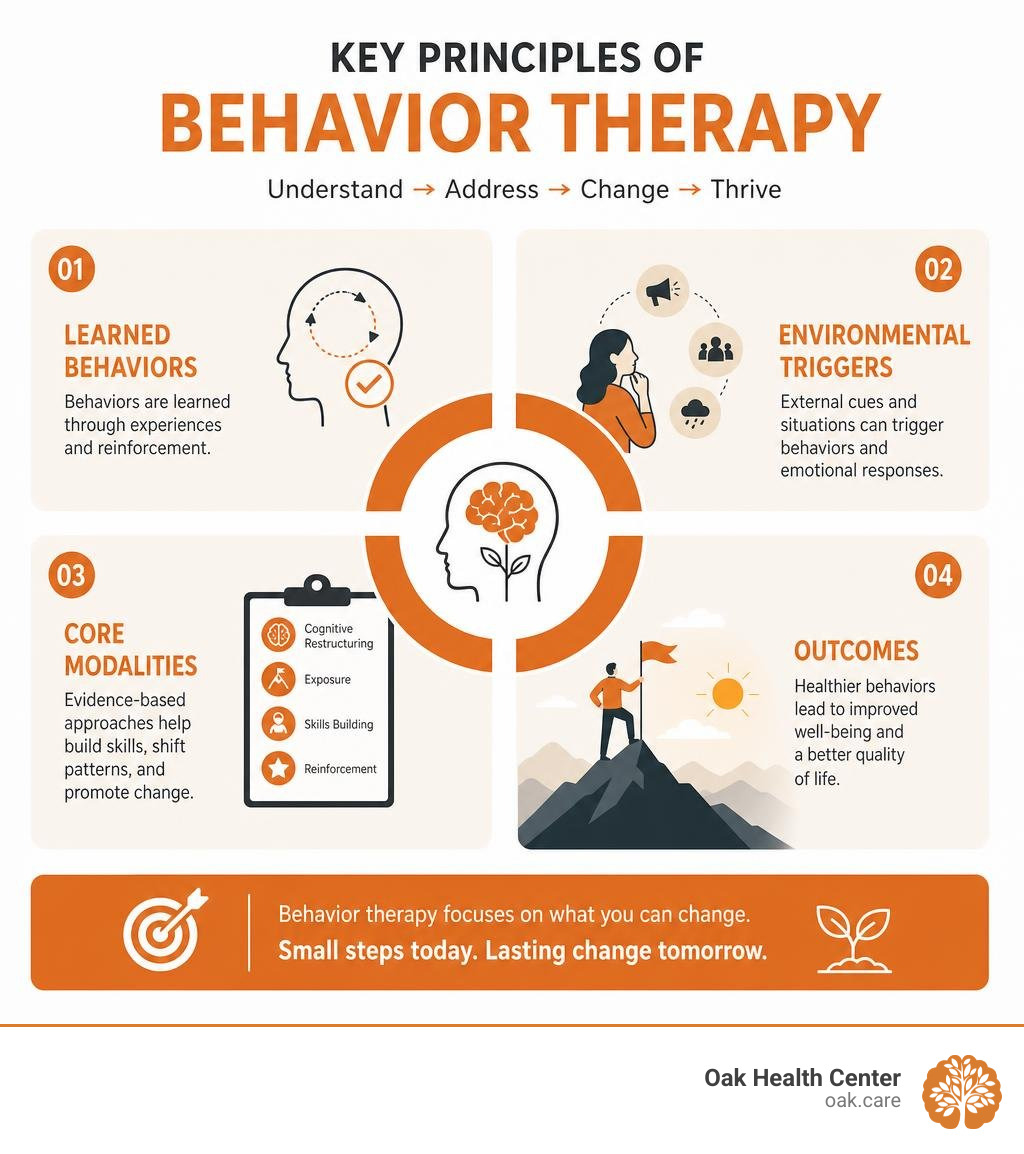
Understanding Behavior Therapy and Its Core Principles
At its heart, behavior therapy operates on a straightforward premise: psychological distress manifests through learned habits, and because behaviors are learned, they can also be unlearned or replaced with healthier alternatives.
Historically rooted in early 20th-century conditioning research pioneered by Ivan Pavlov, John B. Watson, and B.F. Skinner, the behavioral approach gained momentum in the 1950s as a practical alternative to traditional psychoanalysis. Rather than spending months or years attempting to uncover unconscious drives or resolve early childhood conflicts, behavioral practitioners turn their attention to present maintaining conditions.
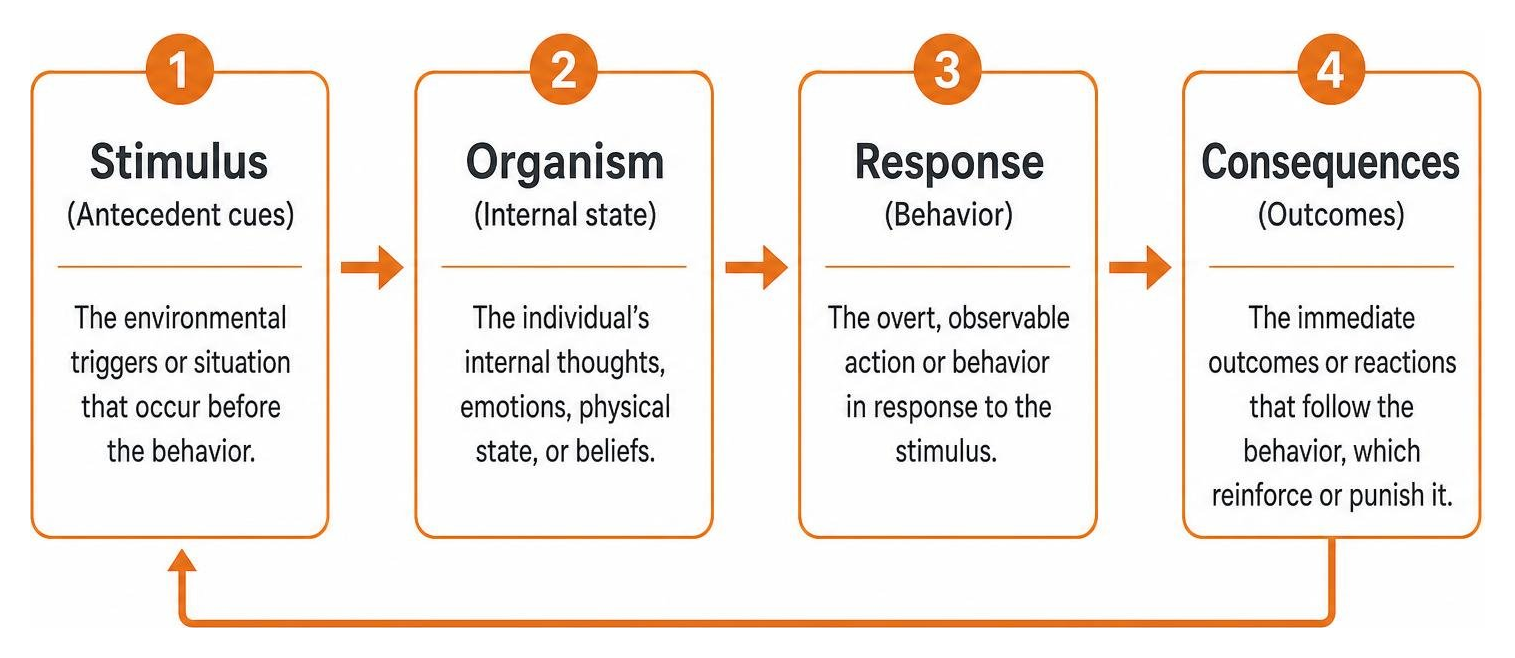
To evaluate what keeps a maladaptive response going, clinicians use functional behavioral analysis. This systematic framework examines four key elements, often remembered by the acronym SORC:
- Stimulus (Antecedent cues): The specific environmental triggers or situation preceding a behavior.
- Organism: The internal physiological, emotional, or cognitive state of the individual.
- Response: The overt, observable action or behavior being evaluated.
- Consequences: The immediate outcomes or reactions that follow the behavior, which serve to either reinforce or punish it.
By gathering objective baseline measurements through self-monitoring, structured rating scales, and direct observation, therapists establish a clear starting point. For instance, questions during an evaluation steer away from abstract “why” queries and focus on concrete “what, where, and when” questions. This helps establish actionable goals.
When comparing this approach with insight-oriented therapies, the difference lies in orientation. Insight therapy aims to help patients understand why they feel or act a certain way, assuming that self-awareness leads to change. Behavior therapy is fundamentally action-oriented; it recognizes that changing what you do changes environmental responses, which in turn alters how you think and feel. For more background on foundational concepts, you can review this Overview of Behavioral Therapy Foundations and explore our step-by-step psychotherapy guide.
Major Modalities and Applied Techniques
Over the past several decades, behavioral psychology has evolved into distinct generations of evidence-based treatments. Below is a comparison of four widely used modalities in clinical practice:
| Modality | Primary Focus | Key Mechanism | Common Applications |
|---|---|---|---|
| Cognitive Behavioral Therapy (CBT) | Interconnection of thoughts, feelings, and behaviors | Identifying automatic thoughts and cognitive restructuring | Anxiety, depression, panic, insomnia, PTSD |
| Dialectical Behavior Therapy (DBT) | Emotional regulation and distress tolerance | Balancing acceptance strategies with behavioral change | Borderline personality disorder, severe dysregulation, self-harm |
| Applied Behavior Analysis (ABA) | Operant conditioning and skill acquisition | Systematic reinforcement, shaping, and task breakdown | Autism spectrum disorder, developmental delays |
| Rational Emotive Behavior Therapy (REBT) | Irrational beliefs and emotional consequences | Active disputation of self-defeating assumptions (ABC model) | Impulsivity, anger management, performance anxiety |
Core Modalities in Behavior Therapy
Within these major categories, clinicians employ specific modalities tailored to individual needs:
- Cognitive Behavioral Therapy (CBT): Pioneer Aaron Beck introduced CBT in the 1960s after observing that depressed patients experienced systematic logical errors, known as cognitive distortions (e.g., catastrophizing, mind reading, or all-or-nothing thinking). CBT helps patients reframe these automatic thoughts to alter emotional states and actions. For deeper technical specifications, refer to this Cognitive Behavior Therapy Clinical Reference.
- Dialectical Behavior Therapy (DBT): Developed by Dr. Marsha Linehan, DBT combines standard behavioral techniques with mindfulness and acceptance principles. It provides specific skills training across four modules: mindfulness, distress tolerance, emotion regulation, and interpersonal effectiveness. Clinical trials demonstrate that symptoms of emotional dysregulation and psychological inflexibility drop noticeably within the first 6 months of DBT.
- Rational Emotive Behavior Therapy (REBT): Founded by Albert Ellis, REBT uses the ABC framework (Activating event, Beliefs, Consequences) to target irrational beliefs directly. Research shows REBT can produce measurable gains in self-control and impulsivity reduction.
- Acceptance and Commitment Therapy (ACT) & Contextual Approaches: Third-generation therapies focus on psychological flexibility, encouraging individuals to accept uncomfortable covert experiences (thoughts and feelings) while taking value-aligned action.
- Exposure Therapy & Systematic Desensitization: Pioneered by Joseph Wolpe using classical conditioning, systematic desensitization pairs deep muscle relaxation with gradual exposure to fear-inducing stimuli. In vivo (real-life) exposure and Exposure and Response Prevention (ERP) remain gold-standard treatments for phobias and obsessive-compulsive patterns.
- Play Therapy & Habit Reversal Training: Specialized applications include Cognitive Behavioral Play Therapy—which helps children aged 3 to 12 process emotional distress through sandbox creation and structured games—and Habit Reversal Training (HRT) for repetitive body-focused behaviors like tics or trichotillomania. Learn more about integrated approaches in our guide to evidence-based psychotherapy.
Reinforcement, Shaping, and Conditioning

The underlying tools across all behavioral frameworks draw directly from operant and classical conditioning:
- Positive Reinforcement: Adding a desirable stimulus immediately following a target behavior to increase the likelihood of that behavior repeating (for example, offering praise or a token point when a child completes homework).
- Negative Reinforcement: Removing an unpleasant or uncomfortable stimulus when a desired action occurs (such as turning off an annoying alarm once a task is completed).
- Shaping: Rewarding small, incremental steps toward a final goal behavior rather than expecting immediate perfection. Expecting immediate perfection often leads to plan failure, whereas shaping builds lasting habits step-by-step.
- Modeling & Observational Learning: Demonstrating healthy, adaptive behaviors so patients can learn through guided observation and practice (role-playing workplace assertiveness during a session).
- Token Economies & Contingency Contracts: Formal systems where target behaviors earn tokens that can be exchanged for privileges, rewards, or backup reinforcers. These are extensively documented in this Behavior Modification Techniques Summary.
In clinical application, intermittent reinforcement—specifically variable ratio schedules—is the most effective pattern for maintaining long-term target behaviors once they are initially established through continuous reinforcement.
Conditions Treated and Clinical Effectiveness
Behavioral therapies are among the most rigorously researched psychological treatments available. Major mental health conditions responsive to behavioral interventions include:
- Generalized anxiety disorder, panic disorder, and social phobias
- Obsessive-Compulsive Disorder (OCD)
- Major depressive disorder and persistent depressive patterns
- Attention-Deficit/Hyperactivity Disorder (ADHD) in both pediatric and adult populations
- Post-Traumatic Stress Disorder (PTSD)
- Eating disorders and substance use disorders
- Childhood conduct disorders, oppositional behaviors, and school refusal
Conditions Successfully Treated by Behavior Therapy
The effectiveness of behavior therapy across diverse clinical presentations is well documented:
- Anxiety and Phobias: Structured behavioral exposure reduces avoidant patterns, allowing individuals to build mastery over physiological panic. Read more about managing anxiety without medication.
- Obsessive-Compulsive Symptoms: Exposure and Response Prevention (ERP) helps patients confront obsessive triggers without resorting to compulsive rituals, recalibrating the brain’s alarm system over time. Discover how this works in our article on therapy for OCD.
- Pediatric and Adult ADHD: Behavior modification provides external structure through organizational routines, environmental modification, and token systems. Clinical guidelines designate behavioral interventions—such as parent management training and behavioral classroom management—as the first-line recommendation for young children under age 6 with ADHD before considering medication. Explore our guides on childhood ADHD management and adult ADHD care.
- Depression and Behavioral Activation: Behavioral activation targets the cycle of withdrawal by scheduling meaningful, daily routines, restoring contact with positive reinforcement in the patient’s environment.
- Pediatric Conduct & School Refusal: Cognitive behavioral play therapy significantly decreases anxiety-driven school refusal and classroom disruptions in elementary school children.
Outcome Measurement and Long-Term Success
A defining feature of behavior therapy is its commitment to empirical validation and quantitative tracking. Progress is evaluated against clear criteria rather than general impressions:
- Transfer of Changes: Do new skills translate into the patient’s daily home, school, or work environment?
- Clinical Significance: Does the reduction in symptoms meaningfully improve the patient’s quality of life and functioning?
- Durability: Are gains maintained months or years after active sessions conclude?
To collect accurate real-world data without relying solely on recall during sessions, clinicians frequently use Ecological Momentary Assessment (EMA) and smartphone-based self-monitoring. These tools allow individuals to record covert thoughts and overt behaviors as they happen.
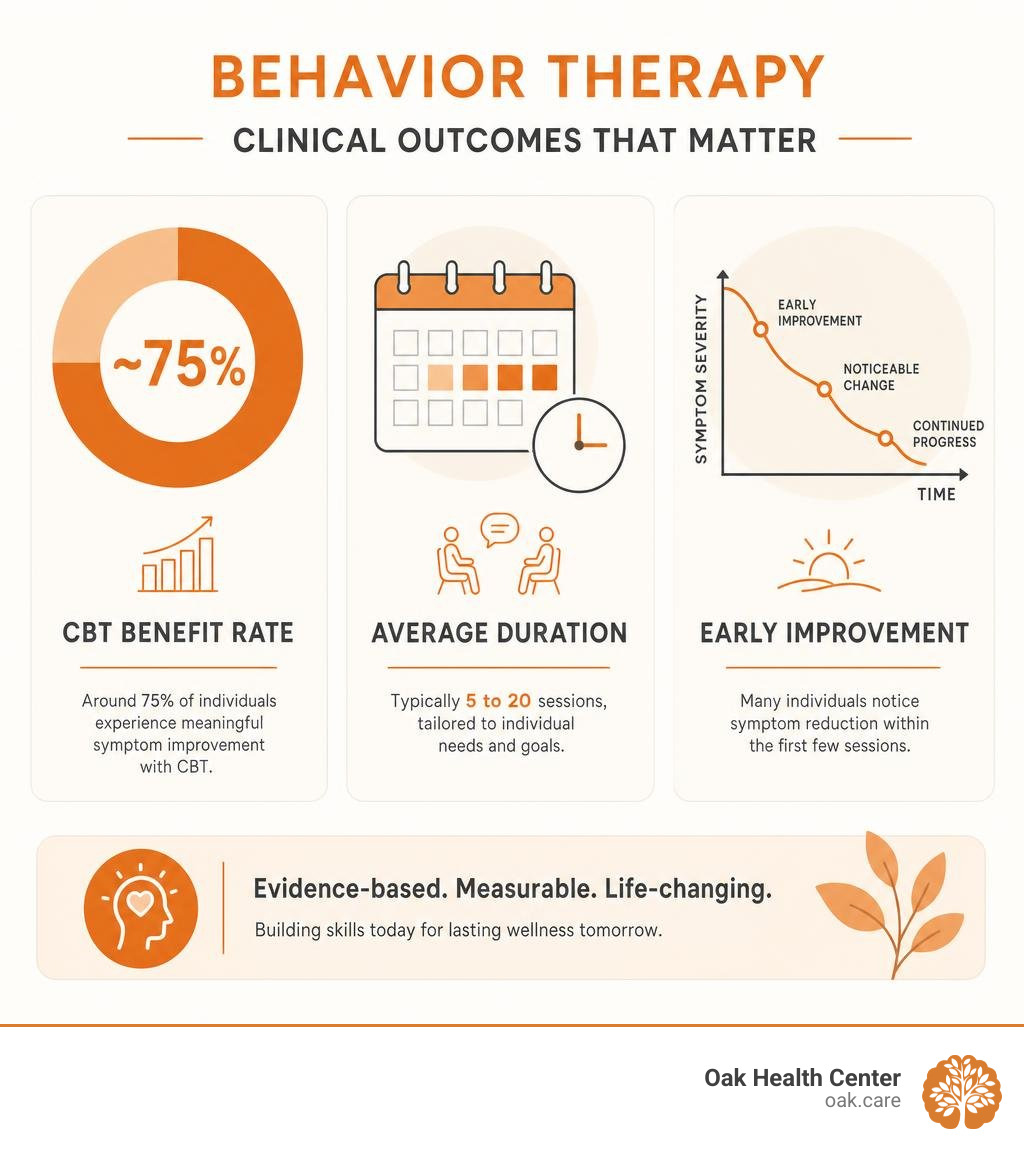
Large-scale meta-analyses confirm that roughly 75% of individuals entering cognitive behavioral interventions experience tangible therapeutic benefits. Standard care protocols are typically short-term—ranging between 5 and 20 sessions (often structured as 8 to 12 weekly 60-minute sessions). For additional clinical outcome insights, refer to the StatPearls Behavioral Therapy Guide.
Healthcare Integration and Ethical Considerations
Chronic Disease Management and Interprofessional Teams
Behavioral principles extend well beyond traditional psychiatric clinics; they play a central role in general healthcare and chronic disease management. Treatment noncompliance—such as missing medications, skipping physical therapy, or maintaining high-risk dietary habits—impacts nearly half of all medical interactions. This noncompliance contributes to poor health outcomes and inflated healthcare costs.

When integrated into multidisciplinary healthcare teams, behavioral strategies improve patient adherence through:
- Motivational Interviewing: Respecting patient autonomy while resolving ambivalence toward health behaviors.
- Behavioral Activation for Pain & Illness: Helping patients living with chronic pain, diabetes, or cardiovascular disease maintain low-impact activity routines.
- Structured Self-Monitoring: Utilizing daily charts or mobile tracking for blood glucose monitoring, medication dosing, and physical rehabilitation tasks.
Interprofessional care teams—comprising primary care physicians, psychiatric providers, nurses, clinical social workers, and pharmacists—rely on shared electronic health records and clear communication frameworks (such as TeamSTEPPS) to coordinate care.
Ethical Standards and Overcoming Implementation Barriers
Applying behavioral principles requires adherence to established ethical standards:
- Autonomy and Consent: Interventions must respect patient self-determination. Targets should be chosen collaboratively rather than imposed unilaterally.
- Reward over Punishment: Modern clinical practice strongly favors positive reinforcement over aversive techniques. Aversive approaches carry higher risks of emotional distress and are rarely appropriate.
- Cultural Adaptation: Programs must reflect local community values. Incorporating Community Advisory Boards and tailoring materials to diverse backgrounds improves engagement and treatment feasibility in under-resourced communities.
Implementation barriers—such as specialized training requirements, administrative overhead, or initial patient resistance to homework assignments—are best managed through gradual goal-setting, ongoing therapeutic rapport, and accessible delivery models like telehealth across California.
Frequently Asked Questions about Behavioral Interventions
How quickly do treatment results typically appear?
Because behavior therapy focuses directly on current maintaining factors, many individuals report noticing measurable changes early in treatment—often within the first 4 to 8 sessions. Empirical studies tracking depressive and anxious symptoms indicate that substantial initial progress frequently occurs in early treatment stages, provided patients actively practice out-of-session skills.
How does behavioral treatment differ from insight-based therapy?
Insight-based therapies aim to build self-awareness by exploring past experiences, unresolved inner conflicts, and unconscious processes. In contrast, behavior therapy is present-focused and action-oriented. It targets observable, learned habits and current environmental triggers, equipping you with concrete strategies to change patterns directly.
How can patients choose a qualified clinician?
When selecting a provider, verify that they are licensed in your state (such as a licensed psychologist, LCSW, LMFT, or psychiatric nurse practitioner) and have specialized training in evidence-based modalities like CBT, DBT, or exposure therapy. Look for clinicians who use structured baseline assessments, set collaborative goal timelines, and maintain a warm, active therapeutic partnership.
Conclusion
Behavior therapy offers a practical, scientifically validated framework for overcoming anxiety, depression, executive functioning challenges, and ingrained behavioral habits. By focusing on present triggers, learned responses, and structured skills training, behavioral interventions empower individuals to achieve lasting, meaningful change.
At Oak Health Center, we provide comprehensive, evidence-based mental healthcare tailored to your unique needs. Whether through our physical locations in Beverly Hills, Fullerton, Laguna Hills, Rancho Cucamonga, and South Pasadena, or via statewide virtual care across California, our team is dedicated to simplifying access to quality support.
If you are ready to explore structured behavioral options and take the next step toward your goals, explore our specialized behavior therapy program today to connect with a compassionate provider.