


Understanding Anxiety DSM-5 Diagnostic Criteria and Standards
Core Criteria for Generalized Anxiety DSM-5 Diagnosis
When clinicians evaluate generalized anxiety disorder (GAD), they look for persistent, pervasive worry that intrudes on daily life. Under the DSM-5 framework, the anxiety cannot simply be a brief reaction to a tough week. It must be excessive—disproportionate to the actual likelihood or impact of feared events—and present more days than not for at least six months across multiple domains like health, work, finances, and family (Munir & Takov, 2022).
For adults, the diagnostic threshold requires that the uncontrollable worry is accompanied by at least three of six hallmark somatic and cognitive symptoms (with at least some symptoms present for more days than not over the past six months). For children, only a single symptom is required to meet diagnostic criteria. For a comprehensive breakdown of these benchmarks, explore our detailed review on Meeting the Criteria: A Deep Dive into GAD DSM-5 Standards.
The six core symptoms defined in the Generalized Anxiety Disorder – StatPearls – NCBI Bookshelf resource include:
- Restlessness or feeling keyed up or on edge: A constant internal vibration or inability to relax physically.
- Being easily fatigued: Depleted energy reserves even without strenuous exertion, often stemming from continuous physical guarding.
- Difficulty concentrating or mind going blank: Cognitive disruption where attention is constantly hijacked by threat monitoring.
- Irritability: A shortened emotional fuse caused by constant sensory and mental overload.
- Muscle tension: Chronic somatic tightness, particularly around the neck, shoulders, and jaw.
- Sleep disturbance: Difficulty falling asleep, frequent nighttime awakenings, or unrefreshing sleep.
The shift from the DSM-IV to the DSM-5 refined diagnostic clarity, particularly surrounding exclusion criteria and comorbidity rules.
| Feature / Criterion | DSM-IV Criteria | DSM-5 Criteria |
|---|---|---|
| Duration & Scope | Excessive anxiety/worry about events, occurring more days than not for $ge$ 6 months. | Maintained: Excessive worry across multiple life domains for $ge$ 6 months. |
| Control of Worry | Individual finds it difficult to control the worry. | Maintained: Clear focus on the subjective inability to modulate persistent worry. |
| Symptom Count | $ge$ 3 of 6 physical/cognitive symptoms for adults; 1 for children. | Maintained: $ge$ 3 of 6 symptoms for adults; 1 for children. |
| Exclusion Language | Narrower list of diagnostic exclusions; separate criteria sets for medical/substance etiologies. | Streamlined: Explicitly rules out specific conditions like illness anxiety, OCD, PTSD, and social phobia alongside medical/substance causes. |
Evaluating Other Anxiety DSM-5 Classifications
Generalized anxiety disorder is only one expression of anxiety. The DSM-5 categorizes several distinct anxiety disorders, each with unique clinical triggers and behavioral manifestations. You can explore these variations in our In-Depth Guide to Anxiety Disorders.
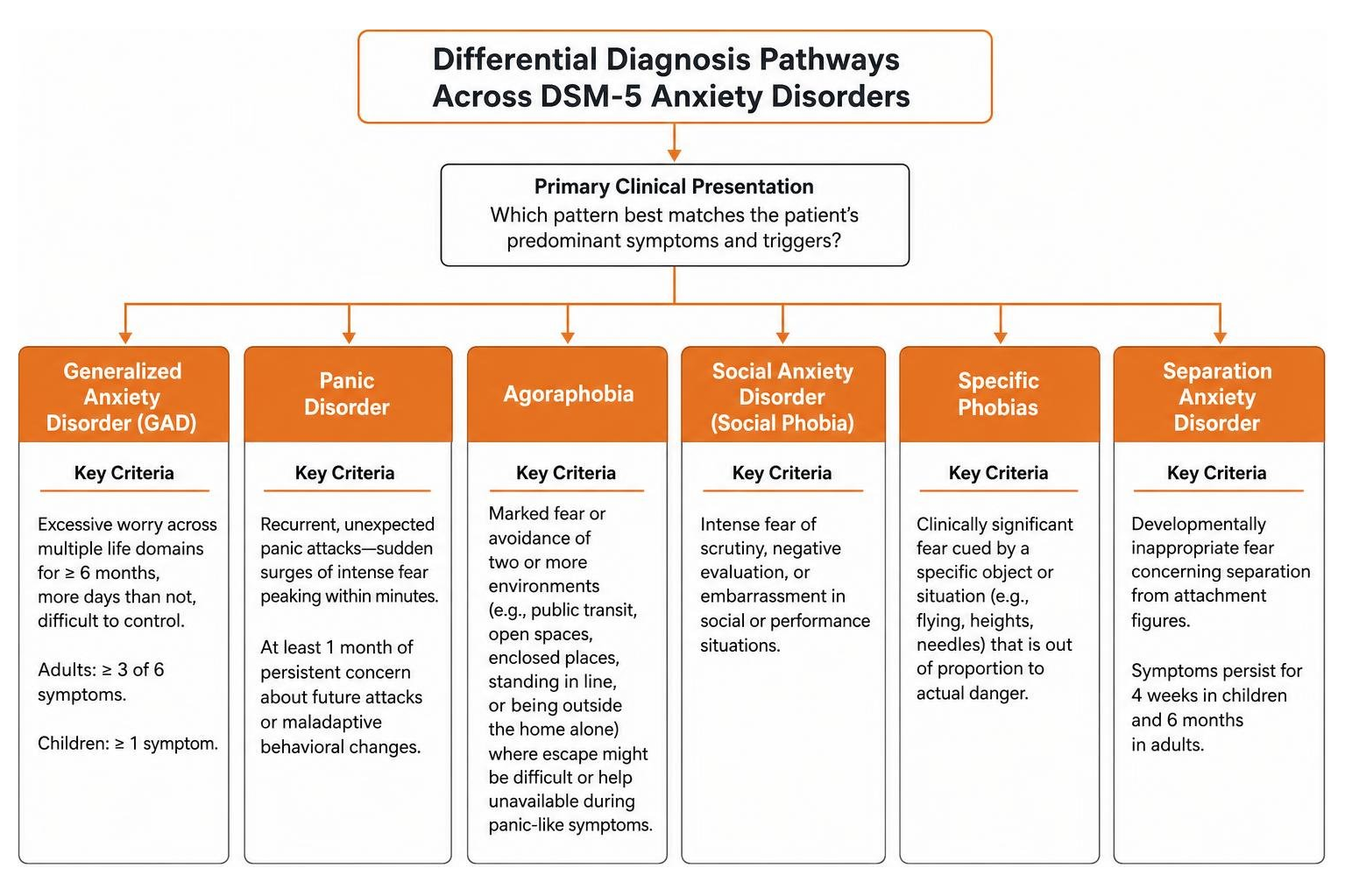
- Panic Disorder: Marked by recurrent, unexpected panic attacks—abrupt surges of intense fear reaching a peak within minutes. A diagnosis requires at least one month of persistent concern about future attacks or maladaptive behavioral changes (such as avoiding exercise or unfamiliar locations).
- Agoraphobia: Marked fear or avoidance of two or more environments (e.g., public transit, open spaces, enclosed places, standing in line, or being outside the home alone) where escape might be difficult or help unavailable during panic-like symptoms.
- Social Anxiety Disorder (Social Phobia): Intense fear of scrutiny, negative evaluation, or embarrassment in social or performance situations.
- Specific Phobias: Clinically significant fear cued by a specific object or situation (e.g., flying, heights, needles) that is out of proportion to actual danger.
- Separation Anxiety Disorder: Developmentally inappropriate fear concerning separation from attachment figures. As detailed in clinical diagnostic guidelines, this condition affects children (roughly 4% prevalence) and adults (0.9% to 1.9% prevalence), requiring symptoms to persist for 4 weeks in youth and 6 months in adults.
- Substance/Medication-Induced Anxiety Disorder: Prominent anxiety or panic attacks caused directly by substance intoxication, withdrawal, or medication exposure.
Clinical Assessment, Screening Tools, and Differential Diagnosis
Measurement Tools and Screening Protocols
Standardized psychometric scales provide measurable benchmarks for symptom severity and treatment tracking. The Generalized Anxiety Disorder 7-item scale (GAD-7) is the standard self-administered screening instrument. It asks patients to rate the frequency of core anxiety symptoms over the previous two weeks on a scale of 0 to 3.
- Scores 0–4: Minimal anxiety
- Scores 5–9: Mild anxiety
- Scores 10–14: Moderate anxiety (clinical threshold for further diagnostic workup)
- Scores 15–21: Severe anxiety
To interpret your numbers, see our guide on Decoding Your GAD-7 Anxiety Score with MDCalc. Because anxiety frequently coexists with mood disorders, clinicians often pair the GAD-7 with the Patient Health Questionnaire-9 (PHQ-9). We explore this combination in our article on Double Trouble: Why Doctors Use Both GAD-7 and PHQ-9.
Differential Diagnosis and Medical Rule-Outs
Before confirming a psychiatric diagnosis, clinicians must evaluate potential physical causes. Many medical conditions trigger autonomic hyperarousal, mimicking psychiatric anxiety. Understanding How to Tell If Your Worry Is Actually GAD involves systematic medical rule-outs:
- Endocrine Disorders: Hyperthyroidism and pheochromocytoma can cause tachycardia, tremors, heat intolerance, and sweating.
- Cardiovascular Conditions: Supraventricular tachycardia, arrhythmias, and mitral valve prolapse can provoke sudden physical panic sensations.
- Neurological Disorders: Temporal lobe epilepsy, vestibular dysfunction, and early-stage neurodegenerative diseases can manifest with acute anxiety or disequilibrium.
- Respiratory Illnesses: Asthma, chronic obstructive pulmonary disease (COPD), and sleep apnea generate hypoxia-driven distress.
- Substance-Related Factors: Excessive caffeine, stimulant medications, or withdrawal from alcohol, sedatives, and opioids can mirror anxiety disorders, as outlined in the Generalized Anxiety Disorder – Psychiatry – Merck Manual Professional Edition.
Prevalence, Risk Factors, and Common Comorbidities

Anxiety disorders are the most common mental health concern in the United States, affecting more than 40 million adults (approximately 19% to 20% of the adult population) every year. The 12-month prevalence for GAD specifically is estimated between 2.9% and 3.4% in the U.S. and around 2% globally.
Prevalence shows a clear gender pattern: GAD is diagnosed roughly twice as often in women as in men, with a lifetime prevalence of 7.7% in women compared to 4.6% in men. The median age of onset is 30 years, though many individuals describe feeling anxious from early childhood. Pediatric anxiety is also common: roughly 7% of children aged 3 to 17, and about 1 in 4 adolescents between 13 and 18, experience an anxiety disorder.
Etiology involves genetic, neurobiological, and environmental influences:
- Genetics: First-degree relatives of individuals with GAD are significantly more likely to develop the condition, with heritability estimated at roughly 30% to 33%.
- Temperament: Traits like behavioral inhibition and high neuroticism (negative affectivity) increase susceptibility.
- Environment: Childhood adversity, trauma, chronic physical illness, and prolonged psychosocial stress often act as triggers.
Comorbidity is common. An estimated 60% of people diagnosed with anxiety also report symptoms of major depressive disorder. When unaddressed, this overlap creates a compounding cycle. You can learn more about these interconnected dynamics in our guide on How Anxiety, Depression, and Sleep Problems Feed Each Other. Clinicians documented in the Generalized Anxiety Disorder – Psychiatry – MSD Manual Professional Edition emphasize that managing these overlaps requires coordinated psychiatric and psychotherapeutic care.
Evidence-Based Treatment Pathways and Long-Term Management
First-Line Psychotherapy and Behavioral Interventions
Psychotherapy is a cornerstone of long-term recovery for anxiety disorders. Cognitive Behavioral Therapy (CBT) carries the strongest empirical backing, offering remission and response rates comparable or superior to pharmacotherapy without medication side effects.
We dive into how these cognitive interventions rewire thought loops in our piece on Mind Over Matter with CBT and Evidence-Based Therapy. Core therapeutic components include:
- Cognitive Restructuring: Identifying and reframing cognitive distortions, such as catastrophizing and probability overestimation.
- Interoceptive and In Vivo Exposure: Gradual, systematic exposure to physical sensations of anxiety and avoided situations to build distress tolerance.
- Applied Relaxation and Somatic Regulation: Progressive muscle relaxation (PMR), diaphragmatic breathing, and autogenic training to downregulate autonomic arousal. Practice these techniques directly using our step-by-step walkthrough on Tense to Calm: Step-by-Step Relaxation Exercises That Melt Anxiety Away.
- Mindfulness-Based Stress Reduction (MBSR): Cultivating present-moment awareness and nonjudgmental acceptance to break recursive worry cycles.
- Lifestyle Interventions: Regular aerobic exercise (e.g., 20 minutes at 60% to 90% maximal heart rate three times weekly), proper sleep hygiene, and minimizing caffeine and nicotine.
Pharmacotherapy and Medication Management

When anxiety causes moderate-to-severe functional impairment, combining psychotherapy with pharmacotherapy provides the fastest and most durable relief.
- SSRIs and SNRIs (First-Line): Selective Serotonin Reuptake Inhibitors (e.g., escitalopram, sertraline) and Serotonin-Norepinephrine Reuptake Inhibitors (e.g., venlafaxine XR, duloxetine) are the primary pharmacologic treatments. They typically require 4 to 8 weeks at therapeutic doses to reach full clinical efficacy.
- Buspirone (Second-Line / Adjunct): A 5-HT1A partial agonist that treats chronic worry without sedation or dependence liability. Because its onset takes 2 to 4 weeks, it is not used for as-needed symptom relief.
- Benzodiazepines (Short-Term / Crisis Only): Agents like clonazepam or lorazepam offer immediate relief by enhancing GABA activity. However, due to risks of physiological dependence, cognitive blunting, tolerance, and rebound anxiety, guidelines restrict them to short-term bridge therapy (1 to 2 weeks) while waiting for antidepressants to take effect.
- Maintenance & Discontinuation: Once full symptom remission is achieved, clinical guidelines recommend continuing medications for at least 12 months before initiating a gradual taper to protect against relapse. For an exploration of non-pharmacological routes, see Managing Anxiety Without Medication: When Psychotherapy Is Enough.
Frequently Asked Questions About Anxiety DSM-5 Criteria
What is the 6-month rule for anxiety under the DSM-5?
The DSM-5 requires excessive worry to occur more days than not for at least six months to prevent diagnosing temporary, situational stress as a chronic anxiety disorder. This duration criterion confirms that symptoms represent a persistent baseline disruption rather than an acute adjustment reaction.
How many symptoms are required for a GAD diagnosis in adults versus children?
Adults must experience at least three of the six DSM-5 physical and cognitive symptoms (restlessness, fatigue, concentration issues, irritability, muscle tension, sleep disturbance). In contrast, children only need one symptom alongside excessive, uncontrollable worry.
How do clinicians differentiate GAD from everyday stress?
Everyday stress is typically tied to a specific trigger, fluctuates with circumstances, and feels manageable. Generalized anxiety disorder involves chronic, pervasive worry across multiple areas of life that feels difficult to control, triggers physical tension, and impairs social, occupational, or daily functioning.
Conclusion
Understanding the DSM-5 criteria provides clarity for individuals living with chronic, overwhelming worry. Accurate diagnosis relies on structured clinical interviews, objective screening instruments like the GAD-7, and thorough medical rule-outs.
Because generalized anxiety disorder is a chronic condition, long-term recovery is supported by evidence-based care combining CBT, lifestyle medicine, and carefully managed pharmacotherapy. If you or a loved one is navigating persistent anxiety, our multidisciplinary clinical team at Oak Health Center provides comprehensive psychiatric evaluations, medication management, and specialized psychotherapy across our Southern California clinics (Beverly Hills, Fullerton, Laguna Hills, Rancho Cucamonga, and South Pasadena) and throughout California via telehealth. Learn more by exploring our in-depth resource, Meeting the Criteria: A Deep Dive into GAD DSM-5 Standards.
References
Sadaf Munir, Veronica Takov. “Generalized Anxiety Disorder.” StatPearls Publishing, 2022. NBK441870.