


Understanding the Types of Psychotherapy for Anxiety — and Which One Is Right for You
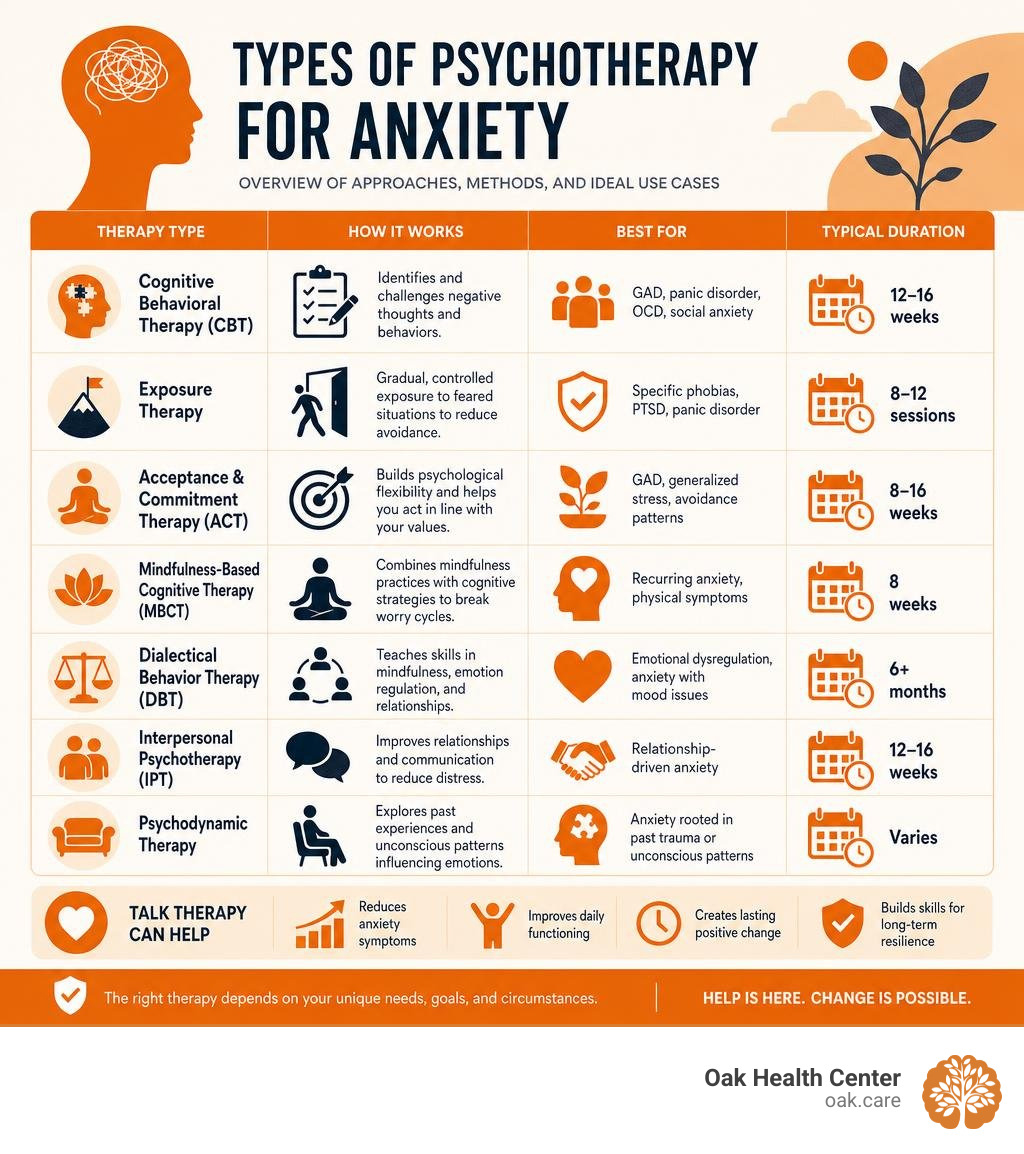
The types of psychotherapy for anxiety include several well-researched, effective options. Here is a quick overview:
| Therapy Type | Best For | Typical Duration |
|---|---|---|
| Cognitive Behavioral Therapy (CBT) | GAD, panic disorder, OCD, social anxiety | 12–16 weeks |
| Exposure Therapy | Specific phobias, PTSD, panic disorder | 8–12 sessions |
| Acceptance and Commitment Therapy (ACT) | GAD, generalized stress, avoidance patterns | 8–16 weeks |
| Mindfulness-Based Cognitive Therapy (MBCT) | Recurring anxiety, physical symptoms | 8 weeks |
| Dialectical Behavior Therapy (DBT) | Emotional dysregulation, anxiety with mood issues | 6+ months |
| Interpersonal Psychotherapy (IPT) | Relationship-driven anxiety | 12–16 weeks |
| Psychodynamic Therapy | Anxiety rooted in past trauma or unconscious patterns | Varies |
Anxiety disorders are incredibly common. Specific phobias affect up to 12% of Americans. Social anxiety disorder affects about 7%. Generalized anxiety disorder affects roughly 3%. Women are about twice as likely as men to experience one.
The good news? All of these conditions are highly treatable. Psychotherapy — talking with a trained mental health professional — is one of the most effective tools available. Research consistently shows it can reduce symptoms, improve daily functioning, and produce results that last.
But not every therapy works the same way for every person. The right fit depends on your specific anxiety type, your goals, and your life circumstances. That is exactly what this guide will help you figure out.
I’m Andrew Brewer, Practice Manager at Oak Health Center, where I’ve worked closely with our clinical teams to expand access to evidence-based care — including the types of psychotherapy for anxiety covered in this guide. My work building and scaling mental health programs across Southern California gives me a front-row seat to what actually helps patients get better. In the sections ahead, we’ll break down each major therapy type so you can walk into your first appointment informed and confident.
Types of psychotherapy for anxiety word roundup:
Understanding Anxiety Disorders and the Role of Talk Therapy
To understand how talk therapy works, we first have to look at what anxiety actually does to the body and the mind. Normal nervousness is a temporary reaction to stress—like feeling your heart race before giving a big presentation or taking a test. An anxiety disorder, however, is a medical condition where the fear or dread is out of proportion to the situation, cannot be easily controlled, and forces you into avoidant behaviors that disrupt your daily life.
Physically, anxiety can show up as a pounding heart, sweating, muscle tension, and chronic fatigue. Emotionally and cognitively, it brings persistent worry, irritability, and a constant sense of impending doom. Left untreated, chronic anxiety can lead to secondary complications, such as depression or substance abuse, as individuals try to self-medicate their distress. If you are trying to figure out what you are experiencing, learning to identify symptoms of anxiety and depression is a crucial first step.
At the biological level, anxiety is deeply tied to how our brains process fear. The amygdala—the brain’s emotional alarm system—plays a central role in managing fear and anxiety. In people with anxiety disorders, the amygdala shows increased activity, firing off “fight-or-flight” signals even when there is no real danger. Talk therapy helps by strengthening the connection between the prefrontal cortex (the rational, thinking part of the brain) and the amygdala, helping you calm that alarm system down.

When anxiety is left unaddressed, it often feeds on itself. Avoidance might make you feel better in the short term, but it actually reinforces the brain’s belief that the situation is dangerous. Understanding why your anxiety keeps getting worse often reveals this cycle of avoidance. Talk therapy breaks this loop by helping you safely confront your fears, reframe your thoughts, and build healthier coping mechanisms.
Comparing the Primary Types of Psychotherapy for Anxiety
When you begin looking at the various types of psychotherapy for anxiety, the options can feel overwhelming. However, modern mental health care relies on evidence-based modalities—treatments that have been rigorously tested in clinical trials.
A landmark network meta-analysis published in JAMA Psychiatry analyzed 65 randomized clinical trials comprising 5,048 participants (with a demographic makeup of 70.9% women and 29.1% men, and a mean age of 42.2 years). The study compared several major psychotherapies to determine their short- and long-term effectiveness. This robust scientific evidence helps us understand which therapies deliver the most reliable results. You can read the full study here: Psychotherapies for GAD in Adults.
To help you compare the primary evidence-based options, we have structured a direct comparison of the three most widely researched therapies:
| Feature | Cognitive Behavioral Therapy (CBT) | Acceptance & Commitment Therapy (ACT) | Exposure Therapy |
|---|---|---|---|
| Core Philosophy | Identify and change unrealistic, unhelpful thoughts and beliefs. | Accept difficult thoughts nonjudgmentally while taking values-based action. | Gradually and safely confront feared objects, situations, or memories. |
| Primary Mechanism | Cognitive restructuring and behavioral experiments. | Developing psychological flexibility and mindfulness. | Systematic desensitization and habituation. |
| Best Suited For | Generalized Anxiety, Panic Disorder, Social Anxiety. | Chronic worry, general stress, and emotional avoidance. | Specific phobias, PTSD, OCD, and Panic Disorder. |
| Patient Role | Highly active; involves homework and tracking thought patterns. | Active; focuses on clarifying personal values and practicing acceptance. | Active; requires facing feared stimuli in a controlled environment. |
| Proven Long-Term Efficacy | Strongest clinical evidence for sustained long-term relief (3–12 months). | Strong short-term relief; long-term clinical data is growing rapidly. | Highly effective for specific triggers; results are highly durable. |
Cognitive Behavioral Therapy: The Gold Standard among Types of Psychotherapy for Anxiety
Cognitive Behavioral Therapy (CBT) is widely considered the gold standard of anxiety treatment. It is a structured, short-term, and highly practical intervention that typically lasts between 12 and 16 weeks, with sessions held once a week.
CBT operates on a simple premise: your thoughts, feelings, and behaviors are interconnected. It isn’t just external events that cause your anxiety, but the way you interpret those events. For a deeper look at how a typical treatment plan is organized, you can read our step-by-step guide to psychotherapy.
During CBT, you will work closely with your therapist to identify “cognitive distortions”—unhelpful, automatic thought patterns like catastrophizing (assuming the worst will happen) or mind-reading (believing you know what others are thinking). Once these patterns are identified, you will use cognitive restructuring to challenge and replace them with more balanced, realistic beliefs.
You will also participate in behavioral experiments. For example, if you believe that speaking up in a meeting will lead to humiliation, your therapist might help you test that belief in a safe, controlled way.
The clinical evidence supporting CBT is incredibly strong. According to a comprehensive systematic review, traditional CBT is associated with a significant reduction in generalized anxiety disorder symptoms compared to treatment as usual, showing a standardized mean difference (SMD) of -0.74 (with moderate certainty). Furthermore, a 2018 review confirmed that CBT is highly effective compared with a placebo, particularly for obsessive-compulsive disorder (OCD), generalized anxiety disorder (GAD), and acute stress disorder.
Crucially, the benefits of CBT are built to last. The JAMA Psychiatry meta-analysis revealed that among all evaluated psychotherapies, only traditional CBT remained significantly associated with greater effectiveness than treatment as usual at 3 to 12 months of follow-up (maintaining an SMD of -0.60). You can explore the detailed findings in the published paper: CBT efficacy for GAD.
To get the most out of CBT, you must be an active participant. This means keeping detailed records between appointments, completing assigned homework, and repeatedly practicing your new skills outside of your therapy sessions.
Exposure Therapy and Systematic Desensitization
Exposure therapy is a specific type of behavioral therapy designed to help you confront your fears. When you have an anxiety disorder, you likely avoid the things, places, or situations that trigger your anxiety. While avoidance keeps you comfortable in the moment, it actually keeps your anxiety alive by preventing you from learning that your feared outcomes are unlikely to happen.
In exposure therapy, a therapist creates a safe, controlled environment where you are gradually introduced to your triggers. This process is called systematic desensitization. You might start by simply talking about the feared object or situation, then looking at photos, and eventually confronting it in real life (in-vivo exposure). Over time, your brain goes through “habituation”—it learns that the trigger is not actually dangerous, and your physical anxiety response naturally decreases.
Exposure therapy is highly effective for specific phobias, panic disorder, social anxiety disorder, and PTSD. It is also a core component of treating obsessive-compulsive disorder through a method called Exposure and Response Prevention (ERP). If you are struggling with intrusive thoughts, you can read more about how therapy helps with OCD.

One of the most exciting advancements in this field is Virtual Reality Exposure Therapy (VRE). VRE allows therapists to precisely control the exposure stimuli in a way that real life does not allow. For example, if you have a severe fear of flying, a therapist can introduce simulated airplane turbulence only when you are clinically ready, rather than booking an actual flight. When seeking VRE, we recommend prioritizing finding a clinician who is specifically trained in the modality rather than simply looking for a clinic with VR equipment.
Acceptance and Commitment Therapy (ACT) and Mindfulness-Based Approaches
Acceptance and Commitment Therapy (ACT) represents what clinicians call the “third wave” of cognitive behavioral therapy. While traditional CBT focuses on identifying and changing the content of your negative thoughts, ACT takes a different approach: it teaches you to change your relationship to those thoughts.
The core philosophy of ACT is that trying to avoid, suppress, or control painful thoughts and emotions only causes more struggle and suffering. Instead, ACT uses mindfulness and acceptance strategies to help you observe your anxious thoughts in a nonjudgmental way. You learn to let these thoughts come and go like clouds in the sky, without reacting to them or trying to force them away.
ACT focuses heavily on two main areas:
- Psychological Flexibility: The ability to stay in the present moment and accept your thoughts and feelings without letting them control your actions.
- Values Clarification: Identifying what truly matters to you (such as family, career, or creativity) and committing to taking actions that align with those values, even when anxiety is present.
If you are looking for ways to recover without relying on prescriptions, ACT is an incredibly powerful tool. You can read more about our approach to managing anxiety without medication.
From a clinical standpoint, third-wave CBTs like ACT have seen a massive surge in research since 2010. Clinical trials show they are highly effective for acute, short-term anxiety relief, demonstrating a standardized mean difference of -0.76 compared to treatment as usual (with moderate certainty). While the long-term effect sizes of third-wave therapies can sometimes diminish slightly over time compared to traditional CBT, they remain an exceptional option for building mindfulness and psychological flexibility.
Other Evidence-Based Modalities: DBT, IPT, and Psychodynamic Therapy
While CBT, ACT, and exposure therapy are the most common treatments, several other evidence-based modalities can be incredibly helpful, especially when your anxiety is tied to relationship stress, emotional regulation difficulties, or past experiences.
- Dialectical Behavior Therapy (DBT): Originally designed to treat borderline personality disorder, DBT is highly effective for managing severe anxiety, panic, and emotional dysregulation. It blends traditional CBT techniques with Eastern mindfulness practices. DBT focuses on four core skill areas: mindfulness, distress tolerance (how to survive an acute anxiety attack without making it worse), emotion regulation, and interpersonal effectiveness. It often combines individual therapy with structured group skills training.
- Interpersonal Psychotherapy (IPT): IPT is a structured, short-term treatment (typically 12 to 16 weekly sessions) that focuses on your interpersonal relationships and social functioning. If your anxiety is driven by relationship conflicts, unresolved grief, life transitions (like moving to a new city or changing jobs), or social isolation, IPT helps you improve your communication skills and build a stronger social support network.
- Psychodynamic Therapy: This is a more traditional approach that focuses on unconscious forces, deep-seated beliefs, and past experiences. In psychodynamic therapy, you and your therapist will explore how your childhood experiences and early relationships shaped your current defense mechanisms and anxiety patterns. It is highly valuable for individuals whose anxiety is complex, multi-layered, or tied to unhealed past traumas.
Rather than sticking strictly to one single therapy, many experienced therapists utilize an integrative approach, blending these different modalities to match your unique needs and triggers.
Key Factors in Choosing the Right Treatment Plan
Finding the right treatment plan is a highly personalized process. Anxiety is not a one-size-fits-all condition, and your therapy shouldn’t be either.
First, consider the timeline. Many short-term, behavior-specific treatments can be successfully completed in 12 to 16 sessions. However, the exact duration of your therapy will depend on the severity of your symptoms, your personal history, and how actively you practice your skills outside of sessions. To read more about how different modalities are structured, you can refer to this comprehensive Healthline guide to anxiety therapy.
You will also want to consider the format of your therapy. With modern advancements in mental health care, you now have the choice between meeting a therapist in a physical office or using online teletherapy. Both formats have unique advantages, and choosing the right one depends on your schedule, comfort level, and lifestyle. To help you decide, we have put together a detailed comparison of teletherapy vs in-person care.

Finally, take a close look at your health insurance plan. Many managed care companies cover mental health services, but they may limit the number of covered psychotherapy sessions per year (often between 5 and 20). Under federal mental health parity laws, employers with 51 or more employees who offer mental health benefits must provide financial coverage parity with physical medical disorders. We always recommend reviewing your network restrictions, copayments, and maximum limits before starting treatment.
How to Choose Between Different Types of Psychotherapy for Anxiety
When you are ready to choose a therapy type, we recommend starting with a clear assessment of your primary anxiety triggers.
- If your anxiety is driven by constant, uncontrollable worry about everyday life, traditional CBT or ACT is often the best starting point.
- If your anxiety is tied to a specific object or situation (like a fear of heights, needles, or driving), exposure therapy is highly recommended.
- If your anxiety is closely linked to relationship conflicts or major life changes, Interpersonal Psychotherapy (IPT) may be the ideal fit.
Finding the right therapist is often a process of trial and error. It is completely normal to interview a few different candidates before finding someone you click with. When you meet with a potential therapist, ask about their licensing, clinical specializations, and the specific evidence-based modalities they use.
To help you prepare for your first session and feel comfortable with the process, we have outlined exactly what to expect in your first therapy appointment.
Frequently Asked Questions about Anxiety Therapy
Which type of therapy is considered the first-line treatment for generalized anxiety disorder?
Cognitive Behavioral Therapy (CBT) is widely considered the first-line psychotherapeutic treatment for generalized anxiety disorder (GAD). This recommendation is backed by decades of rigorous clinical research, including the extensive JAMA Psychiatry study on GAD.
While other options like third-wave CBTs (such as ACT) and relaxation therapy show excellent results for short-term, acute symptom relief, CBT is the only modality that has consistently demonstrated sustained, long-term effectiveness (3 to 12 months post-treatment) in large-scale clinical trials.
Can digital or online therapies be as effective as in-person therapy for anxiety?
Yes. Clinical research shows that internet-delivered Cognitive Behavioral Therapy (iCBT) and video-based teletherapy are highly effective, especially when they are guided by a licensed clinician or coach.
Online therapy offers a highly accessible, flexible, and low-cost entry point for managing anxiety symptoms, making it an excellent option for busy professionals or those with limited mobility. To explore which format fits your lifestyle best, take a look at our guide on teletherapy vs in-person care.
What is the role of medication alongside psychotherapy for anxiety disorders?
For many individuals, combining psychotherapy with medication provides the most effective, comprehensive treatment plan. While psychotherapy focuses on building long-term coping skills and changing thought patterns, medications—such as Selective Serotonin Reuptake Inhibitors (SSRIs)—can help regulate brain chemistry and reduce the physical severity of your anxiety symptoms. This reduction in baseline anxiety often makes it much easier to actively participate and engage in your therapy sessions.
According to a large-scale meta-analysis comparing treatments, both approaches have distinct strengths, and a collaborative care team can help you decide if a combined approach is right for you. You can read the details of this clinical comparison here: Psychological and pharmacological treatments for GAD.
Conclusion
Anxiety can feel incredibly isolating, but you do not have to navigate it alone. Whether you choose traditional Cognitive Behavioral Therapy, modern Acceptance and Commitment Therapy, or a specialized exposure-based approach, taking that first step toward professional support is a powerful act of self-care.
At Oak Health Center, we are dedicated to making compassionate, evidence-based mental healthcare simple and accessible. We offer personalized treatment plans tailored to your unique goals across our five Southern California locations—including Beverly Hills, Fullerton, Laguna Hills, Rancho Cucamonga, and South Pasadena—as well as through our convenient statewide virtual services in California.
If you are ready to find relief and take back control of your emotional well-being, we invite you to explore our professional psychotherapy services and schedule a consultation with our team today.