


Normal Stress vs. Generalized Anxiety Disorder Symptoms
Generalized anxiety disorder symptoms are more than just feeling stressed or nervous before a big meeting. They are persistent, hard-to-control worries that follow you into everyday moments — the grocery run, the drive home, even the quiet before sleep.
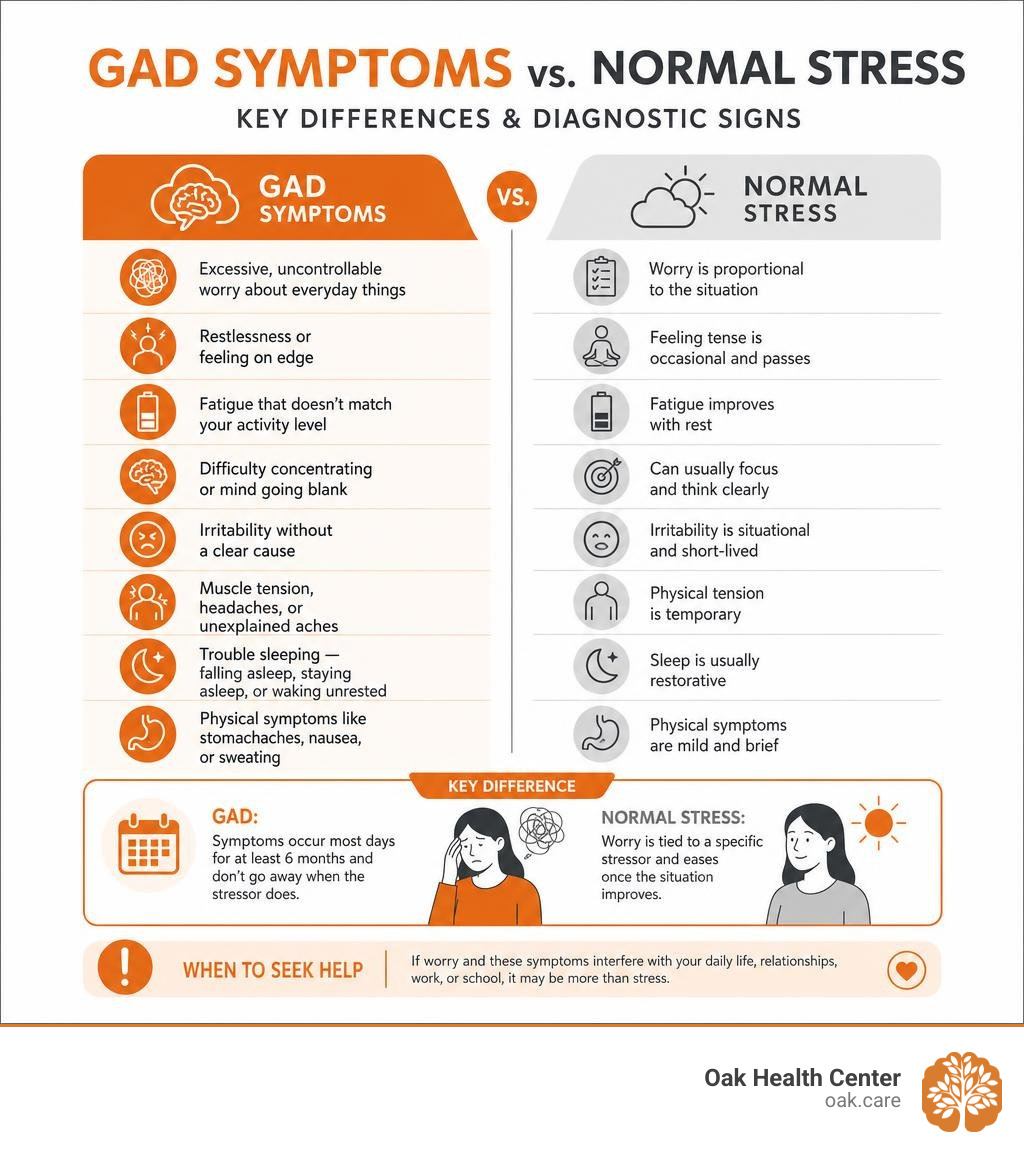
Here is a quick look at the most common GAD symptoms:
- Excessive, uncontrollable worry about everyday things (work, health, money, family)
- Restlessness or feeling on edge most of the time
- Fatigue that doesn’t match your activity level
- Difficulty concentrating or mind going blank
- Irritability without a clear cause
- Muscle tension, headaches, or unexplained aches
- Trouble sleeping — falling asleep, staying asleep, or waking unrested
- Physical symptoms like stomachaches, nausea, or sweating
The key difference from normal stress? These symptoms show up most days for at least six months, and they don’t go away when the stressor does.
Most of us worry. Deadlines pile up. Kids get sick. Bills come due. That kind of worry makes sense — it has a cause, and it fades when things settle down.
But for millions of people, the worry never really stops. It just shifts to the next thing. And the next. According to research, GAD currently affects about 3% of U.S. adults — and only 43% of those affected are receiving treatment.
If you’ve been wondering whether your worry has crossed a line, you’re not alone. And you’re asking exactly the right question.
I’m Andrew Brewer, Practice Manager at Oak Health Center, where I’ve helped grow our clinical programs — including mental health services for conditions like generalized anxiety disorder symptoms — to serve significantly more patients across Southern California. In that role, I’ve seen how often chronic anxiety goes unrecognized until it starts seriously disrupting daily life, which is exactly why we put this guide together.
Important generalized anxiety disorder symptoms terms:
Living in Southern California can be incredibly demanding. Between navigating traffic on the 405, managing demanding careers, and keeping up with family obligations, stress is a regular passenger in our daily lives. But how do we know when our daily stress has crossed the line into clinical anxiety?

The primary difference lies in the source and the duration of the feelings. Stress is typically a reaction to an external trigger. If you have an upcoming performance review at work, a looming financial bill, or a relationship conflict, feeling anxious and tense is a completely normal response. Once that external trigger is resolved—the review is over, the bill is paid, or the conflict is settled—the stress naturally begins to dissipate.
Anxiety, particularly when it stems from GAD, is an internal response that persists even in the absence of an active, immediate threat. It is a constant feeling of being overwhelmed. While stress might make you feel frustrated or anxious for a few days, clinical GAD symptoms linger week after week, month after month, regardless of whether your external life is calm or chaotic.
The severity and impact on your daily functioning also set GAD apart. Normal stress might make you lose a night of sleep or feel slightly impatient. GAD, however, can make simple daily activities like cooking, driving, or leaving the house feel incredibly overwhelming. In women, this can sometimes present as sudden, intense escalations, which we explore in detail in our resource, Is It Just Stress or an Anxiety Attack? A Guide for Women.
Defining GAD and Normal Worry
To truly understand Generalized Anxiety Disorder, we have to look at how the mind directs its focus. In normal worry, your thoughts are usually anchored to a specific, realistic problem. You worry about a sick family member, a broken-down car, or a mistake you made on a project. The worry is proportional to the situation, and you can usually find a way to distract yourself or solve the problem.
With GAD, the worry is characterized by a shifting focus. Instead of worrying about one concrete problem, your mind constantly jumps from one everyday topic to another. If your finances are fine, your mind shifts to worrying about your health. If your health is perfect, you start worrying about the safety of your loved ones, being late to an appointment, or whether you completed your daily chores correctly. The worry is uncontrollable, excessive, and often completely out of proportion to the actual likelihood or impact of the feared event.
The National Institute of Mental Health (NIMH) emphasizes that people with GAD struggle to control their anxiety most days, finding it incredibly difficult to quiet their minds.
To help visualize this, let’s compare the two:
| Feature | Normal Worry | Generalized Anxiety Disorder (GAD) |
|---|---|---|
| Trigger | Tied to a specific, realistic external event | Often occurs without a clear trigger; shifts constantly |
| Controllability | You can put the worry aside to focus on other tasks | The worry feels uncontrollable and intrusive |
| Duration | Temporary; resolves once the situation is over | Persistent; lasts for 6 months or longer |
| Physical Symptoms | Mild, short-lived tension or a temporary headache | Chronic muscle tension, fatigue, digestive issues, insomnia |
| Impact on Life | Does not significantly impair your ability to function | Interferes with work, relationships, and daily tasks |
The Emotional and Physical Signs of GAD
One of the most common misconceptions about GAD is that it is “all in your head.” In reality, GAD is a full-body experience. The brain and the body are deeply connected, and chronic mental worry inevitably shows up as physical, somatic symptoms.

When your brain is stuck in a loop of constant worry, it keeps your nervous system in a low-grade, perpetual state of “fight-or-flight.” This floods your system with stress hormones like cortisol and adrenaline, which can cause a wide variety of physical complaints. In fact, many people first visit a primary care doctor for somatic symptoms like chronic headaches or digestive issues, only to discover that the root cause is actually an anxiety disorder.
We discuss this comprehensive impact in our guide on 5 Ways Anxiety Shows Up in Everyday Life and What to Do About It.
Cognitive and Emotional Generalized Anxiety Disorder Symptoms
On an emotional and cognitive level, GAD can feel like a constant, quiet hum of dread in the background of everything you do. It can make you feel as though something terrible is about to happen, even if there is absolutely no evidence to support that feeling.
Key cognitive and emotional symptoms include:
- Irritability: Feeling constantly on edge or quick to anger over minor inconveniences. Because your mind is already carrying a heavy load of worry, you have very little emotional reserve left to handle daily frustrations.
- Difficulty Concentrating: Finding it hard to focus on work, reading, or conversations because your brain is busy scanning for potential threats. Some people describe this as their mind “going blank” during important tasks.
- Constant Overwhelm: Feeling like the demands of everyday life are simply too much to handle, leading to procrastination or avoidance.
- Perpetual Dread: A persistent, unexplained feeling of worry about the future, often manifesting as “what-if” thinking.
This is particularly common among high-achieving professionals. Many people assume that successful, productive individuals don’t struggle with anxiety, but the reality is that anxiety often drives perfectionism and overworking. To learn more about how this dynamic plays out in corporate and clinical settings, read our analysis on Anxiety in High-Achieving Professionals: What You Should Know.
Physical and Somatic Manifestations of Chronic Anxiety
Because GAD keeps your body’s stress response active, physical symptoms are incredibly common. According to the Mayo Clinic, these somatic signs can mimic other medical conditions, which is why a thorough medical evaluation is always recommended.
The most common physical symptoms of GAD include:
- Chronic Muscle Tension: Constantly clenching your jaw, furrowing your brow, or holding tension in your shoulders and neck.
- Fatigue: Feeling completely exhausted, even if you haven’t done physical labor. Chronic worry drains your physical energy.
- Headaches: Tension headaches caused by chronic muscle tightening in the neck and scalp.
- Digestive Issues and IBS: The gut is often called the “second brain” because it is highly sensitive to stress. GAD frequently causes nausea, diarrhea, cramping, and irritable bowel syndrome (IBS).
- Trembling or Shakiness: Feeling physically unsteady, especially during moments of heightened worry.
- Excessive Sweating: Cold sweats, clammy hands, or sweating even in cool environments.
How GAD Manifests in Children and Teens
Anxiety doesn’t only affect adults. Children and teenagers can also develop GAD, but they often lack the vocabulary to explain what they are feeling. Instead of saying “I feel anxious,” they are much more likely to show their anxiety through behavioral changes or physical complaints.
In younger demographics, GAD often manifests as an intense fear of making mistakes, a strong need for approval, and a hyper-focus on school performance. If left unaddressed, pediatric anxiety can make school, friendships, and daily development incredibly challenging.
Pediatric Generalized Anxiety Disorder Symptoms and Behaviors
Children and teens with GAD often worry about the exact same things adults do, but they also have unique, age-specific worries. They might worry excessively about catastrophic events (like natural disasters, war, or family safety), fitting in with peers, or failing a test.
Common signs of pediatric GAD include:
- Academic Perfectionism: Spending hours redoing homework to make sure it is flawless, or experiencing extreme distress over a slightly less-than-perfect grade.
- Constant Reassurance Seeking: Asking parents or teachers the same questions repeatedly to ensure everything is okay (e.g., “Are you sure you’ll pick me up on time?” or “Are you mad at me?”).
- Physical Complaints: Frequently complaining of stomachaches, headaches, or nausea, especially on school mornings.
- Avoidance Behaviors: Avoiding social gatherings, school, or trying new activities out of a fear of failure or embarrassment.
- Extreme Clinginess: Difficulty being separated from parents or primary caregivers, even in familiar environments.
The clinical reference database StatPearls (NCBI Bookshelf) notes that childhood anxiety is common, affecting about 1 in 4 children between the ages of 13 and 18, with a median age of onset around 11 years. Recognizing these signs early allows for gentle, effective interventions that can set young people up for a healthier, happier future.
DSM-5 Diagnostic Criteria and Causes of GAD
When our clinicians evaluate someone for GAD at Oak Health Center, we use the diagnostic standards outlined in the Diagnostic and Statistical Manual of Mental Disorders (DSM-5-TR). These criteria help us differentiate between temporary situational anxiety and a formal anxiety disorder.
According to the MSD Manual Professional Edition, a formal diagnosis of GAD requires:
- Excessive anxiety and worry about a variety of events or activities, occurring more days than not for at least 6 months.
- Difficulty controlling the worry.
- The anxiety is associated with at least three of the following six symptoms in adults (only one symptom is required for children):
- Restlessness or feeling keyed up/on edge
- Being easily fatigued
- Difficulty concentrating or mind going blank
- Irritability
- Muscle tension
- Sleep disturbance (difficulty falling or staying asleep, or restless, unsatisfying sleep)
- The symptoms cause significant distress or impairment in social, occupational, or other important areas of functioning.
- The disturbance is not due to the direct physiological effects of a substance (e.g., drug abuse, medication) or a general medical condition (e.g., hyperthyroidism).
To understand why GAD develops, we look at a combination of biological, genetic, and environmental factors:
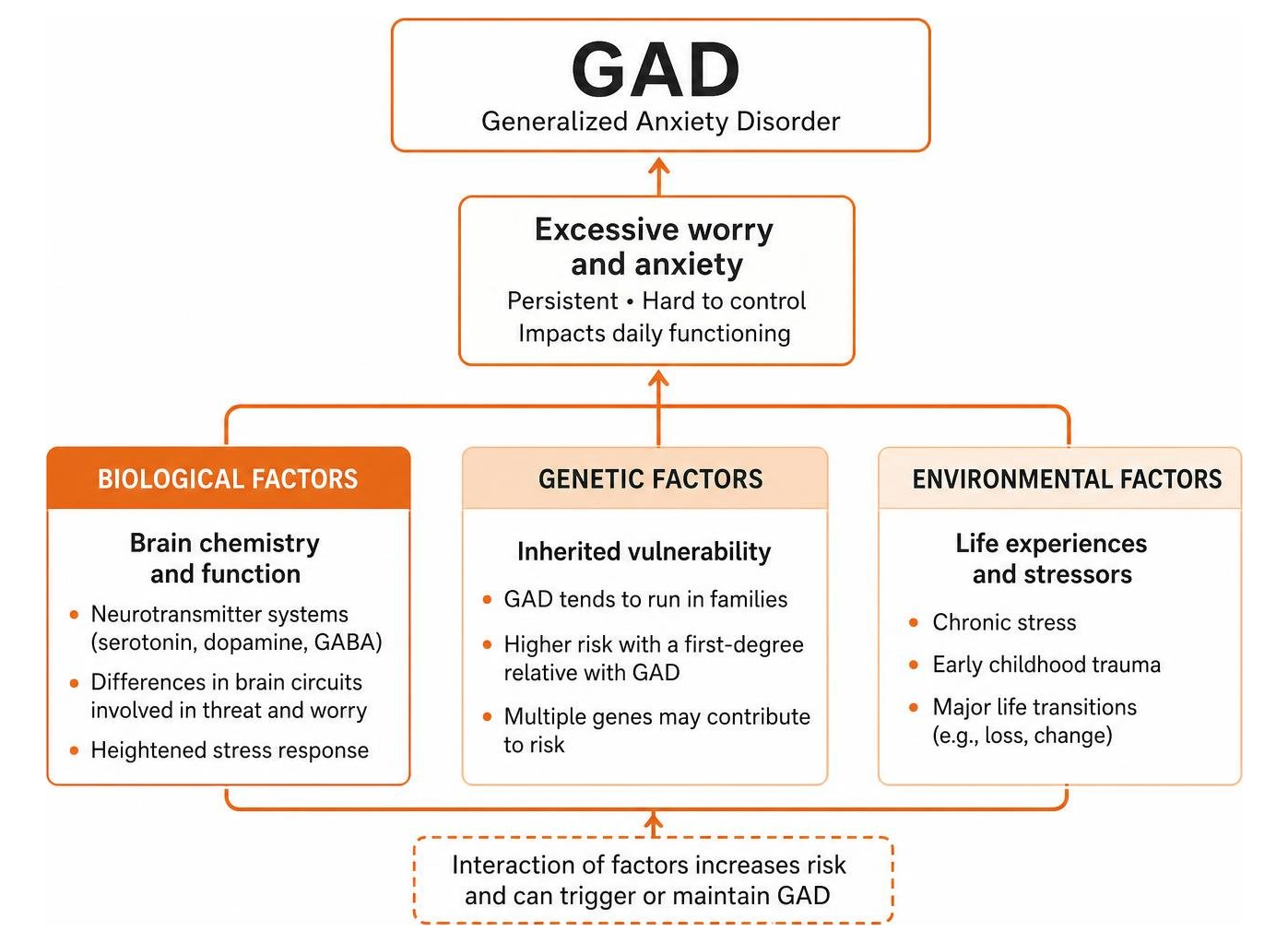
- Genetics: GAD tends to run in families. If you have a first-degree relative with GAD, your likelihood of developing the condition is significantly higher.
- Brain Chemistry: Differences in brain function and neurotransmitter systems (such as serotonin, dopamine, and GABA) play a major role in how our brains process fear and anxiety.
- Environmental Factors: Experiencing chronic stress, early childhood trauma, or significant life transitions (like a career change or loss of a loved one) can trigger the onset of GAD.
For a deeper look into how professional diagnostics work, check out our clinical breakdown: Meeting the Criteria: A Deep Dive into GAD DSM-5 Standards.
Frequently Asked Questions about GAD
What is the difference between stress and GAD?
Stress is your body’s reaction to an immediate, external challenge or demand. Once that challenge is resolved, the stress goes away. GAD is an ongoing, internal state of excessive worry that persists for six months or more, even when there is no active external trigger. If you find that your anxiety remains high even during quiet, peaceful periods of life, it may be GAD. For practical tips on addressing this, see Why Your Anxiety Keeps Getting Worse and What Actually Helps.
How does GAD affect sleep?
Because GAD keeps your body and mind in a constant state of alertness, sleep is often one of the first things to suffer. Racing thoughts make it incredibly difficult to fall asleep, while muscle tension and physical restlessness can cause you to wake up repeatedly throughout the night. This creates a challenging cycle: lack of sleep makes your brain more vulnerable to anxiety, and high anxiety makes it harder to sleep. We discuss this connection and how to break the cycle in our article, Understanding the Anxiety-Sleep Connection.
When should I seek professional help for anxiety?
You should consider reaching out to a mental health professional if your worry is interfering with your daily life, relationships, sleep, or ability to perform at work or school. If you find yourself avoiding social situations, feeling constantly exhausted, or using substances to cope, professional support can help. Many providers use a quick self-assessment tool called the GAD-7 to measure symptom severity. You can learn how to interpret these scores in our guide, Decoding Your GAD-7 Anxiety Score with MDCalc.
Conclusion
Generalized anxiety disorder is a common, highly treatable condition. Living with a constant hum of worry can make everyday life feel exhausting, but you do not have to navigate it alone. With the right combination of professional guidance, evidence-based therapy, and compassionate care, it is entirely possible to quiet the noise, manage your physical symptoms, and regain a sense of calm.
At Oak Health Center, we are dedicated to providing comprehensive, compassionate mental healthcare tailored to your unique needs. We offer simplified access to support across our convenient Southern California locations—including Beverly Hills, Fullerton, Laguna Hills, Rancho Cucamonga, and South Pasadena—as well as flexible statewide virtual services. Our team of experienced clinicians is here to help you understand your symptoms and build a personalized treatment plan that works for you.
If you are ready to take the first step toward managing your anxiety, we invite you to Schedule a consultation for professional psychotherapy with us today. Let’s work together to help you feel like yourself again.