

What Are the Symptoms of an Anxiety Attack? (Quick Answer)
The symptoms of anxiety attack episodes can feel overwhelming and even terrifying — especially when they seem to come out of nowhere.
Before we dive deeper, here is a quick reference if you need an answer right now:
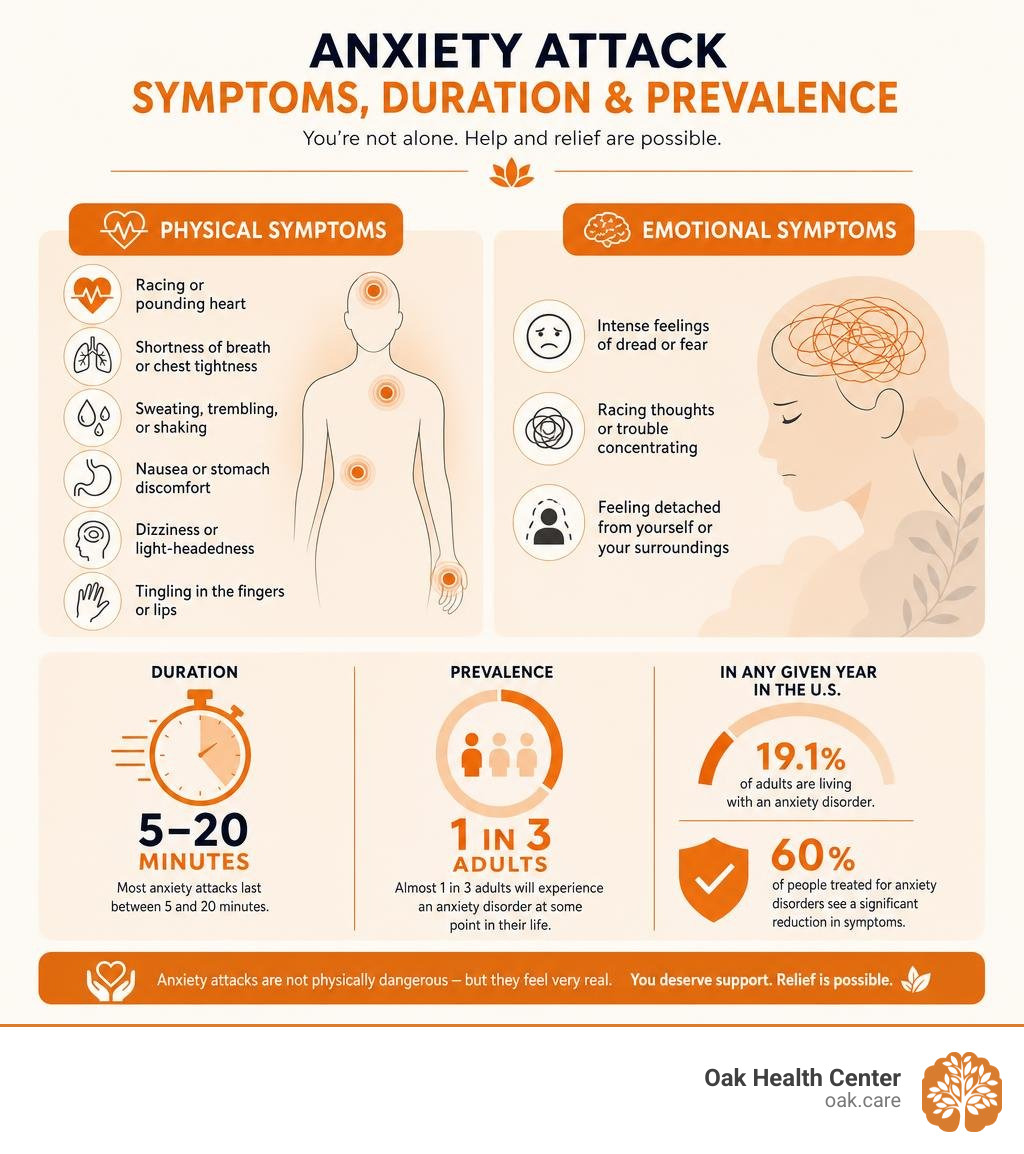
Most common anxiety attack symptoms:
- Racing or pounding heart
- Shortness of breath or chest tightness
- Sweating, trembling, or shaking
- Nausea or stomach discomfort
- Dizziness or light-headedness
- Tingling in the fingers or lips
- Intense feelings of dread or fear
- Racing thoughts or trouble concentrating
- Feeling detached from yourself or your surroundings
Most anxiety attacks last between 5 and 20 minutes. They are not physically dangerous — but they feel very real, and they deserve real attention.
You might be sitting in a meeting, stuck in traffic on the 405, or just going about your day — when suddenly your heart starts racing and you can’t catch your breath. It can feel like a heart attack. It can feel like you’re losing control. For millions of people, this is what an anxiety attack feels like.
Almost 1 in 3 adults will experience an anxiety disorder at some point in their life. In any given year, around 19.1% of U.S. adults are living with one. If this sounds familiar, you are far from alone.
The good news? About 60% of people treated for anxiety disorders see a significant reduction in symptoms. Knowing what you’re dealing with is the first step.
I’m Andrew Brewer, Practice Manager at Oak Health Center, where I’ve spent my tenure helping grow and shape mental health programs — including services directly supporting people navigating symptoms of anxiety attack and related disorders. In that role, I’ve seen how the right information and the right care can genuinely change lives.
Symptoms of anxiety attack basics:
Anxiety Attack vs. Panic Attack: What is the Difference?
When people talk about intense, sudden feelings of fear, they often use the terms “anxiety attack” and “panic attack” interchangeably. However, in the clinical world, there is a distinct and important difference between the two.
According to the Diagnostic and Statistical Manual of Mental Disorders (DSM-5-TR), a panic attack is a recognized, formally defined clinical event. It is characterized by a sudden, intense spike of fear or discomfort that peaks within minutes, often occurring completely out of the blue without an obvious trigger.
An anxiety attack, on the other hand, is not an official clinical diagnosis in the DSM-5-TR. Instead, it is a term people frequently use to describe a period of intense, slow-building worry or dread. While a panic attack strikes like lightning, an anxiety attack is more like a gathering storm. It typically builds gradually over hours, days, or even weeks in response to a specific stressor—such as a difficult project at work, financial pressure, or ongoing relationship problems.
Another key difference lies in what happens afterward. People who experience recurrent, unexpected panic attacks often develop anticipatory anxiety—which is the chronic, intense fear of having another attack. This fear can become so severe that they begin avoiding places or situations where previous attacks occurred, occasionally leading to agoraphobia.
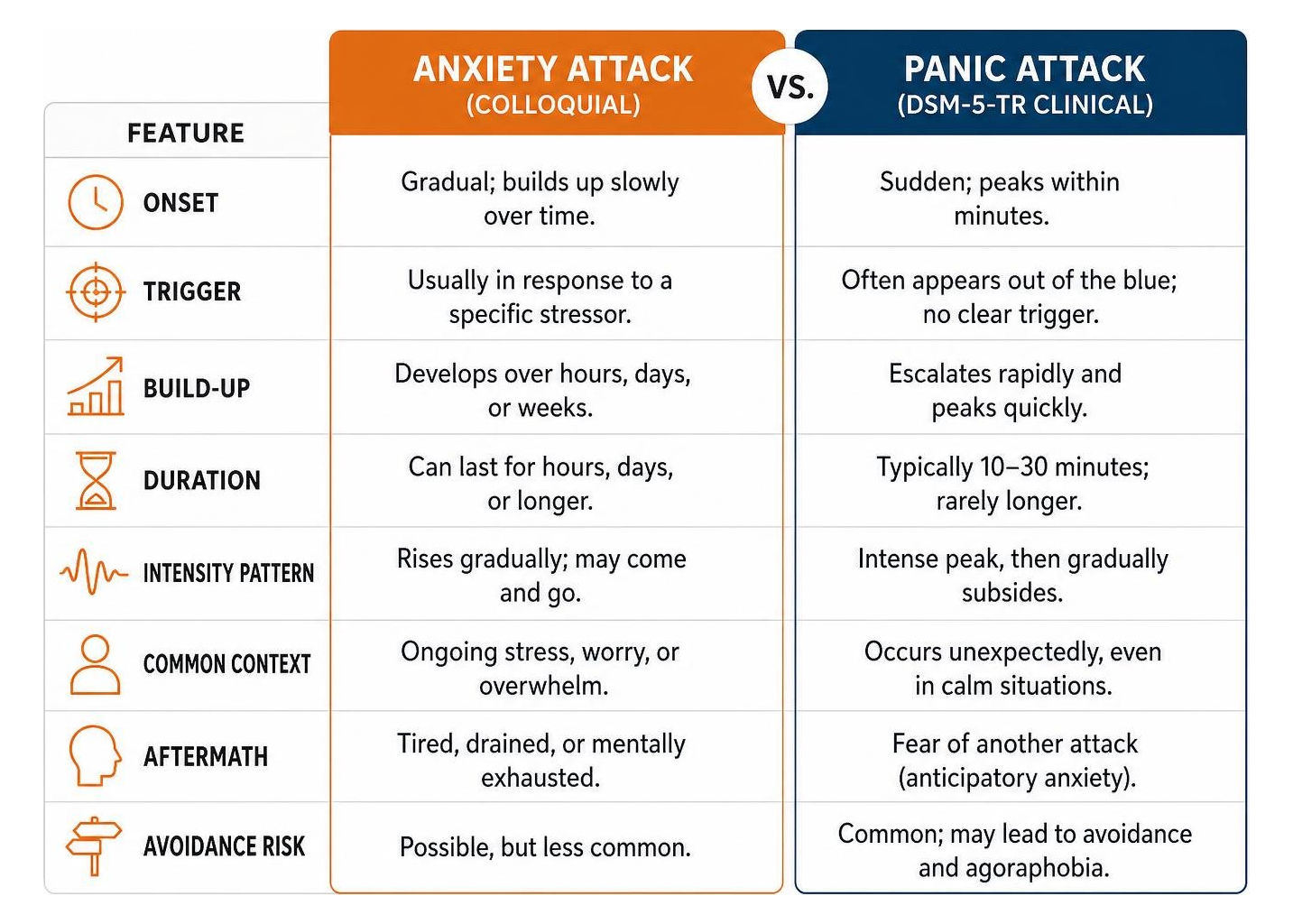
To help clarify these differences, we have mapped out the key distinctions:
| Feature | Anxiety Attack (Colloquial) | Panic Attack (DSM-5-TR Clinical) |
|---|---|---|
| Onset | Gradual; builds up slowly over time. | Sudden; peaks within minutes. |
| Triggers | Typically tied to a specific stressor or worry. | Can occur without any apparent cause or warning. |
| Intensity | Mild to moderate, but can feel highly distressing. | Extremely intense; often accompanied by a fear of dying. |
| Duration | Can persist for hours, days, or even weeks. | Typically lasts 5 to 20 minutes (rarely up to an hour). |
| Physical Sensation | Persistent tension, worry, and fatigue. | Sharp, violent physical surge (racing heart, choking). |
Understanding whether you are experiencing a slow-burning anxiety episode or a sudden panic event is crucial for finding the right coping strategies. For a deeper clinical look at panic episodes, you can read Mayo Clinic’s guide on panic attacks and panic disorder. If you are wondering how these episodes uniquely manifest in women, explore our resource on Is It Just Stress or an Anxiety Attack? A Guide for Women.
The Essential Checklist for Symptoms of Anxiety Attack
When your body perceives a threat—whether it is a real physical danger or a stressful thought—it activates your autonomic nervous system. This triggers the release of stress hormones, primarily adrenaline and cortisol, initiating the classic “fight-or-flight” response.
This biological alarm system causes immediate physical changes. Your heart pumps faster to send blood to your muscles, your lungs take in more oxygen, and your body prepares to either run or fight. While this response is highly useful if you are escaping a dangerous situation, it is incredibly uncomfortable when it is triggered by everyday stressors.

To help you identify what is happening in your body, we have compiled an essential checklist of physical, emotional, and cognitive symptoms. For more context on how these signs manifest, check out Healthline’s overview of anxiety symptoms or read our guide on 5 Ways Anxiety Shows Up in Everyday Life and What to Do About It.
Common Physical Symptoms of Anxiety Attack
The physical symptoms of an anxiety attack are often what drive people to seek medical help, as they can mimic cardiovascular or respiratory emergencies.
- Racing or Pounding Heart (Palpitations): You may feel your heart thumping violently against your chest or beating incredibly fast.
- Shortness of Breath (Dyspnea) or Chest Tightness: It might feel like you cannot get enough air into your lungs, which often leads to rapid, shallow breathing (hyperventilation).
- Sweating: Cold sweats, clammy palms, or sudden hot flashes are highly common.
- Trembling or Shaking: Your hands, legs, or entire body may shake uncontrollably as adrenaline courses through your system.
- Nausea or Stomach Discomfort: The gut is highly sensitive to stress hormones, often causing butterflies, nausea, or sudden digestive upset.
- Tingling Fingers or Lips: Hyperventilation changes the carbon dioxide levels in your blood, which frequently causes a pins-and-needles sensation in your extremities or face.
Emotional and Cognitive Symptoms of Anxiety Attack
The psychological impact of an anxiety attack can be just as debilitating as the physical sensations.
- An Overwhelming Sense of Dread: A heavy, persistent feeling that something terrible is about to happen, even if there is no logical reason for it.
- Racing or Intrusive Thoughts: Your mind may spin out of control, jumping from one catastrophic scenario to another.
- Derealization and Depersonalization: You might experience a strange sensation that the world around you is unreal or foggy (derealization), or feel detached from your own body (depersonalization).
- Fear of Losing Control: A distressing feeling that you are going crazy or completely losing your grip on reality.
- Trouble Concentrating: The brain’s threat-detection centers hijack your focus, making it nearly impossible to concentrate on everyday tasks.
Is Your Anxiety Normal or a Sign of an Anxiety Disorder?
Occasional anxiety is a completely normal, healthy part of being human. Feeling nervous before a job interview, a major exam, or a presentation is actually your body’s way of helping you focus and perform. However, when anxiety becomes persistent, unprovoked, and begins to interfere with your ability to live a normal life, it may be a sign of an underlying anxiety disorder.
To help determine whether your anxiety requires professional support, we recommend asking yourself three fundamental questions:
- Does your anxiety interfere with your daily life? If your worries prevent you from going to work, attending social events, driving, or sleeping, it is a sign that the anxiety has moved past a normal baseline.
- How severe is your anxiety? Normal anxiety is usually mild and manageable. If your symptoms frequently escalate into physical distress, shaking, or overwhelming dread, it warrants professional attention.
- Is your reaction proportional to the situation? Feeling anxious while walking down a dark alley is a proportional response. Experiencing a severe anxiety attack while sitting safely at home or during a routine trip to the grocery store suggests your body’s “false alarm” system is overactive.
Clinicians use standardized tools to evaluate these symptoms. One of the most common screeners is the GAD-7 (Generalized Anxiety Disorder 7-item scale), which measures the severity of generalized anxiety symptoms. These scores are evaluated alongside formal DSM-5 diagnostic criteria to establish an accurate treatment plan.
If you are noticing any of the following signs, it is time to seek professional help:
- Your anxiety has been persistent for six months or longer.
- You actively avoid places, people, or situations to prevent feeling anxious.
- You are struggling with persistent insomnia, headaches, or chronic muscle tension.
- You find yourself using alcohol or substances to self-medicate your nerves.
To learn more about how professionals evaluate these symptoms, you can read the insights from UC Davis Health on symptoms of anxiety and how to know when you need help. You can also explore how to interpret clinical screening tools in our guide, Decoding Your GAD-7 Anxiety Score with MDCalc.
How to Calm Down in the Middle of an Anxiety Attack
When you are in the middle of an anxiety attack, your rational brain is temporarily hijacked by your survival instincts. Fortunately, you can use physical and mental strategies to signal to your nervous system that you are safe, allowing the adrenaline surge to naturally subside.

Here are the most effective, evidence-based techniques to use in the moment:
- Slow Your Breathing (Box Breathing): Hyperventilation keeps your body in a state of high alert. Try box breathing: inhale slowly through your nose for 4 seconds, hold your breath for 4 seconds, exhale slowly through your mouth for 4 seconds, and hold again for 4 seconds. Repeat this cycle several times to lower your heart rate.
- The 5-4-3-2-1 Grounding Method: This sensory exercise helps pull your mind out of racing thoughts and back into your immediate physical surroundings. Name out loud:
- 5 things you can see around you.
- 4 things you can physically touch (like your clothes or the chair beneath you).
- 3 things you can hear.
- 2 things you can smell.
- 1 thing you can taste.
- Progressive Muscle Relaxation (PMR): Anxiety causes your muscles to tense up, which feeds back into your brain’s alarm system. Starting at your toes, tense a specific muscle group tightly for 5 seconds, then release it completely. Work your way up to your calves, thighs, stomach, shoulders, and face.
- Acknowledge and Name It: Instead of fighting the sensation, practice saying to yourself, “I am having an anxiety attack. It is highly uncomfortable, but it is temporary, and I am safe.”
For more clinical tips on stopping acute panic, you can review Cleveland Clinic’s advice on stopping a panic attack. If you find your baseline stress levels are rising, take a look at our deep dive into Why Your Anxiety Keeps Getting Worse and What Actually Helps.
Long-Term Treatment Options for Anxiety and Panic Disorders
While immediate coping skills are incredibly helpful for managing an active attack, long-term recovery involves addressing the root causes of your anxiety. Anxiety disorders are highly treatable, and a combination of psychotherapy, medication, and lifestyle modifications typically yields the best results.
Psychotherapy
Psychotherapy is widely considered the gold standard for long-term anxiety management.
- Cognitive Behavioral Therapy (CBT): This approach helps you identify, challenge, and reframe the negative thought patterns that fuel your anxiety.
- Exposure Therapy: Rather than avoiding your triggers—which actually reinforces and worsens anxiety over time—exposure therapy gently and gradually desensitizes your brain to those situations in a safe environment.
- Interoceptive Exposure: For panic disorder, this specialized therapy involves deliberately inducing mild physical sensations of panic (like spinning to cause dizziness) to help your brain learn that these sensations are not dangerous.
Medication Management
For many individuals, medication is a highly effective tool to help stabilize brain chemistry and reduce the severity of symptoms so they can actively engage in therapy.
- SSRIs and SNRIs: Antidepressants are often the first-line, daily medications prescribed for long-term anxiety prevention. They work by gradually regulating serotonin and norepinephrine levels in the brain.
- Benzodiazepines: These fast-acting sedatives can be highly helpful for short-term, acute panic relief. However, because they carry a risk of tolerance and dependency, they are strictly managed and generally avoided for long-term generalized anxiety care.
Lifestyle and Self-Care
Supporting your nervous system through daily habits is a vital component of recovery.
- Sleep Hygiene: Sleep deprivation directly triggers the amygdala, making you significantly more vulnerable to anxiety. Establishing a consistent sleep schedule is essential.
- Regular Exercise: Physical activity is a natural way to burn off excess stress hormones and boost mood-elevating endorphins.
- Dietary Adjustments: Limiting caffeine and alcohol can make a massive difference, as both substances are notorious for triggering the physical sensations of panic.
To learn more about the clinical causes of anxiety, you can read Mayo Clinic’s overview of anxiety disorders and causes. If you are interested in exploring non-pharmacological paths, check out our resource on Managing Anxiety Without Medication: When Psychotherapy Is Enough.
Frequently Asked Questions about Anxiety Attacks
How long does a typical anxiety attack last?
Most anxiety attacks last between 5 and 20 minutes, with the symptoms usually reaching their peak intensity within 10 minutes. While the acute attack is relatively brief, the massive rush of adrenaline can leave you feeling physically exhausted and worn out for hours afterward.
Can an anxiety attack cause physical harm or mimic a heart attack?
An anxiety attack will not cause physical harm or a heart attack, but the symptoms—especially chest pain, shortness of breath, and a racing heart—can mimic a cardiac emergency. In fact, studies show that up to one-third of people seeking emergency medical care for non-heart-related chest pain are actually experiencing panic attacks. If you are experiencing these symptoms for the first time, it is always a good idea to seek a medical evaluation to rule out any underlying physical conditions.
Are women more prone to anxiety and panic disorders than men?
Yes. Statistics show that women are twice as likely as men to develop panic disorder and other anxiety disorders. Researchers believe this difference is due to a combination of fluctuating hormonal factors, genetic predispositions, and differences in how the brain processes stress.
Conclusion
Living with frequent anxiety or panic is exhausting, but you do not have to navigate this journey alone. Understanding the symptoms of anxiety attack episodes is the first step toward reclaiming control over your life.
At Oak Health Center, we provide comprehensive, compassionate mental healthcare tailored to your unique needs. Whether you prefer to visit us in person at one of our five convenient Southern California locations—including Beverly Hills, Fullerton, Laguna Hills, Rancho Cucamonga, and South Pasadena—or connect with us through our statewide virtual services, we make accessing high-quality support simple and stress-free.
If you are ready to take the next step toward lasting relief, we encourage you to learn more about our psychotherapy services and schedule an appointment with our team today.