


When Standard Treatments Don’t Work: What the NICE Guidelines Say About Treatment-Resistant Depression
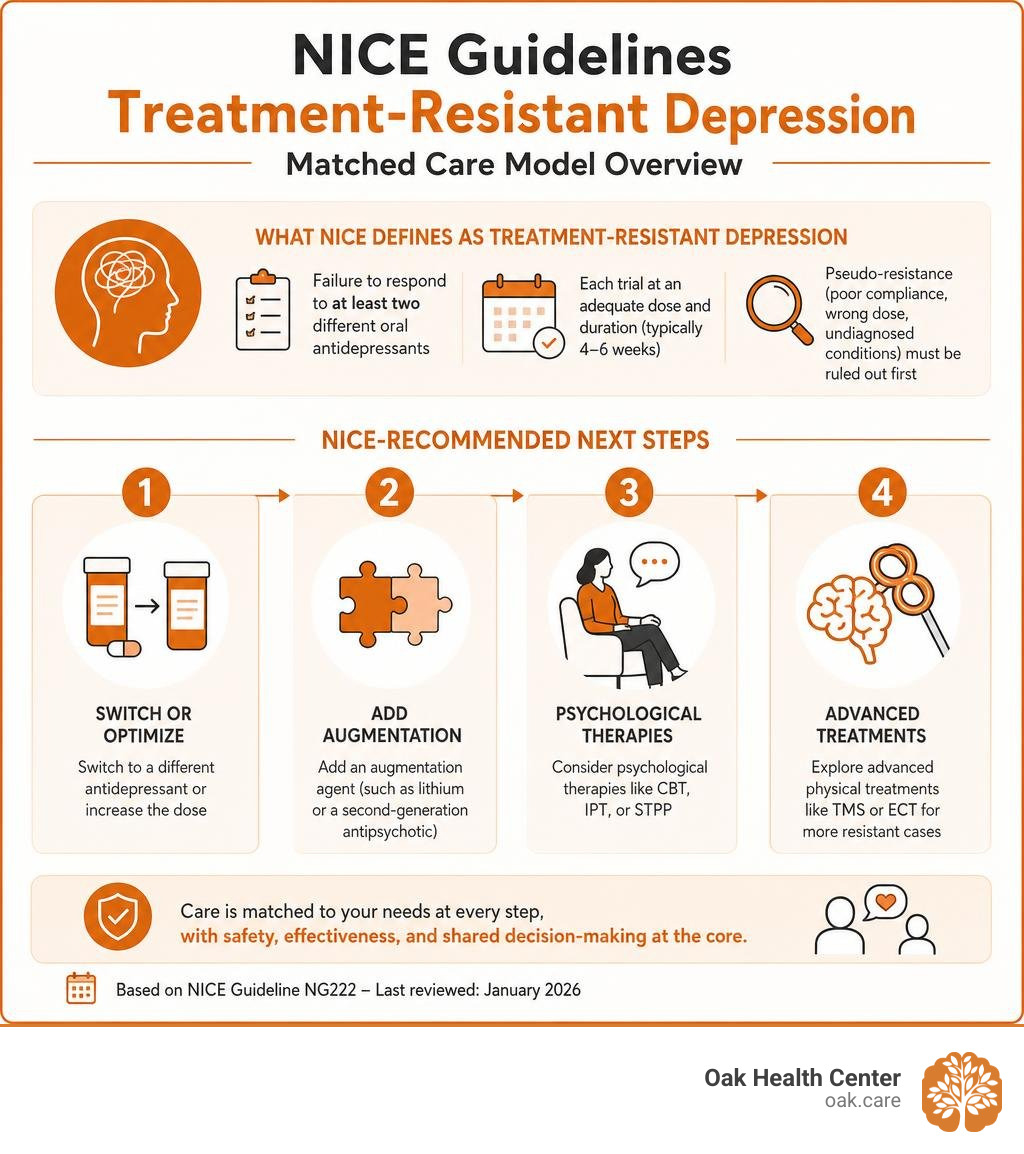
The NICE guidelines treatment-resistant depression framework gives clinicians a clear, evidence-based roadmap for when standard antidepressants stop working. Here’s what you need to know at a glance:
What NICE defines as treatment-resistant depression:
- Failure to respond to at least two different oral antidepressants
- Each trial must be at an adequate dose and duration (typically 4–6 weeks)
- Pseudo-resistance (poor compliance, wrong dose, undiagnosed conditions) must be ruled out first
Key NICE-recommended next steps when treatments fail:
- Switch to a different antidepressant or increase the dose
- Add an augmentation agent (such as lithium or a second-generation antipsychotic)
- Consider psychological therapies like CBT, IPT, or STPP
- Explore advanced physical treatments like TMS or ECT for more resistant cases
When antidepressants don’t deliver results, it’s frustrating — and it raises a lot of questions. Am I truly treatment-resistant? What comes next? Are there other options? These are questions that millions of people face, and the answers aren’t always straightforward.
The UK’s National Institute for Health and Care Excellence (NICE) has published detailed, updated guidance (NG222) that covers exactly this territory. It replaced the older CG90 guideline from 2009 and was last reviewed in January 2026. While it’s a UK framework, its evidence-based approach is widely referenced by clinicians around the world — including here in the US — when standard treatments fall short.
I’m Andrew Brewer, Practice Manager at Oak Health Center, where I’ve helped build and expand programs including TMS and other advanced mental health services. My operational work supporting clinical growth has given me a close-up view of how guidelines like the NICE guidelines for treatment-resistant depression translate into real-world care decisions. In the sections below, we’ll break down what these guidelines actually say — and what they mean for you.
Nice guidelines treatment resistant depression further reading:
- treatment resistant depression
- new drug for treatment resistant depression
- drug resistant depression treatment
Understanding the NICE Guidelines Treatment Resistant Depression Framework
To understand how the nice guidelines treatment resistant depression protocol operates, we must first look at how the National Institute for Health and Care Excellence classifies depression as a whole. Rather than using the traditional, highly fragmented four-tier classification system, the updated guidelines simplify clinical decision-making by categorizing depression into a binary model: “less severe” (subthreshold and mild symptoms) and “more severe” (moderate and severe symptoms).
To make this distinction objective, the guideline committee relies heavily on validated measurement scales. Specifically, a score of 16 or more on the Patient Health Questionnaire (PHQ-9) serves as the formal threshold indicating “more severe” depression.
When standard interventions fail within these severity tiers, clinicians must pivot. The NICE framework conceptualizes treatment resistance not as a permanent personal failure, but as a clinical threshold. It is officially identified when an individual experiencing a major depressive episode does not achieve an adequate response after undergoing at least two distinct trials of oral antidepressants, provided each trial was administered at the recommended target dose for a sufficient duration (typically 4 to 6 weeks).
To learn more about the biological and psychological mechanisms behind this condition, you can explore our resource on What Treatment-Resistant Depression Really Means and What You Can Do About It. For a broader perspective on global clinical standards, the Clinical Practice Guidelines for the management of Depression provides an invaluable comparative look at how different international bodies structure their care paths.
Defining Treatment Resistance vs. Pseudo-Resistance
Before a clinician can officially diagnose a patient with treatment-resistant depression (TRD), they must systematically rule out what is known as “pseudo-resistance.”
Pseudo-resistance occurs when a patient appears to have treatment-resistant symptoms, but the underlying cause of the treatment failure is actually due to external, addressable factors rather than a true biological resistance to medication. Common culprits include:
- Inadequate dosage or duration: The medication was stopped too early (before the 4-to-6-week mark) or was never titrated to an effective therapeutic dose.
- Suboptimal treatment compliance: The patient may have missed doses or stopped taking the medication due to side effects without notifying their provider.
- Unrecognized comorbidities: Co-occurring somatic conditions (such as thyroid dysfunction, vitamin deficiencies, or sleep apnea) or psychiatric conditions (such as ADHD, bipolar disorder, or substance use disorders) can mimic or worsen depressive symptoms.
To rule out pseudo-resistance, we conduct complete clinical and paraclinical assessments, which may include blood panels (checking TSH, vitamin levels, and metabolic function) and therapeutic drug monitoring to verify medication plasma levels. You can read more about navigating this complex diagnostic phase in our guide on Understanding Treatment-Resistant Depression When Standard Treatments Aren’t Enough.
The Overlap of Chronic Depression and Personality Disorders
One of the major challenges in treating complex mental health conditions is that depression rarely exists in a vacuum. The NICE guidelines explicitly address the significant clinical overlap between chronic depressive symptoms (dysthymia or persistent depressive disorder), treatment-resistant depression, and depression in individuals with a coexisting diagnosis of a personality disorder (such as Borderline Personality Disorder).
When these conditions overlap, standard short-term treatments often fall short. Chronic depression and personality disorders can alter a person’s cognitive patterns and interpersonal relationships, making standard pharmacological approaches less effective on their own. NICE advises that for patients with this complex overlap, treatment plans must be highly integrated, combining specialized psychotherapy with careful medication management.
At Oak Health Center, we recognize that an accurate diagnosis is the cornerstone of effective care. If you suspect your symptoms are complicated by co-occurring conditions, our team offers comprehensive diagnostic evaluations through our Services: Psychological Assessment program to help tailor your treatment plan.
Pharmacological and Psychological Interventions for Resistant Cases
When a patient meets the criteria for treatment-resistant depression, the NICE guidelines recommend a structured, step-by-step approach. This matched care model ensures that treatments are stepped up in intensity based on the patient’s ongoing response.
| Treatment Modality | NICE-Recommended Strategies | Key Clinical Considerations |
|---|---|---|
| Pharmacological | • Switch to a different antidepressant class • Dose escalation (with caution) • Augmentation with lithium or atypical antipsychotics |
• Monitor for side effects and drug interactions • Require regular blood draws for lithium levels |
| Psychological | • Cognitive Behavioral Therapy (CBT) • Interpersonal Psychotherapy (IPT) • Short-Term Psychodynamic Psychotherapy (STPP) |
• Focus on longer-term coping strategies • May require combination with pharmacotherapy |
| Advanced/Physical | • Transcranial Magnetic Stimulation (TMS) • Electroconvulsive Therapy (ECT) • Esketamine Nasal Spray |
• Reserved for further-line treatment resistance • Requires specialized clinical monitoring |
For a comprehensive breakdown of how these options fit into a long-term recovery plan, refer to our Ultimate Guide to Treatment-Resistant Depression.
Pharmacological Strategies Under the NICE Guidelines Treatment Resistant Depression Protocol
The pharmacological protocol for managing resistant cases involves several distinct phases:
- Optimizing the Current Dose: While some global guidelines advocate for aggressive dose-escalation as a first step, the NICE guidelines display some reserve and caution regarding general recommendations for dose-escalation, noting that higher doses often increase side-effect burdens without guaranteed clinical benefits.
- Switching Antidepressants: If there is no response to the initial drug, NICE recommends switching to another antidepressant. This can be within the same class (e.g., switching from one SSRI to another) or, more commonly, switching across classes (e.g., moving from an SSRI to an SNRI or a tricyclic antidepressant). Vortioxetine, for instance, is specifically recommended by NICE only when a patient has shown no or limited response to at least two previous antidepressants.
- Augmentation and Combination: When a partial response is observed, or when multiple single-drug trials have failed, NICE recommends adding a second agent. The primary recommended augmentation strategies include:
- Lithium: Adding lithium carbonate as an active synergizing agent, which requires regular blood monitoring to maintain therapeutic, non-toxic levels.
- Second-Generation Antipsychotics (SGAs): Adding low doses of atypical antipsychotics (such as aripiprazole, quetiapine, or olanzapine) to boost the antidepressant’s efficacy.
To understand how clinicians select these medications and find the safest fit for your biochemistry, read our detailed overview on Meds to Treat Depression Finding Your Perfect Match. For deeper insight into the clinical trials backing these pharmacological steps, you can consult the Clinical guidelines for the management of treatment … research.
Recommended Psychological Therapies and Prioritization
Psychotherapy is a vital component of the NICE treatment pathway for resistant depression. Rather than relying solely on medication adjustments, the guidelines emphasize that psychological interventions should be offered alongside or integrated with pharmacological changes.
The primary evidence-based psychotherapies recommended by NICE include:
- Cognitive Behavioral Therapy (CBT): Highly structured therapy focusing on identifying and modifying negative thought patterns and behaviors.
- Interpersonal Psychotherapy (IPT): Focuses on addressing interpersonal issues and relationship patterns that may contribute to or sustain depressive episodes.
- Short-Term Psychodynamic Psychotherapy (STPP): Explores developmental patterns, unresolved conflicts, and emotional processing.
Interestingly, the guideline committee’s extensive review found that in cases of more severe depression, the differences in efficacy between individual CBT, individual behavioral therapy, individual IPT, and individual STPP are neither statistically nor clinically significant (with standardized mean differences, or SMDs, falling below 0.50). This means that rather than forcing a patient into one specific modality, the choice of therapy should heavily prioritize patient preference, past experiences, and therapist availability.
At Oak Health Center, we provide access to a wide range of therapeutic styles tailored to your unique history through our Services: Psychotherapy department.
Advanced Physical and Neuromodulation Treatments
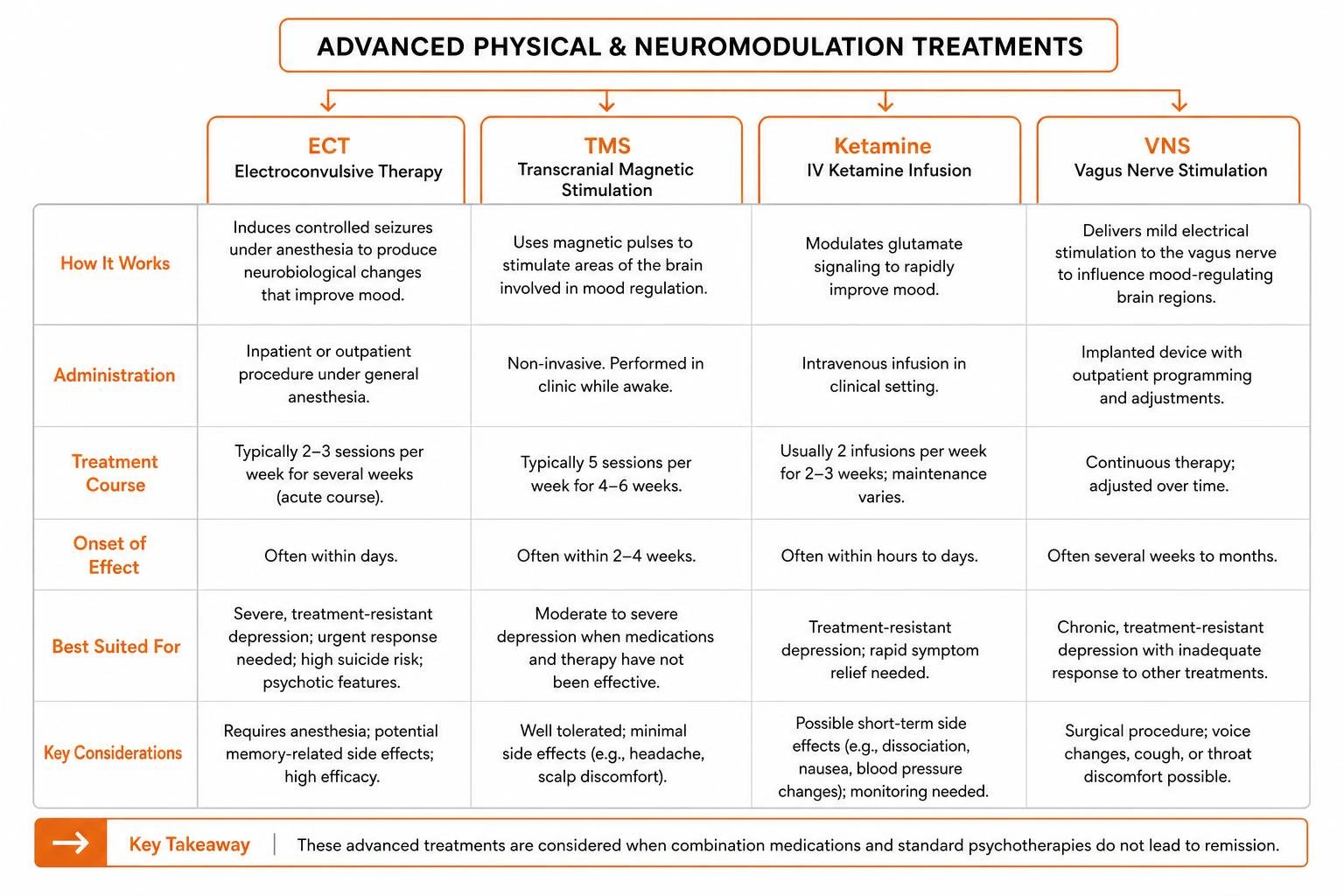
When combination pharmacotherapy and standard psychotherapies do not lead to remission, the NICE guidelines point toward advanced neuromodulation and physical treatments. These therapies work by directly stimulating specific areas of the brain involved in mood regulation.
If you are curious about how these options compare to traditional treatments, you can read our guide on How TMS Therapy Works for Depression or explore our deep dive into The Ultimate Guide to Ketamine Infusion for Depression.
Electroconvulsive Therapy (ECT) and Transcranial Magnetic Stimulation (TMS)
Two of the primary physical treatments evaluated by NICE are Electroconvulsive Therapy (ECT) and Transcranial Magnetic Stimulation (TMS):
- Transcranial Magnetic Stimulation (TMS): Repetitive TMS (rTMS) is a non-invasive procedure that uses magnetic fields to stimulate nerve cells in the prefrontal cortex—the area of the brain responsible for mood control. Because it does not require anesthesia or sedation and has virtually no systemic side effects, it is an increasingly popular option for patients who cannot tolerate antidepressant side effects. At Oak Health Center, we provide this advanced care at our Southern California clinics; you can read more about our approach on our Services: Transcranial Magnetic Stimulation page.
- Electroconvulsive Therapy (ECT): ECT is a highly effective, rapid-acting treatment that involves delivering a brief electrical stimulation to the brain under general anesthesia, intentionally triggering a brief, controlled seizure. Because of its intensity and potential temporary cognitive side effects (such as short-term memory loss), NICE recommends reserving ECT primarily for severe, life-threatening depression (such as catatonia or severe suicidal crisis) or when all other further-line treatment options have failed.
The Role of Esketamine Nasal Spray and Treatment Burden
Esketamine nasal spray (Spravato) represents a newer class of rapid-acting treatments for treatment-resistant depression. While clinical trials like TRANSFORM-2 showed a statistically significant reduction in depression severity (an adjusted mean reduction in the Montgomery-Asberg Depression Rating Scale, or MADRS, score of 19.8 for esketamine compared to 15.8 for placebo), the NICE committee highlighted several practical complexities.
First and foremost is the treatment burden and logistical constraints associated with the drug:
- In-Office Administration: Esketamine must be self-administered under the direct supervision of a healthcare professional in an approved clinical setting.
- Post-Treatment Monitoring: Patients must remain at the clinic for at least two hours after each session so clinical staff can monitor them for transient side effects like dissociation, sedation, or spikes in blood pressure.
- Transportation Constraints: Because of the drug’s psychoactive and sedative effects, patients are strictly prohibited from driving themselves home post-treatment, requiring them to arrange reliable transportation.
- Frequency: The treatment typically requires twice-weekly visits for the first month, followed by weekly or bi-weekly maintenance visits, representing a significant time commitment for both patients and their caregivers.
Additionally, due to the dissociative effects during and immediately after administration, patients cannot undergo active psychological therapy sessions on the same day as their esketamine treatment, though integrating therapy on alternate days is highly recommended. To learn more about how this medication is changing the clinical landscape, see our article on Finding Hope in a New Drug for Treatment-Resistant Depression.
Critical Assessment and Limitations of the NICE Framework
While the nice guidelines treatment resistant depression framework is highly respected, it has faced rigorous academic and clinical critique. Understanding these limitations is crucial for clinicians and patients alike, as it highlights why a rigid, “one-size-fits-all” application of any guideline can sometimes lead to suboptimal real-world care.

A landmark critique published in the medical literature, A critical assessment of NICE guidelines for treatment of depression, raised serious concerns regarding how the guideline committee evaluated and structured its recommendations.
Methodological Gaps in the NICE Guidelines Treatment Resistant Depression Evidence Base
The academic critique identified several significant methodological gaps within the NICE framework:
- Extrapolation of Data: Critics point out that the NICE committee frequently extrapolated psychotherapy rankings and cost-effectiveness data from clinical trials of “new episodes of depression” to construct recommendations for “treatment-resistant depression” and “depression with personality disorder.” This is highly problematic because patients with chronic or resistant conditions were explicitly excluded from the primary trials used to generate those rankings.
- Modest Effect Sizes: The guideline committee’s own analysis revealed that for the vast majority of evaluated treatments, the differences in effect sizes between active treatments and control groups fell below what is considered a “minimal clinically significant difference” (defined as a standardized mean difference, SMD, of >0.5 or <-0.5).
- Inconsistent Head-to-Head Comparisons: The committee’s final rankings and conclusions regarding the superiority of certain active treatments over others were occasionally found to be inconsistent with their own pairwise, head-to-head trial data.
- Over-Reliance on Short-Term Studies: The guidelines heavily favor short-term psychotherapies (typically 4 to 20 sessions). However, critics argue this fails to account for the limited remission rates (only about 30%) associated with short-term therapies for complex cases, and the fact that most short-term treatment effect sizes are not stable at long-term follow-up.
- Lack of Pre-Registered Threshold Analysis: Although the committee attempted to adjust trial results for potential bias, a pre-registered threshold analysis—which is standard practice for ensuring maximum confidence in clinical recommendations—was not carried out.
Patient Preferences and Shared Decision-Making
Because clinical guidelines are built on broad statistical averages, they cannot predict with 100% accuracy how an individual patient will respond to a specific treatment. This is why both the NICE committee and our team at Oak Health Center place an immense emphasis on shared decision-making and patient preferences.
Clinical guidelines are not mandatory mandates; they are decision-support tools. A truly effective treatment plan must balance standard clinical evidence with:
- A patient’s unique biological tolerance and past treatment history.
- Their personal values, lifestyle, and logistical capabilities (such as their ability to attend frequent TMS or esketamine clinic visits).
- Their individual therapeutic goals—whether that means achieving complete clinical remission, reducing specific side effects, or simply regaining the functional ability to return to work and enjoy family life.
To read more about how to advocate for yourself and collaborate with your provider to build a highly individualized treatment plan, explore our practical advice on How to Manage Treatment for Drug-Resistant Depression Without Losing Your Mind.
Frequently Asked Questions about NICE Depression Guidelines
How do the NICE guidelines define treatment-resistant depression?
Under the NICE guidelines, treatment-resistant depression is formally defined as major depressive disorder in individuals who have failed to respond to at least two different oral antidepressants, provided each trial was administered at an adequate dose and for an adequate duration (typically 4 to 6 weeks). Before confirming this diagnosis, clinicians must systematically rule out “pseudo-resistance” by evaluating treatment compliance, checking medication plasma levels, and identifying any untreated co-occurring physical or psychiatric conditions.
What is the difference between chronic depression and treatment-resistant depression under NICE?
While there is significant clinical overlap, they are defined differently. Chronic depression (or persistent depressive symptoms) refers to a long-lasting state of depression where symptoms persist for two years or more, regardless of how many treatments have been tried. Treatment-resistant depression, on the other hand, is defined strictly by a lack of clinical response to specific therapeutic interventions (specifically, failing two or more antidepressant trials). A person can have chronic depression that is highly responsive to the very first treatment they try, just as someone can have a relatively recent, acute episode of depression that proves highly treatment-resistant.
Does NICE recommend TMS or ECT for treatment-resistant depression?
Yes, NICE recommends both, but they occupy different positions in the treatment pathway. Repetitive Transcranial Magnetic Stimulation (rTMS) is recommended as a safe, non-invasive option for treatment-resistant depression, particularly for patients who wish to avoid the systemic side effects of oral medications. Electroconvulsive Therapy (ECT) is also recommended, but because of its intensity and potential cognitive side effects, NICE advises reserving it primarily for severe, life-threatening cases of depression, or when multiple other further-line pharmacological and psychological treatments have completely failed.
To see how these and other advanced options stack up against one another, you can view our comparative article on The Best Professional Alternative Treatments for Depression Ranked.
Conclusion
Navigating treatment-resistant depression can feel like wandering through a complex maze, but clinical frameworks like the nice guidelines treatment resistant depression protocol offer a valuable map. By outlining clear steps for switching medications, utilizing augmentation strategies, integrating evidence-based psychotherapies, and exploring advanced neuromodulation techniques like TMS, these guidelines ensure that patients and providers always have a logical “next step” to take.
At the same time, academic critiques remind us that guidelines are just that—guides. They cannot replace highly personalized, compassionate care that takes your unique biochemistry, life circumstances, and personal preferences into account.
If you or a loved one is struggling with depression that hasn’t responded to standard treatments, you don’t have to navigate this journey alone. At Oak Health Center, we provide comprehensive, compassionate mental healthcare across multiple convenient locations in Southern California—including Beverly Hills, Fullerton, Laguna Hills, Rancho Cucamonga, and South Pasadena—as well as statewide virtual services across California.
Our multidisciplinary team specializes in matching patients with the exact level of support they need, from advanced psychiatric care to cutting-edge neuromodulation. Contact us today to explore your options by visiting our Services: Psychiatry page and take the first step toward finding a treatment plan that truly works for you.