


When Standard Treatments Fail: What Resistant Depression Guidelines Actually Say
Resistant depression guidelines are the clinical protocols that help doctors decide what to do when antidepressants stop working — but here’s the problem: even the world’s top medical guidelines don’t fully agree on the answers.
Quick answer for clinicians and patients:
| Key Question | Current Answer |
|---|---|
| What is TRD? | Failure to remit after at least 2 adequate antidepressant trials |
| How common is it? | Up to 40–50% of people with major depression |
| Top pharmacological options | Lithium augmentation, atypical antipsychotics, esketamine |
| Top neuromodulation options | ECT (per German NVL), rTMS (per US VA/DoD) |
| Is there global consensus? | No — the two highest-quality guidelines diverge significantly |
If you or someone you love has tried multiple antidepressants without finding relief, you are far from alone. Research from the landmark STAR*D trial — one of the largest real-world depression studies ever conducted — found that after two rounds of treatment, more than half of patients still had not achieved remission. That means roughly 40% to 50% of people diagnosed with major depression end up in a category clinicians call treatment-resistant depression (TRD).
What makes this even more difficult is the clinical landscape itself. As of July 2026, out of 63 depression guidelines evaluated globally, only 2 met the highest quality standards and specifically addressed TRD — and those two guidelines recommend meaningfully different treatments.
That gap matters enormously in real-world care. It means that the “standard” next step for resistant depression can look very different depending on where you live or which protocol your doctor follows.
I’m Andrew Brewer, Practice Manager at Oak Health Center, where I’ve helped build and expand programs including TMS and other advanced treatment services for patients navigating complex conditions like treatment-resistant depression. Through that work, I’ve seen why understanding the differences across resistant depression guidelines is critical to helping patients find a path forward. In the sections below, we’ll break down what the evidence actually says — clearly and practically.
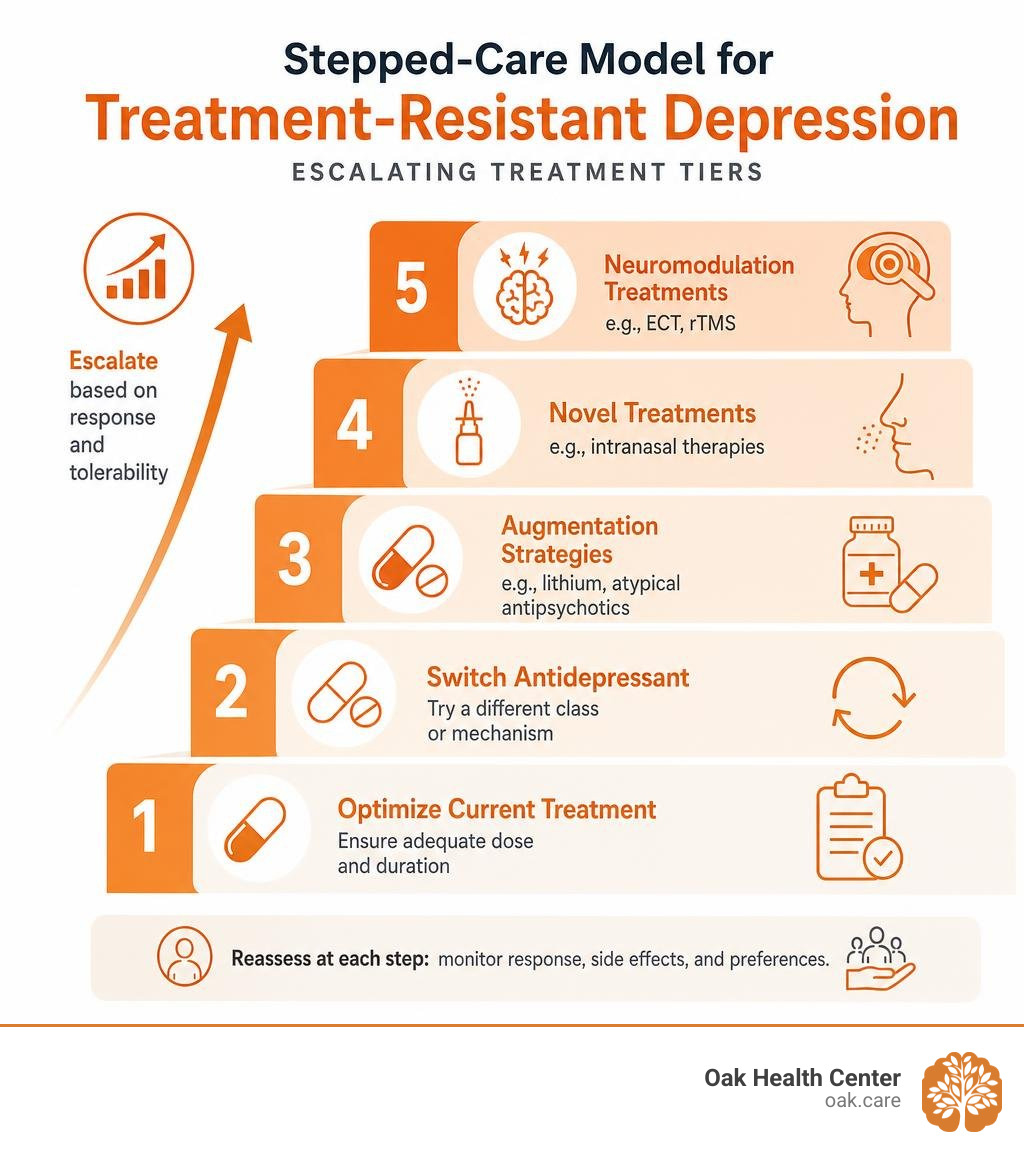
Resistant depression guidelines basics:
- treatment resistant depression
- new drug for treatment resistant depression
- drug resistant depression treatment
The Challenge of Defining Treatment-Resistant Depression
To treat something effectively, we first have to agree on what it is. Unfortunately, when it comes to treatment-resistant depression (TRD), the scientific community has historically struggled with a massive definition problem.
In clinical trials and standard practice, the most widely accepted definition of TRD is a major depressive episode that does not remit after at least two separate antidepressant treatment trials of adequate dose and duration. However, beyond this basic concept, the exact diagnostic criteria remain highly inconsistent across different resistant depression guidelines.
Some guidelines require the two failed trials to be from different pharmacological classes, while others allow trials from the same class. Some protocols specify a rigid duration for an “adequate” trial (historically 6 to 8 weeks, though modern literature increasingly suggests up to 12 to 14 weeks to observe maximum therapeutic effect), while others are much more vague.
This inconsistency directly impacts how clinical practice guidelines are developed and applied. Without a standardized, universally accepted definition, clinical trials end up studying highly diverse patient populations. This makes it incredibly difficult for guideline developers to synthesize evidence and create reliable, uniform treatment pathways. To explore this core issue further, we recommend reading our breakdown on Understanding Treatment-Resistant Depression: When Standard Treatments Aren’t Enough.
To address this gap, global experts have actively worked to establish a clearer framework. For instance, researchers have published A Delphi-method-based consensus guideline for definition of TRD to help unify the scientific community and improve the trustworthiness of future guidelines.
The Lack of Consensus in Resistant Depression Guidelines
When researchers evaluate the quality of clinical practice guidelines using standardized instruments like the AGREE II (Appraisal of Guidelines for Research & Evaluation) and AGREE-REX (Recommendations Excellence), a startling reality emerges.
Out of 63 guidelines analyzed globally, only 17 were classified as high-quality. More shockingly, only 2 of those high-quality guidelines actually included a specific definition of TRD and provided comprehensive recommendations for its management.
This means that the vast majority of official depression guidelines fail to provide specific, actionable protocols for the 40% of patients who do not respond to first-line treatments. Instead, many guidelines rely on broad “stepped-care” models that offer little concrete direction when a patient fails multiple medication trials. For a deeper look into what this clinical label actually implies for your care, you can read our guide on What Treatment-Resistant Depression Really Means and What You Can Do About It.
Differentiating True TRD from Pseudo-Resistance
Before we can classify a patient as having true treatment-resistant depression, we must systematically rule out what clinicians call “pseudo-resistance.” Pseudo-resistance occurs when a patient appears to have resistant depression, but their lack of improvement is actually caused by external, addressable factors.
Common causes of pseudo-resistance include:
- Inadequate dosing or duration: The patient was never prescribed a therapeutic dose, or did not take it long enough.
- Non-adherence: Missing three or more doses within a 14-day period is a clinically significant threshold for non-adherence.
- Unrecognized comorbidities: Untreated conditions like thyroid disorders, obstructive sleep apnea, ADHD, or substance use can mimic or worsen depression.
- Pharmacokinetic variations: Differences in the Cytochrome P450 enzyme system can cause a patient to metabolize medications ultra-fast, leading to subtherapeutic drug levels in the blood.
To rule out these issues, we utilize Therapeutic Drug Monitoring (TDM) to measure actual drug levels in the blood, alongside exhaustive diagnostic reassessments. If you are currently feeling overwhelmed by this process, our resource on How to Manage Treatment for Drug-Resistant Depression Without Losing Your Mind offers practical support.
Comparing High-Quality Resistant Depression Guidelines Globally
Because so few guidelines meet the rigorous methodological standards required to address TRD, clinicians frequently look to the two highest-quality guidelines that do: the German NVL (Nationale VersorgungsLeitlinie) and the US VA/DoD (Veterans Affairs/Department of Defense) guidelines.
Surprisingly, these two top-tier guidelines offer almost zero convergence in their therapeutic strategies. Let’s look at how they compare:
| Treatment Category | German NVL Guidelines | US VA/DoD Guidelines |
|---|---|---|
| Primary Neuromodulation | Highly recommends Electroconvulsive Therapy (ECT) | Recommends Repetitive Transcranial Magnetic Stimulation (rTMS) |
| Pharmacological Augment | Recommends Lithium augmentation | Recommends Atypical Antipsychotics |
| Glutamatergic Agents | Historically omitted or highly restricted | Recommends Ketamine and Esketamine |
| Psychotherapy Role | Recommends intensive, structured psychotherapy | Recommends evidence-based psychotherapy (CBT, ACT, etc.) |
As this comparison shows, what is considered a first-line advanced treatment in one country might not even be recommended in another. To understand the full breadth of these options, check out our Ultimate Guide to Treatment-Resistant Depression.
Divergent Neuromodulation and Pharmacological Strategies
The divergence between these guidelines is particularly striking in the realms of brain stimulation and medication augmentation.
For instance, the German NVL guidelines strongly support electroconvulsive therapy (ECT) and lithium augmentation as gold-standard treatments for severe, non-responsive cases. In contrast, the US VA/DoD guidelines do not recommend ECT or lithium as primary strategies, opting instead to recommend repetitive transcranial magnetic stimulation (rTMS) and atypical antipsychotics (such as aripiprazole or quetiapine).
Other regional bodies have attempted to bridge these gaps. For example, the French Society for Biological Psychiatry and Neuropsychopharmacology (AFPBN) guidelines provide a highly structured, expert-consensus approach that balances both pharmacological potentiation and neuromodulation based on whether a patient has a “partial response” or “no response” to initial therapies.
Why High-Quality Guidelines Disagree on TRD Protocols
Why do the world’s leading medical experts look at the same scientific literature and come away with completely different recommendations? Several factors explain these discrepancies:
- Differences in Evidence Interpretation: Some guideline panels place a higher value on randomized controlled trials (RCTs), while others prioritize real-world clinical consensus.
- Timing of Guideline Development: Guidelines are massive undertakings that take years to update. A guideline published or updated in 2024 or 2026 will naturally include newer rapid-acting treatments (like ketamine or esketamine) that older guidelines completely missed.
- Regional Healthcare Infrastructure: In some regions, specialized equipment and trained personnel for treatments like rTMS are concentrated only in select urban centers, making the treatment less feasible to recommend on a national level compared to widely available pharmacological options.
To understand how clinical experts navigate these complex decisions in real time, you can refer to the comprehensive UpToDate clinical guidelines on TRD.
Advanced Interventions: Ketamine, Esketamine, and Neuromodulation

When standard oral medications fail, advanced interventional psychiatry offers some of the most encouraging paths forward. These modern treatments target the brain’s neurochemistry and neural pathways in entirely new ways. If you are curious about how these stack up against traditional talk therapy, read our ranking of The Best Professional Alternative Treatments for Depression Ranked.
The Role of Rapid-Acting Glutamatergic Modulators
One of the most significant breakthroughs in modern psychiatry is the use of glutamatergic agents like IV ketamine and intranasal esketamine. Unlike traditional antidepressants, which can take weeks to work by slowly altering monoamine neurotransmitters (like serotonin), these rapid-acting treatments target glutamate pathways to promote rapid synaptic plasticity.
- Intranasal Esketamine: Backed by the robust TRANSFORM and SUSTAIN clinical trials, esketamine is FDA-approved for adults with TRD when used in conjunction with an oral antidepressant. It must be administered under direct medical supervision to monitor for transient blood pressure spikes and dissociative side effects.
- IV Ketamine: While used off-label for depression, intravenous ketamine infusions have demonstrated remarkable, rapid efficacy in reducing severe depressive symptoms and acute suicidal ideation.
To learn more about what to expect during these treatments, explore The Ultimate Guide to Ketamine Infusion for Depression.
Navigating Neuromodulation in Resistant Depression Guidelines
For patients seeking non-pharmacological options, non-invasive brain stimulation has revolutionized depression care.
- Repetitive Transcranial Magnetic Stimulation (rTMS): rTMS uses magnetic fields to gently stimulate underactive regions of the brain associated with mood regulation (specifically the dorsolateral prefrontal cortex). Because it is entirely non-invasive, requires no anesthesia, and has virtually no systemic side effects, it has become a highly recommended option in many modern guidelines.
- Electroconvulsive Therapy (ECT): While highly effective—particularly for severe, psychotic, or life-threatening depression—ECT requires general anesthesia and carries a higher risk of temporary cognitive side effects, making it a treatment we typically reserve for specific clinical profiles.
To understand the science behind how magnetic fields can help retrain your brain, see our article on How TMS Therapy Works for Depression.
Clinical Decision-Making: Navigating Discrepancies in Practice
Because the world’s highest-quality guidelines don’t always align, we cannot simply rely on a “one-size-fits-all” clinical checklist. Instead, clinical decision-making must be highly individualized, balancing the best available scientific evidence with patient-specific factors.
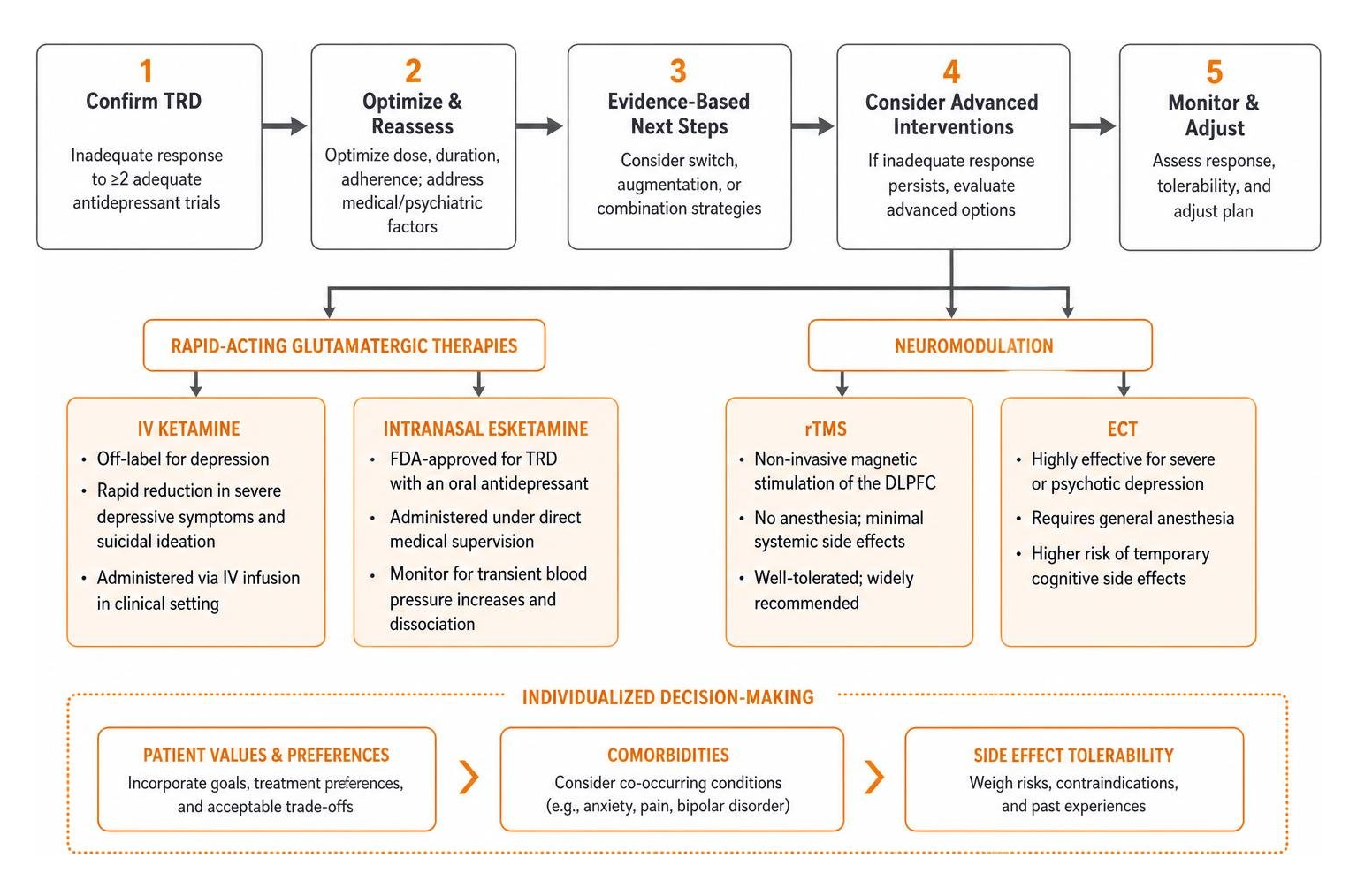
When we design a treatment plan for treatment-resistant depression, we prioritize:
- Patient Values and Preferences: Some patients prefer to avoid medications entirely and opt for neuromodulation, while others prefer the convenience of oral or nasal therapies.
- Comorbidities: A patient with comorbid anxiety, chronic pain, or bipolar tendencies will require a very different clinical pathway than someone with unipolar major depression alone.
- Side Effect Tolerability: We carefully weigh the side-effect profiles of potential treatments (e.g., avoiding certain atypical antipsychotics in patients with metabolic risks).
To understand how we match patients with the right treatment options, you can read more about Meds to Treat Depression: Finding Your Perfect Match.
Implementing a Personalized, Stepped-Care Model
At Oak Health Center, we address these challenges by implementing a highly personalized, stepped-care model rooted in measurement-based care. This means we don’t just ask how you are feeling; we use validated, objective tools like the Patient Health Questionnaire-9 (PHQ-9) and the Montgomery-Åsberg Depression Rating Scale (MADRS) to track your progress at regular intervals.
By combining objective data with collaborative care models—where our psychiatrists, psychotherapists, and nurse practitioners work closely together—we can quickly pivot your treatment plan if a specific intervention isn’t yielding the desired results.
This structured, adaptive approach mirrors the clinical algorithms recommended in leading international consensus papers, such as the Saudi Arabia Delphi consensus on TRD, which emphasizes the vital role of measurement-based care in optimizing patient outcomes.
Frequently Asked Questions about Resistant Depression Guidelines
What is the official definition of treatment-resistant depression?
While definitions can vary slightly across different medical organizations, the most widely accepted clinical definition of treatment-resistant depression (TRD) is a major depressive episode that does not achieve satisfactory remission after at least two separate trials of antidepressant medications. These trials must be of adequate dose and duration (typically at least 4 to 8 weeks) with confirmed treatment adherence.
To explore how international expert panels define these boundaries and differentiate them from chronic or refractory depression, you can view the Austria consensus statement on TRD.
How do clinical guidelines differ in their treatment recommendations for TRD?
The differences are often regional and methodological. For example, the United States VA/DoD guidelines strongly recommend repetitive transcranial magnetic stimulation (rTMS) and atypical antipsychotic augmentation, but do not prioritize lithium or ECT. Conversely, the German NVL guidelines place a heavy emphasis on electroconvulsive therapy (ECT), lithium augmentation, and structured psychotherapy, while remaining much more conservative regarding rTMS and newer glutamatergic agents.
Is ketamine or ECT better for treatment-resistant depression according to top guidelines?
Both treatments are highly effective, but they serve different clinical roles. ECT remains documented as the most effective acute treatment for severe, psychotic, or life-threatening depression where immediate intervention is required. Ketamine and esketamine are highly favored for their rapid onset of action and are particularly useful for patients with severe TRD who prefer to avoid the anesthesia and potential cognitive side effects associated with ECT.
If you want to read more about how these newer rapid-acting therapies are changing the treatment landscape, check out our article on Finding Hope in a New Drug for Treatment-Resistant Depression.
Conclusion
Navigating treatment-resistant depression can feel overwhelming, especially when even the world’s leading medical guidelines don’t completely agree on the “perfect” next step. But this lack of global consensus actually highlights an important truth: your mental health care must be as unique as you are.
At Oak Health Center, we believe that when standard treatments fail, it isn’t a dead end—it’s simply an invitation to look closer and think more creatively. By combining the latest scientific evidence with a compassionate, patient-centered approach, we help you navigate the complexities of advanced care to find a treatment plan that truly works for your life.
Whether you are interested in exploring advanced neuromodulation like TMS, rapid-acting therapies, or a highly tailored combination of Psychiatry and Psychotherapy, our team is here to support you every step of the way.
We provide comprehensive, compassionate mental healthcare across Southern California, with convenient physical locations in Beverly Hills, Fullerton, Laguna Hills, Rancho Cucamonga, and South Pasadena, alongside statewide virtual consultations.
If you or a loved one is ready to explore a personalized approach to lasting recovery, contact us today to schedule a consultation.